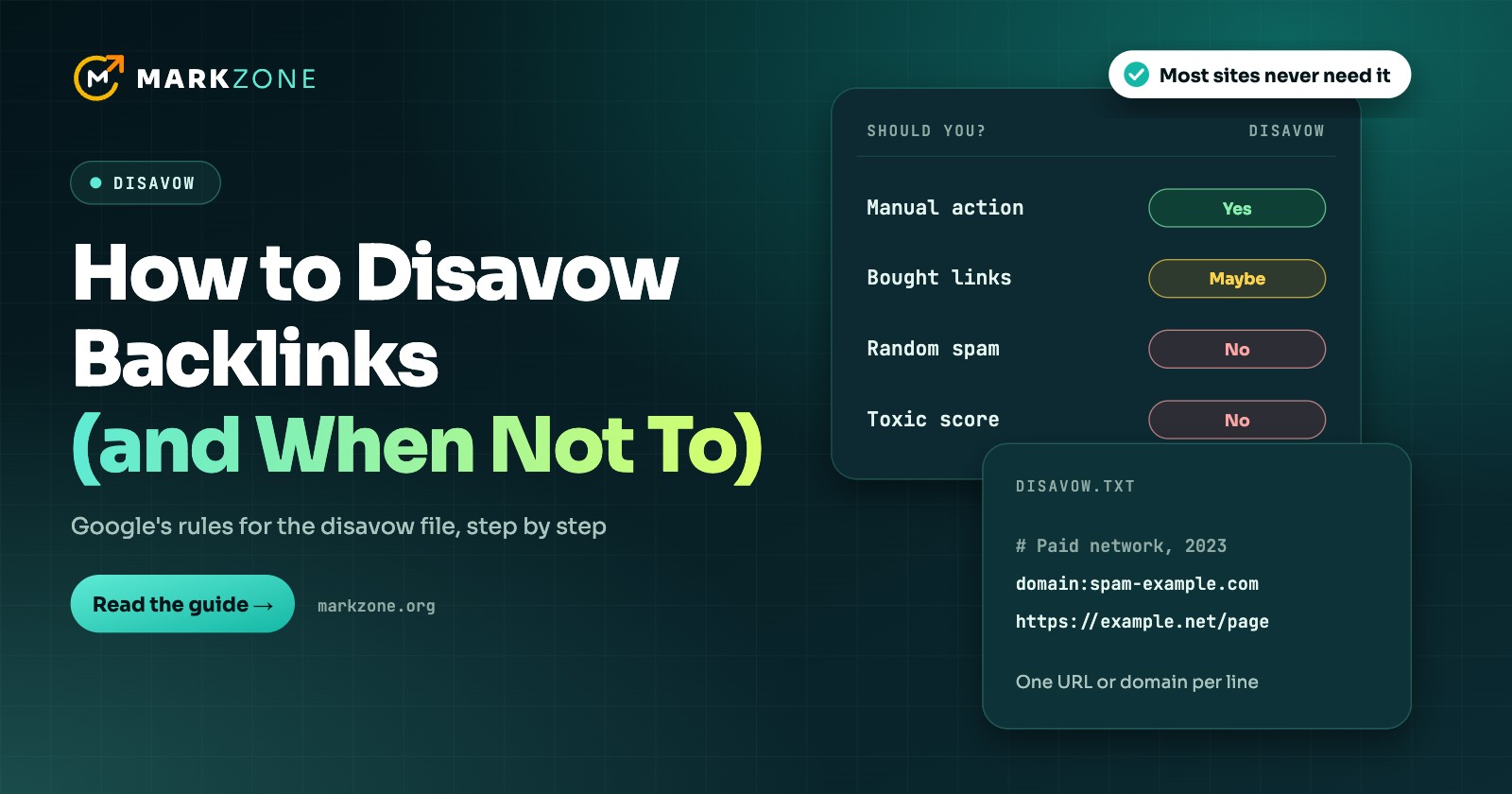
Most sites never need to. In Google’s words, “most sites will not need to use this tool.” Its test is a manual action for unnatural links, or one that is likely.
Paid links are the usual exception. In our catalog, 21,754 of 22,073 publisher sites list followed links and only 240 say they label guest posts as sponsored. If a manual action arrives, those are the links to deal with first.
Remove or relabel first, then disavow the rest. One .txt file per property, “domain:” lines for whole sites, and a full re-upload every time you change it.
To disavow backlinks, list the URLs or domains you want Google to ignore in a plain .txt file, one per line, with “domain:” in front of each whole site. Then upload the file with the disavow links tool in Google Search Console. Do this only when Search Console reports a manual action for unnatural links, or when you expect one because of links that you or someone you hired built. Google’s disavow guide warns that if the tool is used incorrectly, it “can potentially harm your site’s performance in Google Search results.”
We build links for clients and sell placements on publisher sites, most of them followed paid links, so we have a stake on both sides of this question. That is why we quote Google directly throughout and date each statement.
- What a disavow does, and what it doesn’t
- Should you disavow? A decision table
- Links you paid for: what our catalog shows
- Before you disavow: ask for removal
- How to disavow backlinks in four steps
- After you upload: timing, reviews and changes
- What Google has said about disavowing, 2012 to 2026
- Frequently asked questions
- Sources
What a disavow does, and what it doesn’t
A disavow asks Google to leave certain links out when it assesses your site. When Google launched the tool in October 2012, it described a disavow as “a strong suggestion rather than a command.” Nothing changes on the other site. The link stays live, people can still click it, and Google says “Disavowed links will continue to be shown in the Links report.”
Three rules catch people out:
- One list per property. A new upload replaces the old list. A list covers only the property you upload it to and its child properties, so “if you have both http and https properties, you should upload a list for each.”
- No Domain properties. “The disavow links tool does not support Domain properties.” If that is all you have, verify a URL-prefix property for the version of your site that people visit.
- No folders. You can disavow single pages, whole domains or subdomains, but not a folder such as example.com/en/.
Bing removed its disavow feature in October 2023. It said its systems “can now differentiate between natural and unnatural links,” so older guides that send you to Bing Webmaster Tools are out of date.
Should you disavow? A decision table
Google’s test has two parts. You need “a considerable number of spammy, artificial, or low-quality links pointing to your site,” and those links must already have triggered a manual action, or be likely to trigger one. In practice:
| Your situation | Disavow? | What to do |
|---|---|---|
| The Manual actions report shows “Unnatural links to your site” | Yes, for links you can’t get removed or relabeled | Contact site owners first, disavow the rest, then request a review |
| No manual action, but you or an agency bought followed links in bulk, used a link network or repeated keyword anchors | Only if a manual action is likely | Stop the pattern, then ask for removal or rel="sponsored" on the worst links |
| Spam links you never built | No | Google can usually tell which links to trust. If they still worry you, John Mueller of Google said in March 2026 that it’s “totally fine to set up & use disavow files” |
| A tool scores some links as “toxic” | Not on that basis | Mueller called disavowing toxic links a “billable waste of time” in December 2024 |
| Rankings fell after a Google update, with no manual action | Usually no | Compare the drop with update dates and rule out site-wide technical problems, as Mueller advised in September 2026 |
To check, open the Manual actions report. With no manual action, Google shows “a green check mark and an appropriate message.” Then only the second row needs a decision.
Links you paid for: what our catalog shows
Google’s disavow guide names paid links directly: bad links built “via paid links or other link schemes that violate our spam policies.” Google wants paid links qualified with rel="sponsored" or rel="nofollow". Its spam policies accept buying and selling links as “a normal part of the economy of the web” only “as long as they are qualified.”
Most paid links aren’t. On 13 November 2026, 21,754 (98.6%) of the 22,073 publisher sites in our catalog listed followed links. Just 240 (1.1%) stated that guest posts get a sponsored label, 7,190 (32.6%) stated that they don’t, and the other 14,643 (66.3%) were silent. So if you bought guest posts without asking for a label, assume most of them pass ranking credit.
That alone isn’t Google’s reason to disavow; a manual action, or a likely one, is. The numbers change the order of work if one arrives:
- List every placement you paid for, with the date and the seller. Your invoices are a more complete record than any backlink tool.
- Relabel links that still bring visitors. Google’s fix for this manual action is to remove the links “or prevent them from passing PageRank, such as by adding a
rel="nofollow"or a more specific attribute.” Ask the publisher forrel="sponsored", and the article keeps its readers. - Ask for removal where the page gets no search traffic. In our catalog, 7,133 of the 18,977 priced sites (38%) show no Ahrefs search traffic. That group has the lowest typical price, $25 per post. A campaign bought on price alone is likely to include many of them.
- Disavow whatever nobody fixes.
Links in our catalog are dofollow by default unless the publisher marks them otherwise, and you can ask for a sponsored label on any order. A sponsored label doesn’t make a link suspicious; it is the label Google asks paid links to carry. If one of our placements is part of your clean-up, contact us with the page URL. The full figures are in our guest post price study.
Before you disavow: ask for removal
Google’s first advice is removal: “we recommend that you remove as many spammy or low-quality links from the web as possible.” Its manual action guidance is blunter: “Blindly adding all backlinks to the disavow file is not considered a good-faith effort, and will not be enough to make your reconsideration request successful.”
- Start where Google suggests. “If the list is large, start by looking at the sites that link to you the most, or links that were created recently (in the last few months).”
- Make each request specific. Give the page URL, the link and the change you want: removal, or
rel="sponsored". - Keep a log. Note who you contacted, when, and the reply. When you request a review, Google asks you to “Include documentation about the links you’ve had removed and an explanation of any links you were unable to remove.”
- Go through the seller. If you paid an agency or a marketplace, it holds the publisher contacts.
How to disavow backlinks in four steps
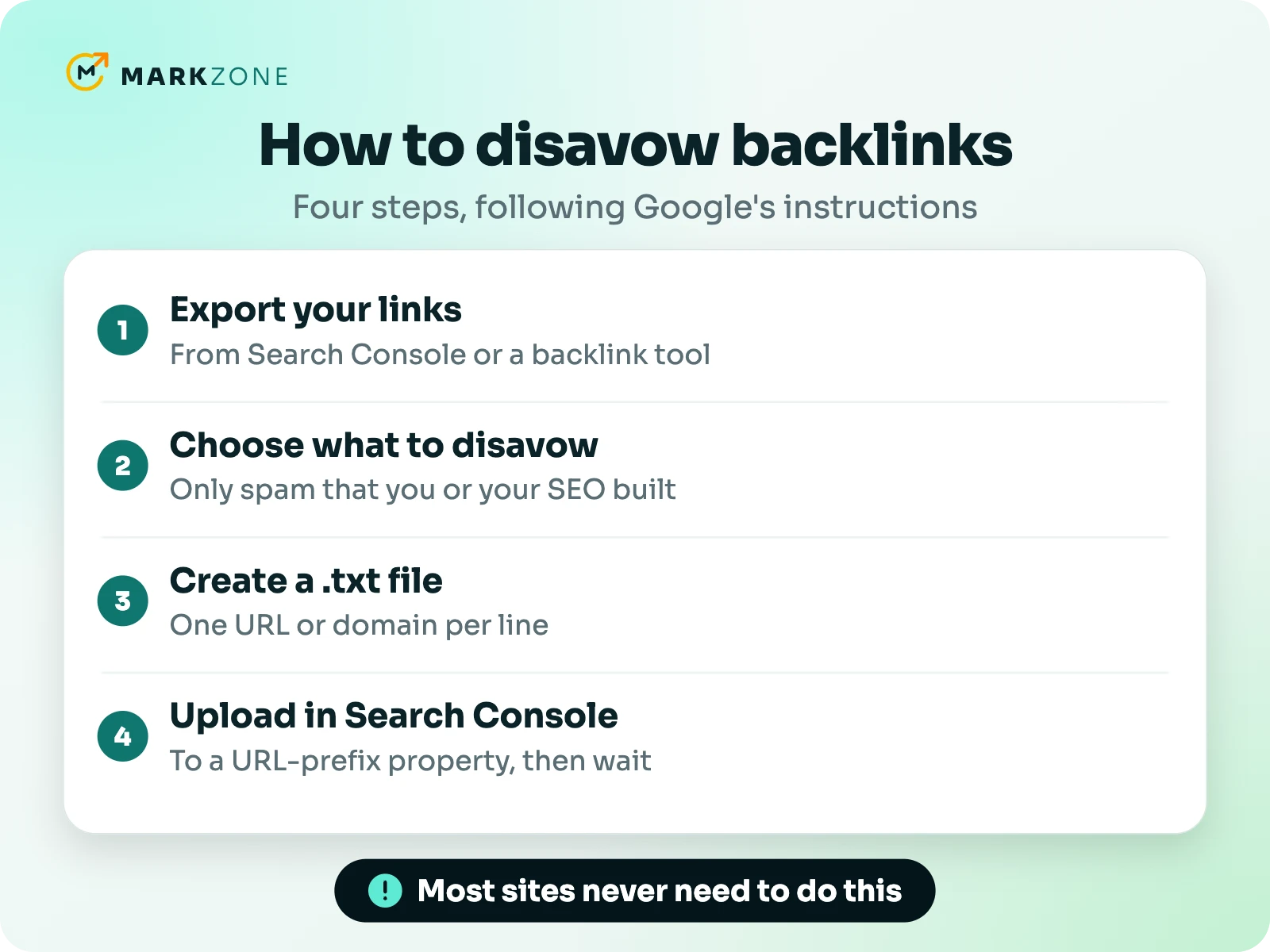
1. Export your links
In the Search Console Links report, use Export external links > Latest links. That export lists up to 100,000 links “sorted by discovery date,” which helps you find a campaign by when it ran. Google calls the report “a sample,” so add an export from a backlink tool such as Ahrefs or Semrush if you need a fuller list.
2. Choose what to disavow
Mark only links that break Google’s link spam policy and that you, or someone working for you, are responsible for. That means paid followed links, link networks, guest posts stuffed with keyword anchors and automated links. Google’s rule: “Make sure that you don’t disavow organic links to your site.” If a site links to you from several pages, list the domain rather than each URL. If you aren’t sure about a link, leave it out.
3. Create the file
Google’s rules:
- A text file encoded in UTF-8 or 7-bit ASCII, with a name ending in .txt.
- One URL or one domain per line. Put “domain:” in front of a domain or subdomain.
- URLs of up to 2,048 characters.
- “Maximum file size is 100,000 lines (including blank lines and comment lines) and 2MB.”
- Lines that start with # are comments, and Google ignores them.
Use the comments as your log. Here is an example file; the sites and dates are made up:
# Disavow file for https://www.example.com/ (updated 2026-11-19)
# Manual action "Unnatural links to your site" received 2026-11-03
# 2026-11-05: asked both owners for removal or rel="sponsored", no reply by 2026-11-18
domain:links.example.net
domain:posts.example.org
# 2026-11-06: owner removed four links, but this archived page can't be edited
https://blog.example.com/2024/03/tools-roundup/
4. Upload it
Open the disavow links tool, select a URL-prefix property and upload the file. You must be an owner of the property. “If the file has any errors, you will see a list of errors immediately. Your old list will not be replaced.” If you have both http and https properties, upload a list to each.
After you upload: timing, reviews and changes
Google says “it can take a few weeks for Google to incorporate your list into the index as Google recrawls the web and reprocess the pages that we see.”
With a manual action, finish the clean-up first, then select Request Review in the Manual actions report. Explain what you removed, relabeled and disavowed, and attach your log. Google says “Most reconsideration reviews can take several days or weeks, although in some cases, such as link-related reconsideration requests, it may take longer than usual.” Don’t send a new request while one is pending.
To change a list, upload the complete new file, because it replaces the old one. Keep a master copy so you never upload only the new lines. To remove everything, select the property and click Cancel Disavowals, which also takes a few weeks. If you disavowed links that were helping, follow Mueller’s advice from September 2026. He said to “fix the disavow file to be what you really need/want it to be (which might be empty, or might not be empty).”
What Google has said about disavowing, 2012 to 2026
| Date | Source | What was said | What it means for you |
|---|---|---|---|
| 16 Oct 2012 | Google, launching the tool | “The vast, vast majority of sites do not need to use this tool in any way.” | Not using it is the default |
| 23 Sep 2016 | Google, Penguin update | “Penguin now devalues spam by adjusting ranking based on spam signals, rather than affecting ranking of the whole site.” | Spam links lose value rather than sink the site |
| 21 Sep 2023 | Bing | Its disavow tool would be removed in October 2023 | You only need a file in Google |
| Dec 2024 | Mueller, on Bluesky | Disavowing toxic links is a “billable waste of time” | Don’t pay for clean-ups based on toxic scores |
| Jan 2025 | Mueller, on Bluesky | “90%+ (probably 99%+) of the web has never used the disavow links tool” | Not using it is normal |
| 6 Mar 2026 | Mueller, on Bluesky | “The disavow file is a tool, not a religion :-). Most sites don’t need it, but that’s not all sites.” | A careful file for obvious spam is acceptable |
| Sep 2026 | Mueller, on Reddit | “it has its place & time, it does have effects” | A careless file can cost you rankings |
Frequently asked questions
Will disavowing hurt my rankings?
It can, if you disavow links that were helping. Mueller said in September 2026 that the tool “does have effects,” though “disavowing a handful of links is not going to make your site drop out of search.”
Should I disavow guest posts I bought?
Only if they meet Google’s test: a manual action for unnatural links, or a likely one. Otherwise, rel="sponsored" on the placements you keep fixes the problem at the source. Our post is buying backlinks safe sets out Google’s paid-link rules in full.
Can I disavow a whole top-level domain such as .xyz?
Mueller said in March 2026 that you can, but he called it “a big hammer,” and Google’s documentation doesn’t describe it. Most sites should list the individual domains instead.
Sources
- Google Search Console Help: Disavow links to your site (undated help page, checked 16 November 2026)
- Google Search Console Help: Manual actions report (checked 16 November 2026)
- Google Search Console Help: Links report (checked 16 November 2026)
- Google Search Central: Spam policies for Google web search (last updated 28 August 2026)
- Google Search Central Blog: A new tool to disavow links (16 October 2012)
- Google Search Central Blog: Penguin is now part of our core algorithm (23 September 2016)
- Bing Blog: Bing Webmaster Tools to Remove Disavow Links Feature in October 2023 (21 September 2023)
- Search Engine Roundtable: Google: Disavowing Toxic Links Is A Billable Waste Of Time (17 December 2024; reports Mueller’s Bluesky reply of December 2024)
- Stan Ventures: Toxic Links Aren’t Worth Disavowing, Says Mueller (18 December 2024)
- Search Engine Roundtable: Google Says Spammers Encourage You To Waste Time Disavowing Links (24 January 2025; quotes Mueller’s Bluesky post in full)
- Search Engine Roundtable: Google: Most Sites Don’t Need To Disavow Links But That’s Not All Sites (6 March 2026; quotes Mueller’s Bluesky post of 6 March 2026)
- Search Engine Roundtable: Google explains undocumented way to disavow entire TLDs (11 March 2026; also states that Bing removed its tool in 2023)
- Search Engine Roundtable: Google: The Disavow Tool Does Have Effects (2 September 2026; quotes Mueller’s Reddit reply)
- Markzone: Guest post price study (catalog snapshot of 13 November 2026: link types, sponsored labels, traffic tiers)

Muhammad Suleman is the founder of Markzone. He has done guest posting and link building since 2018 and has worked with hundreds of clients. Today his team handles 300–400 orders a month for brands and SEO agencies, with publisher sites in every major niche. He leads outreach, site checks and reporting, and writes about link building from his daily work with publishers and clients.