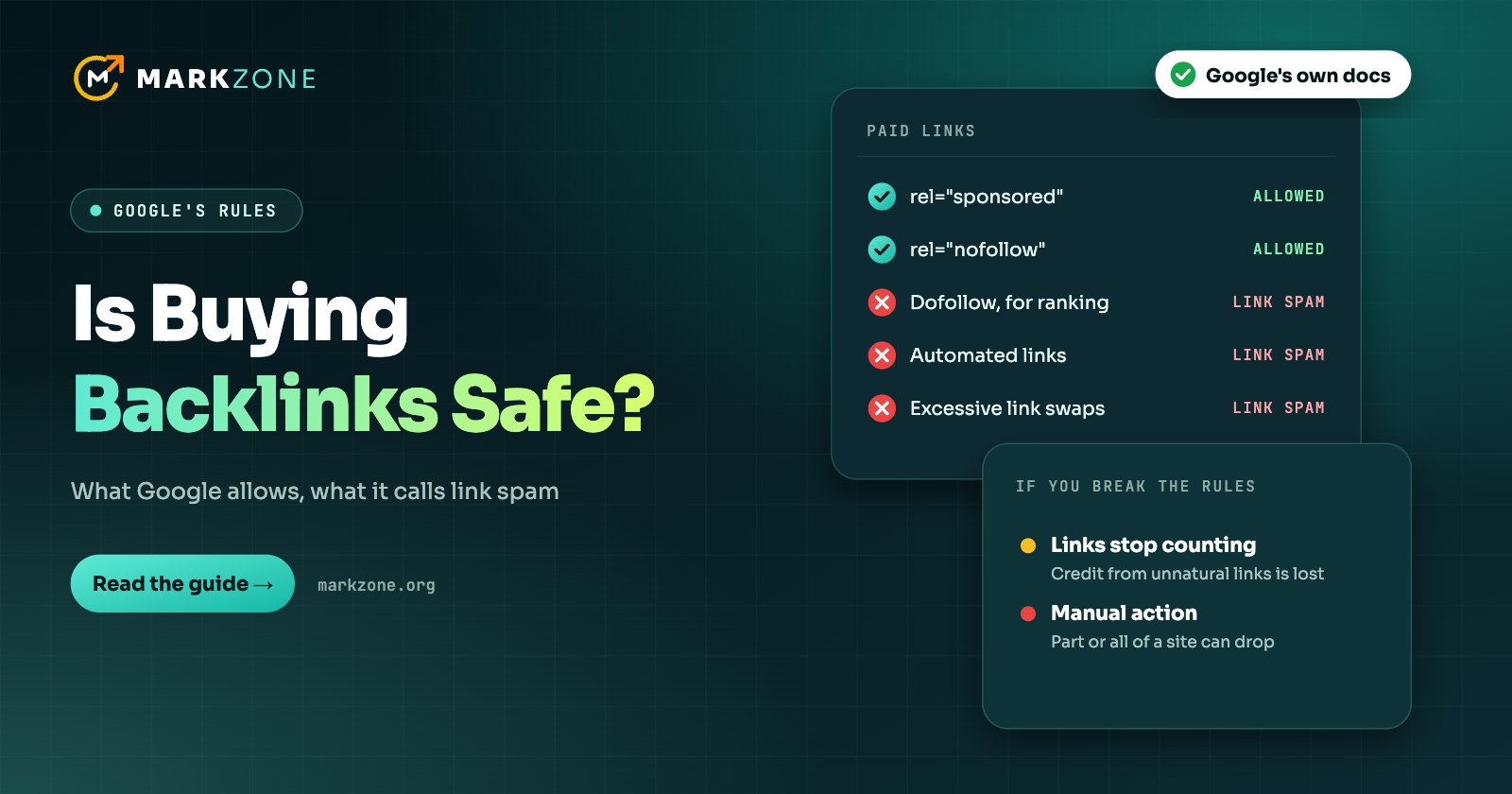
Against Google’s rules, unless labeled. Google treats buying links for ranking as link spam. Paid links marked rel="sponsored" or nofollow are allowed.
Two kinds of risk. Google can neutralize paid links so they stop counting, or apply a manual action to part or all of a site.
The site decides most of the risk. Spam networks and bulk packages are the riskiest buys, while labeled links stay within Google’s rules.
Buying backlinks is not safe in Google’s eyes when the links are meant to pass ranking credit. Its spam policies list “buying or selling links for ranking purposes” as link spam. The only way to buy a link that fully follows Google’s rules is to have it marked rel="sponsored" or nofollow. If you buy links that aren’t marked, the risk ranges from Google ignoring them to a manual action that hurts part or all of your site.
Selling links is our business, so we are not neutral here. That is why this guide quotes Google’s own documents and shows exactly where its line is.
What Google’s rules say about paid links
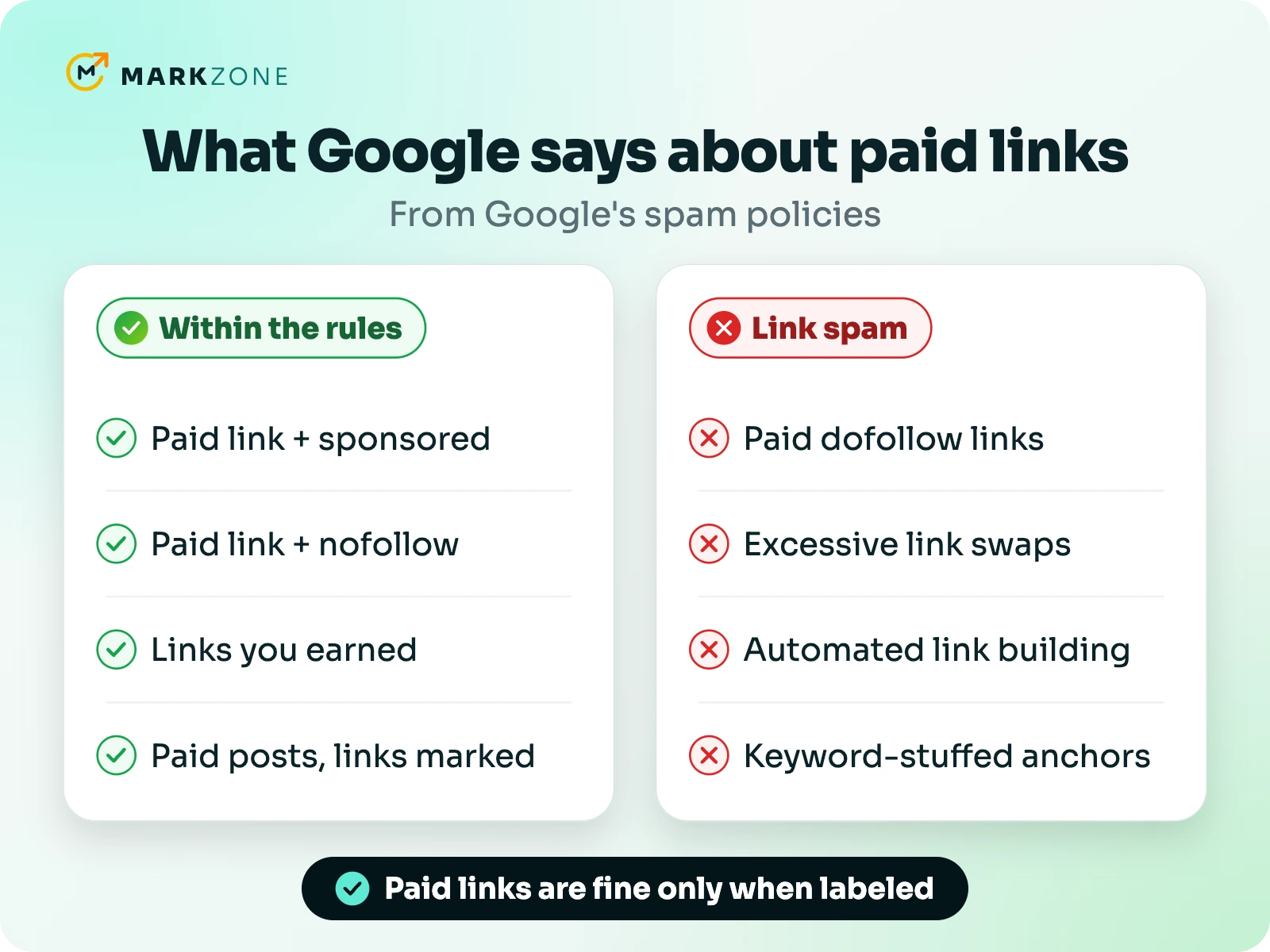
Google’s spam policies define link spam as creating links “primarily for the purpose of manipulating search rankings.” Under “buying or selling links for ranking purposes,” they include paying money for links or for posts that contain links. They also include trading goods or services for links, and sending someone a free product in exchange for a review with a link.
The same page also lists “excessive link exchanges,” “using automated programs or services to create links to your site,” and paid articles that include links which pass ranking credit. But it says paid links are not a violation as long as they are qualified with rel="nofollow" or rel="sponsored". That is what Google asks for in its guide to qualifying outbound links.
What can happen if you buy links
- The links stop counting. Google went further in its December 2022 link spam update. Its SpamBrain system, it said, “can now detect both sites buying links, and sites used for the purpose of passing outgoing links.” Credit passed by unnatural links is lost. You keep paying for links that do nothing.
- A manual action. Google’s Manual Actions report includes “unnatural links to your site,” used when Google has “detected a pattern of unnatural, artificial, deceptive, or manipulative links pointing to your site.” It can affect part or all of a site.
- The seller’s site gets hit. Google has a separate manual action for unnatural links from a site. If the site that sold you a link is penalized for selling, your link is likely to lose its value too.
If you do get a manual action for links, Google asks you to have the links removed or changed so they no longer pass PageRank. After that, disavow the ones you can’t remove, and then submit a reconsideration request.
Is buying backlinks illegal?
Buying a link is not a crime in itself. It is a question of Google’s rules, not the law. Where the law does come in is disclosure. In the US, the FTC expects paid content to be clearly labeled as advertising, as we explain in what a sponsored post is. This is general information, not legal advice.
Why people still buy links
Links still matter. Google says one of the factors it uses to judge quality is whether other prominent websites link to or refer to the content. Earning those links through outreach alone is slow. Many site owners also charge for guest posts anyway: our own catalog lists thousands of sites that charge for a post. Our guest posting outreach guide covers both free pitches and price requests. So buying is common, and the real question for most site owners is how much risk they are willing to take.
| Buying links | Earning links | |
|---|---|---|
| Cost | Money for each link | Mostly your time |
| Speed | Fast once you order | Slower and less predictable |
| Control | You choose the site and the anchor | The site decides |
| Google’s rules | Allowed only when labeled as paid | Allowed |
| Main risk | Links ignored, or a manual action | Little, beyond the time spent |
How to lower the risk if you buy links
The site you buy from decides most of the risk. These are the checks we use and recommend:
- Buy from real sites. Choose sites with steady organic traffic and a clear topic. Check that the traffic hasn’t been artificially boosted and that the DR comes from real backlinks.
- Stay out of networks. Skip private blog networks, bulk packages and sites whose recent posts are full of paid links. Our $20 vs $200 comparison shows what to look for.
- Keep the link in a useful article. A link in the body of a real article is part of the content. Every article we write is written by a person, not AI.
- Use natural anchor text. Google lists optimized anchor text in guest posts and paid articles as link spam, so mix brand, URL and descriptive anchors.
- Accept a label when the site uses one. A link marked as sponsored isn’t meant to pass ranking credit, but it is fully within Google’s rules and can still bring readers. Our guide to do nofollow links help SEO covers how Google handles these labels.
- Get removal cover in writing. Ours lasts 8 months: if the link goes, we replace it or refund you.
For a full checklist of what makes a link worth having, see what makes a good backlink.
Check each site’s DR, Ahrefs traffic and price yourself before you order anything.
Frequently asked questions
Is buying backlinks a good idea?
It depends on how much risk you accept. Links that pass ranking credit go against Google’s rules unless they are labeled, so the safest paid links are marked sponsored. If you buy unlabeled links, buy only from relevant sites with real traffic.
Is buying backlinks illegal?
No, buying a link is not a crime in itself. It breaks Google’s spam policies when the link passes ranking credit, and in the US the FTC expects paid content to be clearly labeled.
Can Google tell if a link is paid?
Google says its SpamBrain system can detect both sites buying links and sites used to pass outgoing links, and that it neutralizes unnatural links. It can also use human review that leads to a manual action.
What happens if I get a manual action for links?
Your site, or part of it, can rank lower or drop out of results. To recover, get the links removed or changed so they don’t pass PageRank, disavow the rest, and submit a reconsideration request.
Are sponsored links worth buying?
They don’t pass ranking credit, but they can bring readers, brand searches and trust, which is why they suit PR more than rankings.
Want to buy links the careful way?
Send us your website, and we’ll suggest checked sites and tell you how each link will be marked.

Muhammad Suleman is the founder of Markzone. He has done guest posting and link building since 2018 and has worked with hundreds of clients. Today his team handles 300–400 orders a month for brands and SEO agencies, with publisher sites in every major niche. He leads outreach, site checks and reporting, and writes about link building from his daily work with publishers and clients.