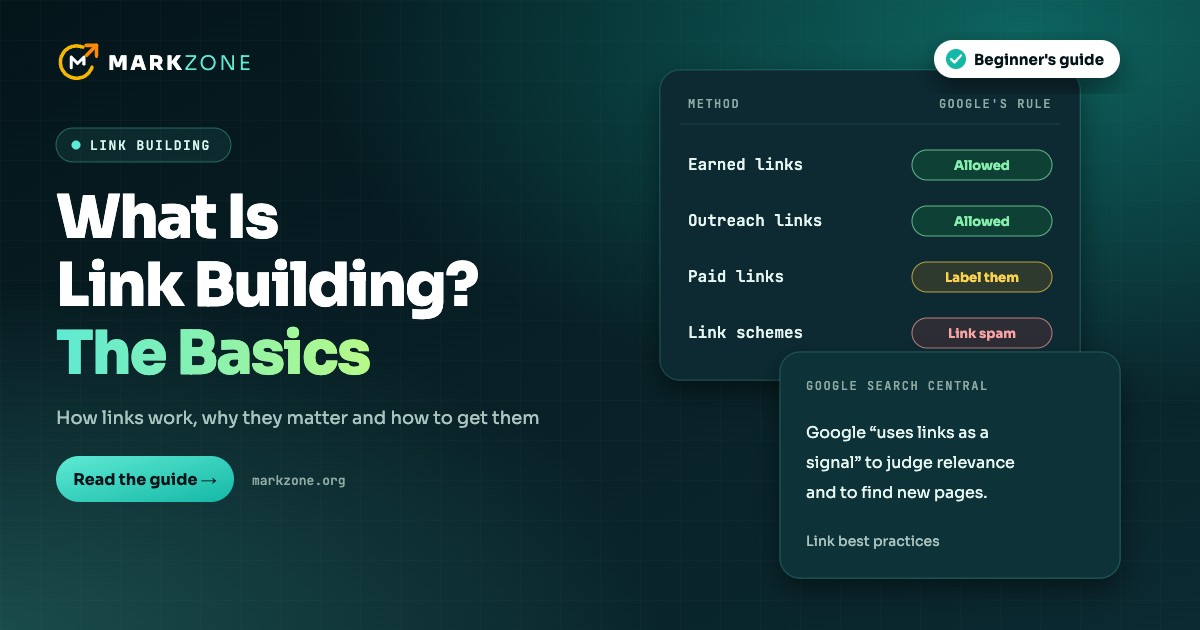
Links work like citations. Google uses them to find pages and as one sign of quality, so pages with good links tend to rank higher.
Relevance beats volume. A link from a real site in your topic counts for more than many links from sites nobody reads.
Earn, ask or pay, but label paid links. Google allows paid links only when they are marked sponsored or nofollow.
Link building is the work of getting other websites to link to pages on your site. Search engines follow those links to find new pages and treat them as signs of relevance and trust. So pages with links from relevant, real sites tend to rank higher. You can earn links with content worth citing, ask for them through outreach, or pay for placements. Google accepts paid links as long as they are labelled as paid.
Markzone sells two link building methods, guest posts and niche edits. This guide covers the free methods as well, and it shows exactly where Google draws the line on paid links.
- What is link building?
- Why link building matters for SEO
- What makes a good link?
- Types of backlinks
- How to build links: the main methods
- Link building by type of business
- Does link building still work in 2026?
- How long does link building take?
- How much does link building cost?
- How to measure link building
- Frequently asked questions
What is link building?
A link from another website to yours is called a backlink. Link building is everything you do to get more of those links, and better ones. If the term is new to you, start with our guide to what a backlink is.
Two parts of every link matter for SEO: the page it sits on and the words that carry it. Those clickable words are the anchor text. Google’s link best practices say good anchor text is “descriptive, reasonably concise, and relevant to the page that it’s on and to the page it links to.” Our guide to keyword backlinks shows how to keep anchors natural.
Links between pages of your own site are internal links. They help visitors and search engines move around your site, and they spread the value of your backlinks to other pages. Link building, though, is about links from other sites.
Why link building matters for SEO
Links help a page in three ways:
- Discovery. Google says it “uses links as a signal when determining the relevancy of pages and to find new pages to crawl.” A page that nothing links to is harder to find.
- Quality. In Google’s explanation of how it ranks results, “one of the factors used to determine quality is understanding if other prominent websites link or refer to the content.”
- Visitors. A link on a page people read sends some of them to you, whatever it does for rankings.
The idea is as old as Google. In the paper that introduced the search engine, Sergey Brin and Larry Page described PageRank as “an objective measure of its citation importance.” A page counted for more when more pages cited it, and when those pages were important themselves.
Ranking studies still see the pattern. Backlinko’s analysis of 11.8 million Google results found that “domain diversity has a substantial impact on rankings,” meaning links from many different sites. Ahrefs reports a correlation between referring domains and rankings in its own study of over a billion pages. Both are correlations, not proof, but they agree.
That is why the number of linking sites matters more than the number of links. Our guide on how many backlinks you need turns this into a simple calculation for any keyword.
What makes a good link?
A good link is one a real reader might click. Before you chase or pay for one, check five things:
- Relevance. The linking site covers your topic, so the link makes sense to its readers.
- Real traffic. The site gets visits from search, not just a high score. In our catalog of 22,073 publisher sites, 39% show no Ahrefs traffic at all, including 722 sites with a Domain Rating of 50 or more.
- Placement. The link sits in the body of an article, not in a footer or author bio. That is what contextual links are.
- A natural anchor. Your brand, your URL or a descriptive phrase, rather than the same keyword every time.
- The right attribute. A normal link can pass ranking value, while nofollow, sponsored and ugc are hints Google may or may not use. Our guide to nofollow links explains the difference.
Judge the whole backlink profile too, not just single links. Real sites collect a mix: some nofollow links, many brand anchors and links from different kinds of sites. Seeing good and bad links side by side makes the difference clear. Our checklist of 12 signs of a good backlink goes further, and high authority backlinks explains what a strong site really looks like.
Types of backlinks
Backlinks differ in two ways. Some differ by attribute: followed, nofollow, sponsored or ugc. Others differ by source: editorial mentions, guest posts, link insertions, resource pages, directories, social profiles, forums and more. Profile and directory listings, sometimes called foundation links, help people find you but rarely move rankings. Some types, such as sitewide footer links, carry more risk than value.
Our guide to types of backlinks rates 15 of them on what they do for rankings. Links from university websites get plenty of attention too, so check what they are really worth before you pay a premium for one.
How to build links: the main methods
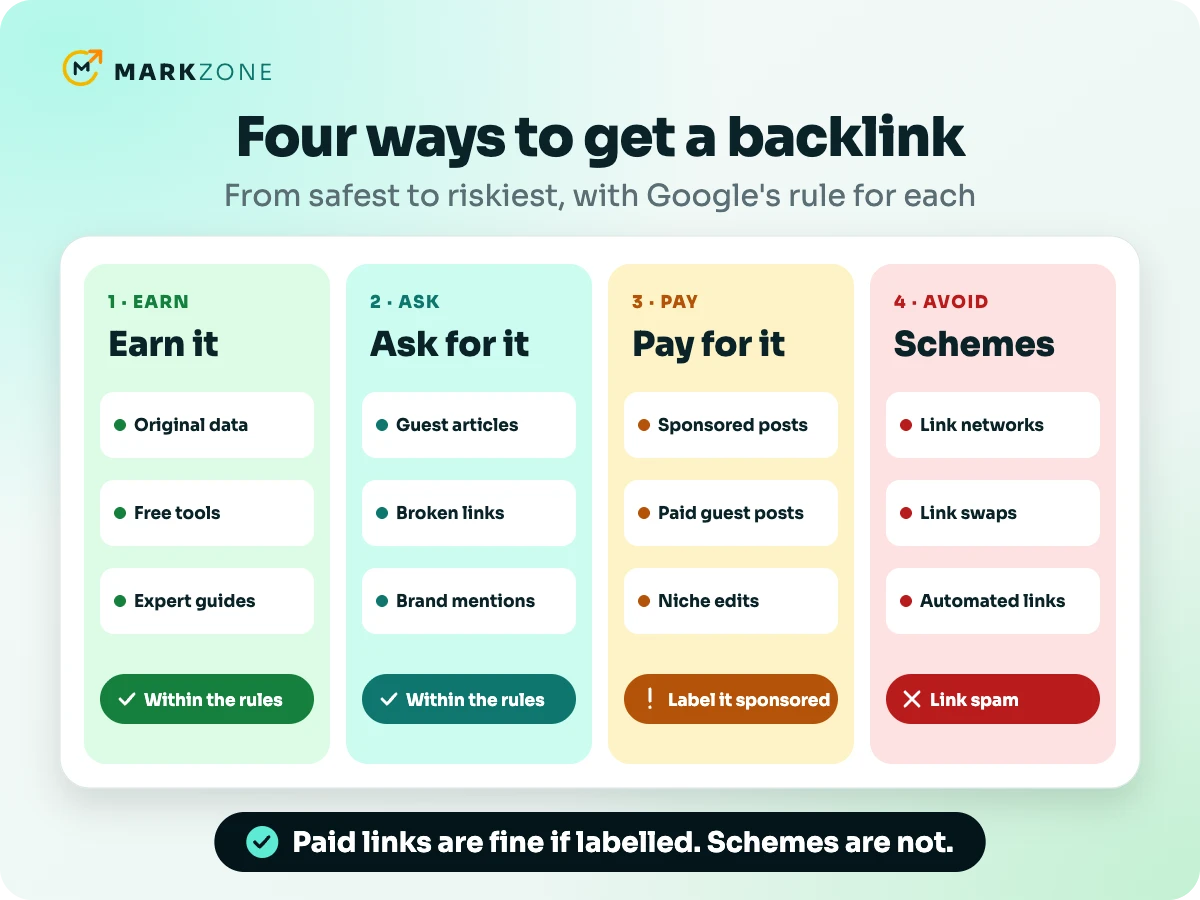
There are four ways to get a link: earn it, ask for it, pay for it or swap it. The first three can work. The fourth, and anything automated, is where most penalties come from.
1. Earn links with content worth citing
Original data, free tools, clear guides and real expertise give other writers a reason to link without being asked. It is the slowest method: in a study of 912 million blog posts, 94% had no links from other websites. But one strong resource can keep earning links for years. Our guide to link building strategies covers 17 tactics, from digital PR to broken link building.
2. Ask for links through outreach
Outreach means contacting site owners with a reason to link. You might pitch a guest article, suggest your page as a replacement for a broken link, or ask a site that mentions your brand to add the link. Our guides to guest posting outreach and guest posting for SEO show how to do it well.
3. Pay for placements
Many publishers charge for guest posts, sponsored articles or links added to existing posts, called niche edits. Google’s spam policies accept that “buying and selling links is a normal part of the economy of the web.” But such links are only within the rules “as long as they are qualified” with a rel="nofollow" or rel="sponsored" attribute. Our guides to buying backlinks, sponsored posts and backlink marketplaces cover the risks. If you buy, compare providers and see the sites before you pay. We sell guest posts and niche edits ourselves, with a sponsored label on request.
4. Avoid link schemes
Google defines link spam as “creating links to or from a site primarily for the purpose of manipulating search rankings.” Its examples include “excessive link exchanges” and “using automated programs or services to create links to your site.” Private blog networks and tiered link schemes fit that definition too. Since its December 2022 update, Google says its SpamBrain system “can now detect both sites buying links, and sites used for the purpose of passing outgoing links.”
Link building by type of business
The best link sources depend on who you are:
- Local businesses: local news, chambers of commerce, community sponsorships and local directories.
- Online stores: gift guides, product reviews and the brands or suppliers you work with.
- SaaS companies: integration partners, comparison and “best tools” lists, and original data.
- B2B firms: trade media, industry associations and partner pages.
- Startups: investors, accelerators, launch platforms and press around a launch.
- Healthcare providers: expert commentary, professional bodies and local health coverage, with extra care for accuracy.
- Sites that sell in several countries: local-language sites in each market, not just English ones.
Does link building still work in 2026?
Yes, for links that would exist without the ranking benefit. Google still names links from prominent sites as a quality factor, as quoted above. What has changed is how well it spots the rest. In its December 2022 update, Google said “any credit passed by these unnatural links are lost” once spammy links are neutralized. So a manipulative link today is often wasted money before it is a risk.
Links also aren’t the only route to traffic. Pages that answer a specific search better than anything else can rank with few or no backlinks, and that is often the best place for a new site to start.
How long does link building take?
Usually weeks to months. A link only counts once Google has crawled and indexed the page it sits on, and then processed the link. With the links we place, rankings often start to move 4 to 12 weeks after a link goes live. Each step is broken down in how long backlinks take to work.
Pace matters too. A steady flow of relevant links looks like a site people are talking about, while a sudden burst on a small site looks bought. Our guide to how many backlinks per day is safe shows how to set a monthly pace. To find which links to go after first, look at the links your competitors have and you don’t.
How much does link building cost?
Earned links cost time rather than money. Paid placements vary a lot. In our catalog, the typical guest post costs $50, and half of the 18,977 sites with a listed price charge between $25 and $170. BuzzStream’s 2026 data puts the average at $295 for a guest post bought directly from a site and $461 through a vendor. Prices are set by the publishers who sell links, and they follow a site’s traffic more closely than its DR.
Our guides to link building pricing and cheap link building explain what moves the price. If you would rather hand the work off, see how to outsource link building.
How to measure link building
- New referring domains. Count new relevant sites linking to you each month, not total links.
- Rankings for target pages. Track the pages you built links to, week by week.
- Referral visits. In your analytics, see which links actually send people.
- Link health. Check that each link is still live and the page is indexed. If you move a page, redirect the old URL so its links still count.
Ahrefs and Semrush show new and lost links, and Search Console’s Links report lists the links Google knows about for free. If a link you placed doesn’t appear in your tools yet, see why backlinks don’t show in Ahrefs.
Most wasted budgets come from a handful of common mistakes, such as chasing DR alone or using the same keyword anchor everywhere. If you inherit bad links, you rarely need to act. Google says that “in most cases” it “can assess which links to trust without additional guidance,” so disavowing links is a last resort.
Frequently asked questions
Is link building still important for SEO?
Yes. Google says it uses links to find pages and as one sign of quality. Content and relevance come first, but in competitive searches the pages that rank usually have links from many different sites.
Is link building allowed by Google?
Earning and asking for links is fine. Paying for links is allowed if the links are marked with rel=”sponsored” or rel=”nofollow”. Link schemes such as networks, excessive exchanges and automated links break Google’s spam policies.
What is the difference between link building and SEO?
Link building is one part of SEO. SEO also covers content, technical health and the experience on your pages. Links help most when the page they point to already answers the search well.
Can I do link building myself?
Yes. Outreach, guest posts, broken link building and digital PR need time more than money. Many businesses do some themselves and pay for placements when time runs short.
How many backlinks do I need?
There is no fixed number. Count the sites linking to the pages that rank for your keyword, then aim to close the gap with relevant links. Our guide on the number of backlinks you need shows the math.
Not sure where your first links should come from?
Send us your website and target pages. We’ll suggest a mix of free and paid links that fits your niche.

Muhammad Suleman is the founder of Markzone. He has done guest posting and link building since 2018 and has worked with hundreds of clients. Today his team handles 300–400 orders a month for brands and SEO agencies, with publisher sites in every major niche. He leads outreach, site checks and reporting, and writes about link building from his daily work with publishers and clients.