A link in an article that already exists. A niche edit, or link insertion, adds your link to a published post instead of a new guest post.
Judge the page, not the method. A niche edit on a relevant page with real readers can help. One on a spammy or hacked site is money wasted.
Know the rules. Paying for a link that passes ranking credit is link spam under Google’s policies unless the link is marked sponsored or nofollow.
Niche edits, also called link insertions, are links added to articles that are already live on another website. They still work for SEO in 2026 when the article is relevant to your page, indexed by Google and read by real people. They carry the same risks as any paid link, though. Google’s spam policies treat paying for links that pass ranking credit as link spam. Edits on hacked or spammy sites are wasted money at best.
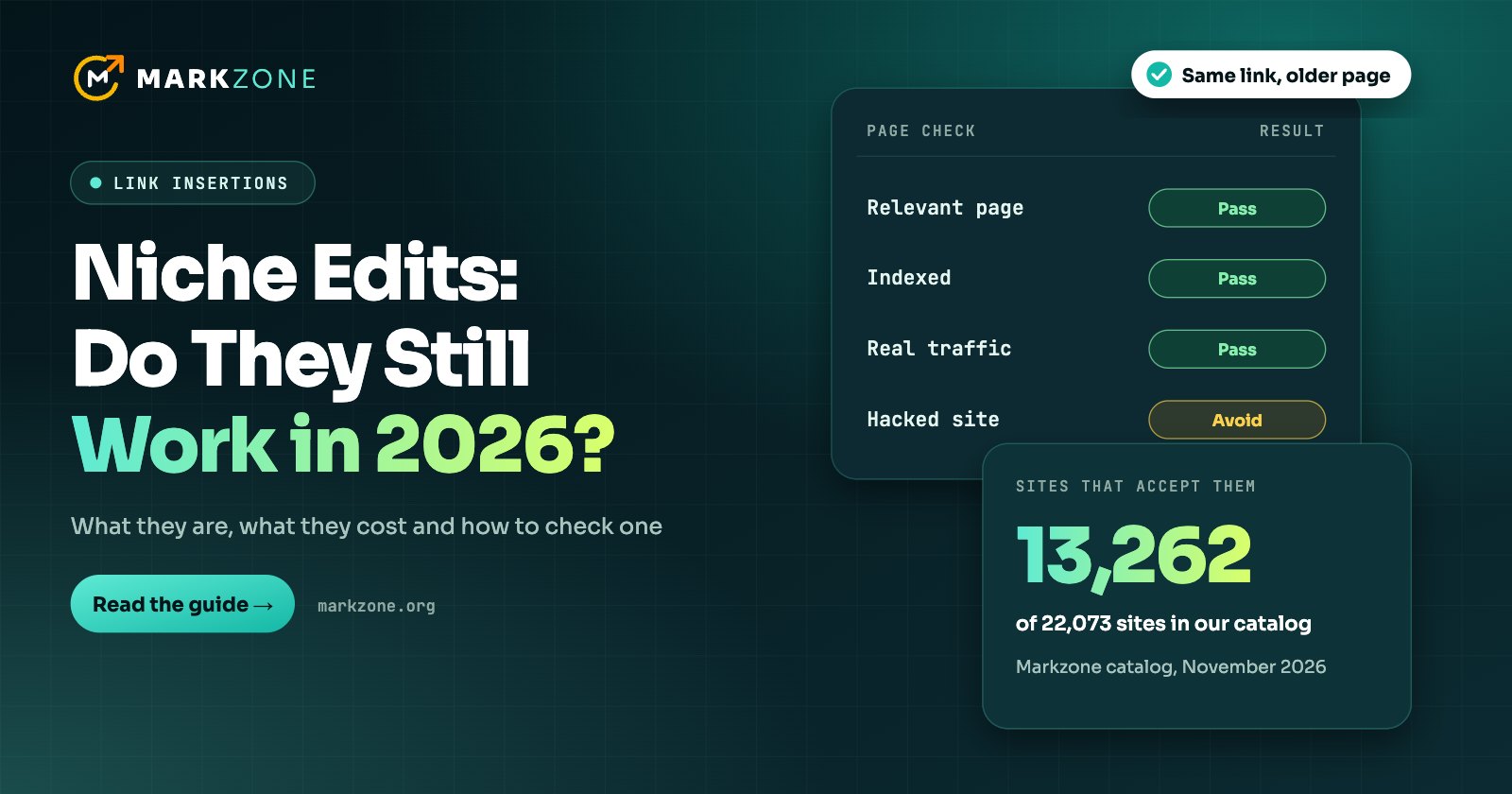
We sell link insertions as well as guest posts, and 13,262 of the 22,073 sites in our catalog accept them. Here is how they work, what they cost and how to tell a good one from a bad one.
- What is a niche edit?
- How niche edits work
- Do niche edits still work in 2026?
- Pros and cons of niche edits
- Niche edits vs. guest posts
- How much do niche edits cost?
- How to check a niche edit before you buy
- How to find niche edit opportunities yourself
- Red flags: hacked and fake niche edits
- Frequently asked questions
What is a niche edit?
A niche edit is a link added to an existing article on a site in your niche. The name comes from the method. Instead of writing a new post, the site owner edits an old one to include your link. Sometimes they add a new sentence or short paragraph so the link fits.
For example, a travel blog with a popular post on packing tips might add a link to your luggage size guide in the paragraph about carry-on rules. Readers who want that detail can click through, and your page gets a link from a page that is already part of the site.
How niche edits work
- Find the right article. Look for a page on a relevant site that covers your topic and gets organic traffic.
- Check the page. Confirm it is indexed, that the site is real, and that the page doesn’t already link out to lots of unrelated sites.
- Agree the details. Settle the target URL, the anchor text, where the link goes and the price, if there is one.
- The link goes live. The site owner edits the article, and you check that the link is in the body text and points to the right page.
Do niche edits still work in 2026?
Yes, when the page is a good one. A niche edit is still a link from another website. Google counts links from other prominent websites among the factors it uses to judge quality. Nothing in Google’s guidance treats a link differently because it was added to an older article; what matters is the page, the site and why the link is there.
Two things can stop a niche edit from working. First, Google’s spam policies list “exchanging money for links, or posts that contain links” as link spam. Paid links are fine only when they are marked with rel="nofollow" or rel="sponsored". Second, in its December 2022 link spam update, Google said its SpamBrain system can detect sites used to pass outgoing links and that credit from unnatural links is lost. So a niche edit on a site that sells links to anyone may simply not count.
A niche edit can also take a while to be seen. Google finds your link when it next revisits the page. Google’s Gary Illyes put the typical revisit of a known page at about 30 days at a Search Central event in October 2026, though popular pages are revisited sooner. We explain the timing in how long backlinks take to work.
Pros and cons of niche edits
| Pros | Cons | |
|---|---|---|
| The page | Already published, and may already have traffic and links | May be old, and you can’t rewrite it around your topic |
| The work | No new article to write or approve | The link has to fit text someone else wrote |
| The timing | Often quick to arrange once a site agrees | Seen only when Google revisits the page |
| The risk | Easy to check before you pay, because the page already exists | Fake edits on hacked sites, and links that get edited out later |
Niche edits vs. guest posts
Both put your link in the body of an article on another site. The difference is the page: a guest post is a new article written around your topic, while a niche edit uses an article that already exists. A guest post gives you more control over the content; a niche edit can give you a page with history. We compare them in detail in guest posts vs. link insertions.
How much do niche edits cost?
In BuzzStream’s 2026 data, a link insertion cost $179 on average, against $295 for a guest post bought directly from the site. BuzzStream also found that insertion prices rise with traffic at every level, so traffic is a better guide to the price than DR. At the publishers we work with, the gap is smaller. Insertions there usually cost a little less than a guest post on the same site, and some publishers charge the same. Our link building pricing guide has the full numbers.
Filter the catalog to sites that accept link insertions and see each one’s DR, traffic and price.
How to check a niche edit before you buy
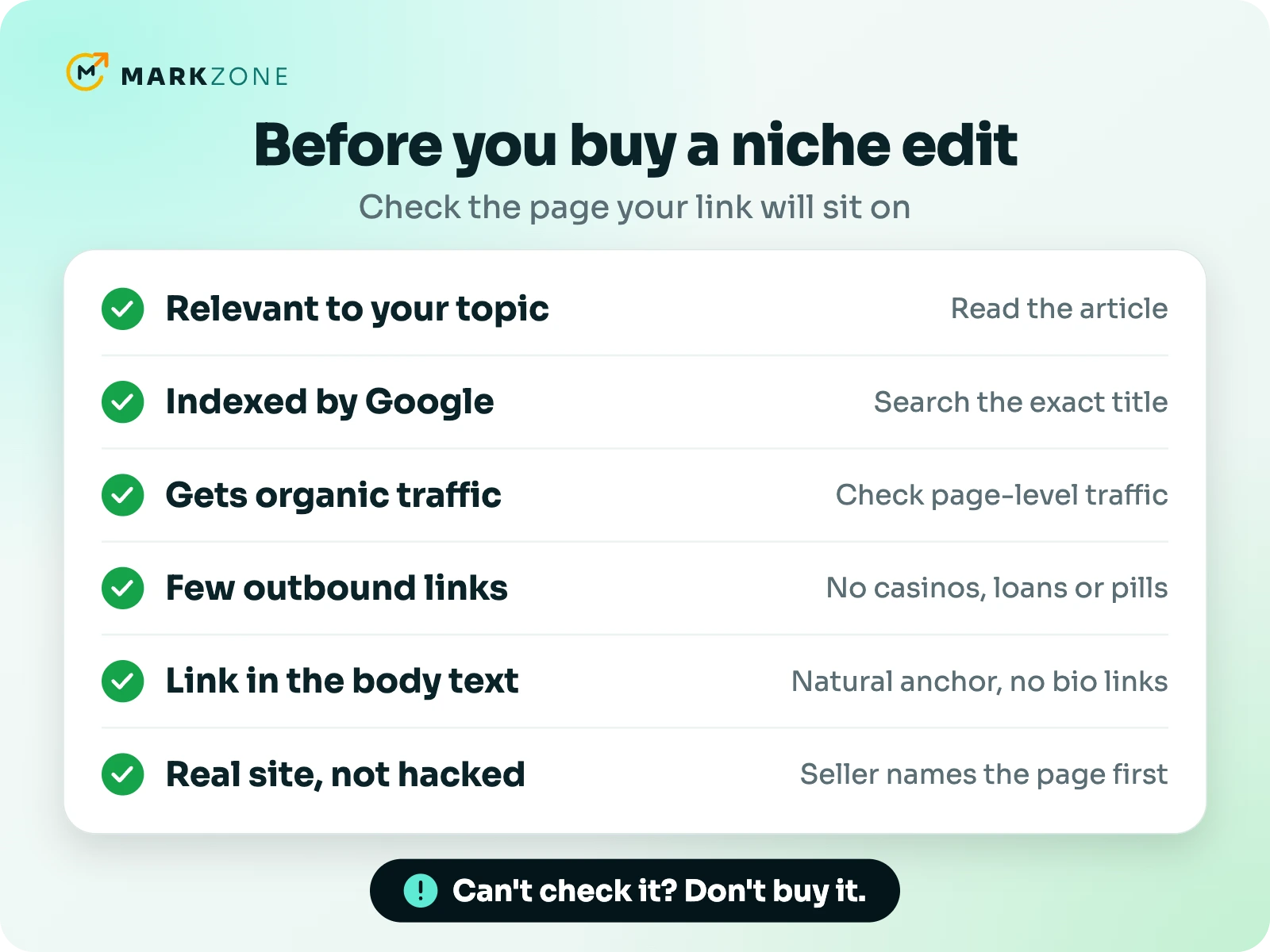
- Relevance. The article should be about your topic, so the link makes sense to someone reading it.
- Indexed. The article should appear when you search Google for its title in quotes. If it doesn’t, the link is unlikely to count.
- Real traffic. In Ahrefs or Semrush, check that the page itself gets organic visits, not just the domain.
- Outbound links. A page that already links to dozens of unrelated sites, especially casinos, loans or pills, is probably selling links to anyone.
- Placement and anchor. Your link should sit in the body text with a natural anchor, not in a footer, a list of “useful links” or an author bio.
- Cover if it disappears. An insertion can be edited out later, so ask what happens then. We cover ours for 8 months: a new link or your money back.
Our guide to good backlinks covers these checks in more detail.
How to find niche edit opportunities yourself
You don’t have to buy niche edits. Search Google for articles in your niche that cover what your page covers. Or use a content search tool such as Ahrefs’ Content Explorer to find relevant pages that get traffic. Then look for a real reason to link. That could be a broken link your page can replace, an outdated statistic you have newer data for, or a step your guide explains in more depth. Pitch that reason, not the link. Our guide to link building strategies covers broken link building and other ways to earn these links.
Red flags: hacked and fake niche edits
Some cheap “niche edits” on famous sites are not edits at all. Google defines hacked content as “any content placed on a site without permission, due to vulnerabilities in a site’s security,” and that includes hidden links added to existing pages. A link placed that way can be removed at any moment, and it is spam by Google’s definition. Be wary when:
- A seller offers links on well-known, high-DR sites for a few dollars.
- The seller won’t tell you the site or the page before you pay.
- The page is old, unrelated to your topic and has had many new links added at once.
- The link is hidden or doesn’t show up for normal readers.
Frequently asked questions
What is the difference between a niche edit and a link insertion?
There is none. Niche edit, link insertion and curated link are different names for the same thing: a link added to an article that is already published.
Are niche edits white hat?
It depends on how you get them. A link you earn, for example by suggesting a replacement for a broken link, is within Google’s rules. A paid niche edit that passes ranking credit counts as link spam under Google’s policies unless it is marked sponsored or nofollow.
How long do niche edits take to work?
Usually weeks to months. Google first has to revisit the page and process the link, and in our experience the first change in rankings often shows within 4 to 12 weeks.
Can a niche edit be removed?
Yes. The site owner can edit the article again, or delete or redirect the page. In our experience removals are rare, and our links come with an 8-month replacement or refund guarantee.
Want links in articles that already rank?
Send us your page, and we’ll look for related articles that could link to it.

Muhammad Suleman is the founder of Markzone. He has done guest posting and link building since 2018 and has worked with hundreds of clients. Today his team handles 300–400 orders a month for brands and SEO agencies, with publisher sites in every major niche. He leads outreach, site checks and reporting, and writes about link building from his daily work with publishers and clients.