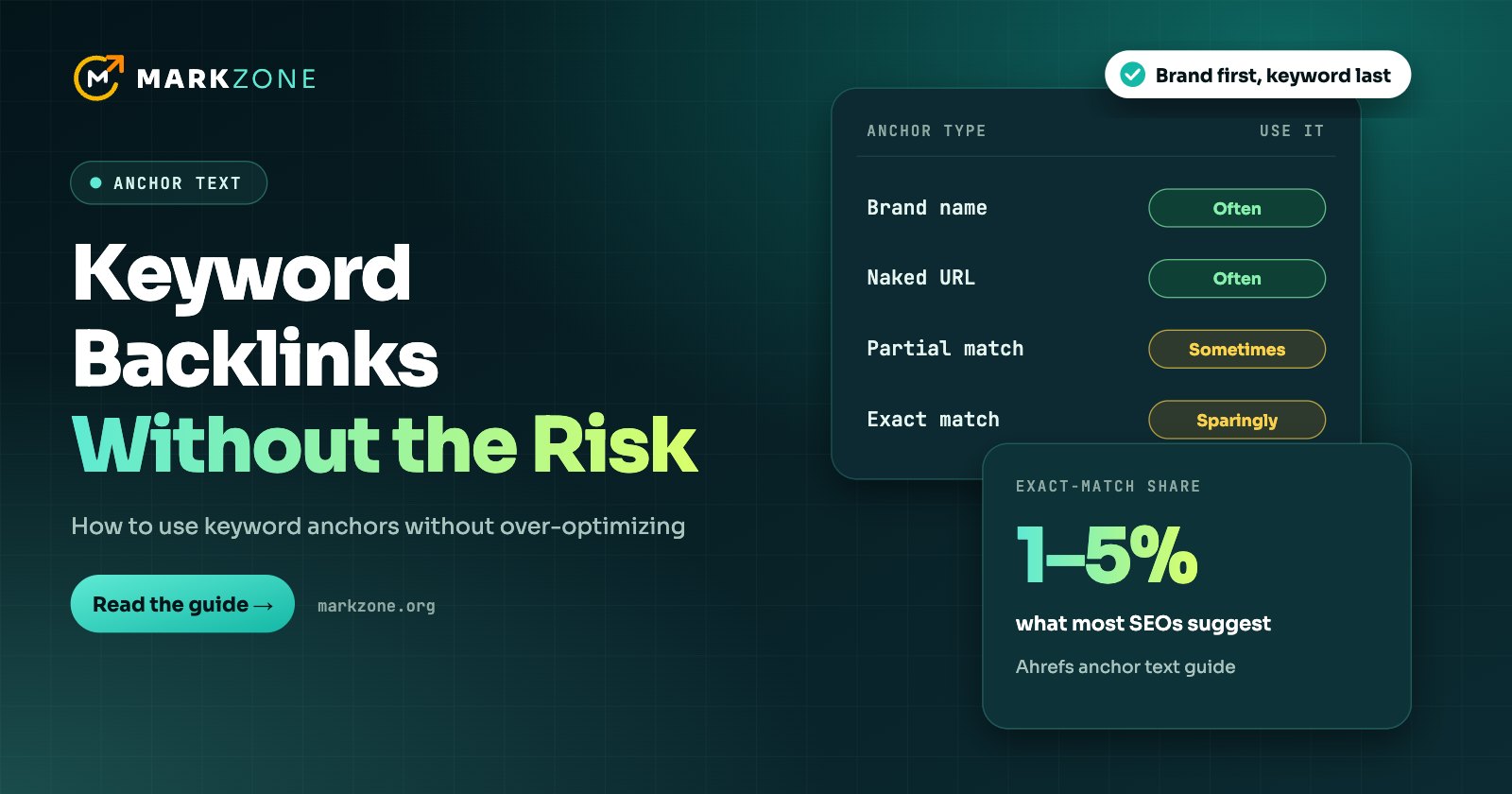
A keyword backlink uses your keyword as the link text. It tells readers and Google what the linked page is about.
Too many look manipulative. Google’s spam policies list optimized anchor text in guest posts and articles as link spam.
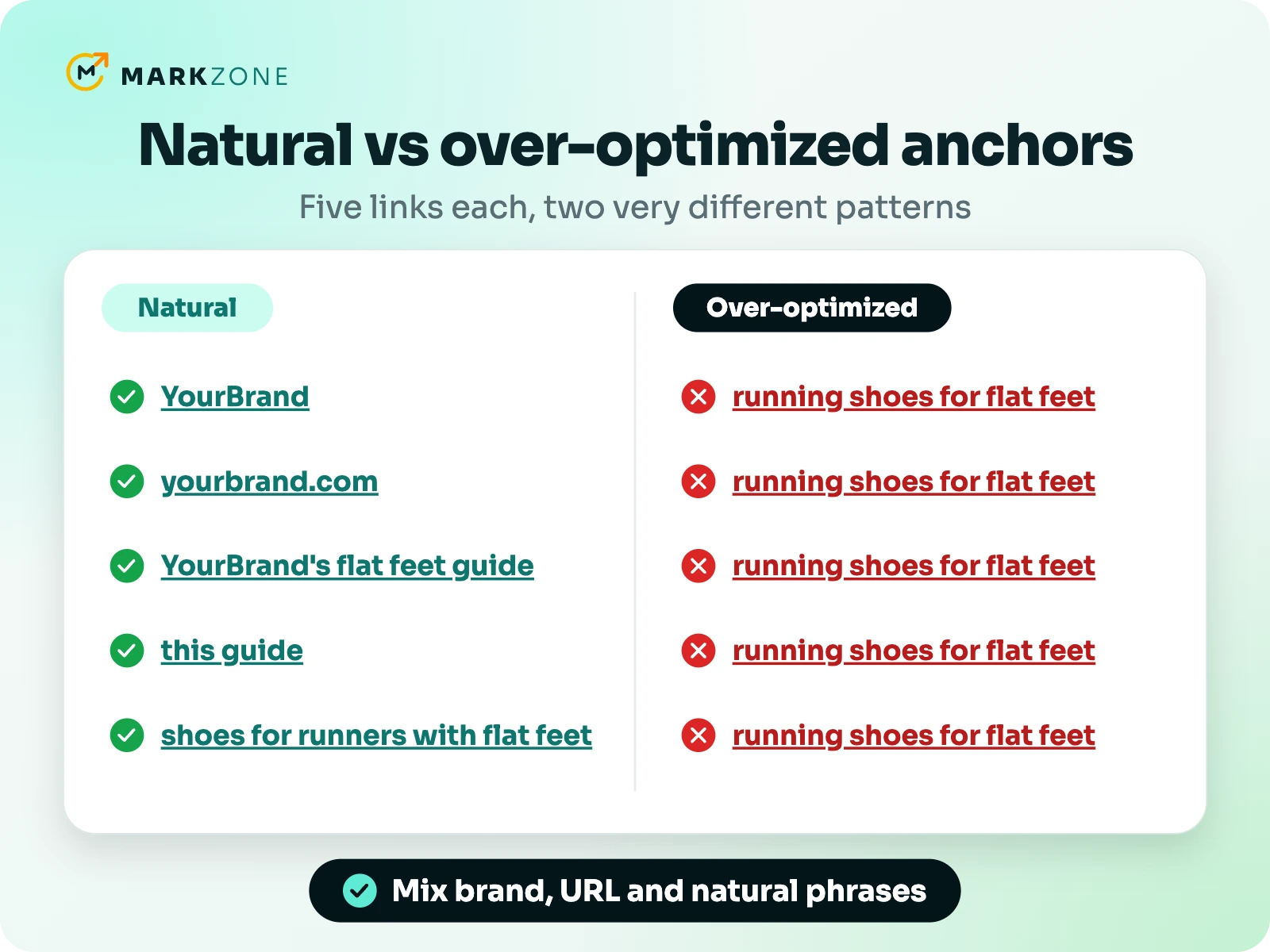
Mix your anchors. Lean on your brand, your URL and natural phrases, and keep exact-match keywords to a small share.
Keyword backlinks are links from other websites whose anchor text, the clickable words, includes the keyword you want the linked page to rank for. A few of them help Google understand what your page is about. Building many on purpose is risky, though: Google’s spam policies list “links with optimized anchor text in articles, guest posts, or press releases distributed on other sites” as link spam. The safe approach is a natural mix, with most links using your brand, your URL or a descriptive phrase, and only a small share using the exact keyword.
Our clients choose the anchor text for every guest post and link insertion they order from us, so we see a lot of anchor choices, good and bad. This guide covers what Google says, what the data shows and how to keep your anchors natural.
- What is a keyword backlink?
- Do keyword anchors still help rankings?
- The risk of too many keyword anchors
- What anchor text ratio should you aim for?
- How to check your anchor text profile
- How to build keyword backlinks safely
- Choosing anchors for guest posts and link insertions
- What to do if your anchors are over-optimized
- Frequently asked questions
What is a keyword backlink?
A keyword backlink is a link whose anchor text contains a search term you are targeting. Anchor text comes in several types. Here is how each might look for a guide to running shoes for flat feet on a site we’ll call YourBrand:
| Anchor type | Example | How often |
|---|---|---|
| Exact match | running shoes for flat feet | Sparingly |
| Partial match | shoes for runners with flat feet | Sometimes |
| Branded | YourBrand | Often |
| Naked URL | yourbrand.com | Often |
| Brand plus topic | YourBrand’s flat feet guide | Often |
| Page title | How to Choose Running Shoes for Flat Feet | Sometimes |
| Generic | this guide, read more | Sometimes |
Exact and partial matches are the keyword backlinks. The rest still give context, because the words around a link matter too, as we explain in contextual link building.
Do keyword anchors still help rankings?
Anchor text has mattered since the start of Google. Sergey Brin and Larry Page described the search engine in a 1998 paper, The Anatomy of a Large-Scale Hypertextual Web Search Engine. They wrote that “anchors often provide more accurate descriptions of web pages than the pages themselves.” Google’s current link best practices still say anchor text “tells people and Google something about the page you’re linking to.”
The effect looks modest, though. An Ahrefs study, published in 2019 and updated in 2020, looked at 384,614 pages ranking for 19,840 keywords. It found the correlation between exact-match anchors and rankings was positive but relatively weak. Other anchor types showed even less.
The risk of too many keyword anchors
Real people rarely link with the exact phrase you want to rank for. They use your brand name, your URL or whatever words fit their sentence. A profile full of identical keyword anchors is a pattern that points to links someone arranged. Google’s spam policies name optimized anchors in guest posts, articles and press releases as link spam.
Since 2016, Google’s Penguin system has mostly devalued spammy links rather than demoting whole sites, so the usual cost of overdoing it is links that stop counting. A clear pattern of manipulative links can still lead to a manual action for unnatural links. Either way, you pay for links that don’t help.
What anchor text ratio should you aim for?
Google has never published an ideal ratio, and no ratio fits every site. Ahrefs notes that most SEOs recommend using exact-match anchors sparingly, usually for about 1% to 5% of links. Its own advice is not to try to manipulate anchor text ratios at all.
For example, say you plan 10 new links to your flat feet guide over the next few months. A natural mix might use your brand on four of them and your URL or brand plus topic on three. The page title or a descriptive phrase could go on two, and a partial-match keyword on one. Links people give you on their own will add their own words to that mix, which is exactly what makes it look natural.
A better guide is the pages you compete with. Look up the anchors of the top pages for your keyword in Ahrefs or Semrush, and keep your share of exact-match anchors within the range they show, or below it. If their links mostly use brand names and URLs, yours should too.
How to check your anchor text profile
- Ahrefs: open Site Explorer, enter your domain and go to the Anchors report to see every anchor and how many sites use it.
- Semrush: Backlink Analytics has an Anchors tab with the same breakdown.
- Google Search Console: the Links report shows your top linking text, though Google says it is a sample, not a full list.
- Compare by page. Check the anchors pointing to your most important pages one by one. A page whose links all use the same keyword is the one to fix first.
Pick a relevant site, then write the anchor yourself; we place the link in the article body.
How to build keyword backlinks safely
- Let earned links be. When a site links to you on its own, it picks the words. Don’t ask it to change them to your keyword.
- Default to brand and URL anchors. In guest posts and link insertions you choose the anchor, so use your brand, your URL or a descriptive phrase most of the time.
- Vary the keyword anchors you do use. Partial matches and longer phrases read more naturally than the same exact keyword again and again.
- Point keyword anchors at the right page. The anchor should describe the page it links to, which is what Google’s own guidance asks for.
- Use keywords freely on your own site. Internal links are a different case. Google’s Gary Illyes said in 2019 that there is no over-optimization penalty for internal links, as Search Engine Roundtable reported. Matt Cutts said back in 2013 that internal links typically won’t cause trouble.
Choosing anchors for guest posts and link insertions
When you buy or arrange a link, you usually pick the anchor yourself, so this is where most over-optimization starts. In a guest post, you write the sentence, so you can use your brand or a descriptive phrase that fits naturally. In a link insertion, the link has to fit a sentence someone else wrote, so a descriptive phrase or the page title usually reads better than a bare keyword. We explain how insertions work in niche edits.
Before you settle on an anchor, ask four questions:
- Does it read naturally in the sentence?
- Does it describe the page it links to?
- Have you already used the same words on several other links?
- Would the site’s own writer have chosen these words?
If the answer to the third question is yes, or to any of the others is no, pick different words.
What to do if your anchors are over-optimized
Stop adding keyword anchors first. Then build new links with brand, URL and descriptive anchors, so the old ones become a smaller share over time. Where you control a link, for example on a partner’s site or one of your own guest posts, you can ask for the anchor to be changed to your brand. If you have a manual action for unnatural links, follow Google’s process in Search Console to fix the links and request a review.
Frequently asked questions
What is a good anchor text ratio?
There is no official one. Keep exact-match keyword anchors to a small share of your links, and use your brand, your URL and natural phrases for the rest. Compare with the pages that rank for your keyword.
Are exact-match anchors bad?
Not on their own. A few are natural, because some people do link with the topic’s name. The problem is a pattern of them, especially in links you arranged or paid for.
Do keyword anchors in internal links hurt?
No. Google has said there is no over-optimization penalty for internal links, so descriptive keyword anchors on your own site are fine.
Should I let the publisher choose the anchor?
For earned links, yes. For guest posts and insertions, agree on a natural anchor together: your brand, your URL or a phrase that fits the sentence.
What is a keyword backlink checker?
Any backlink tool that shows anchors, such as the Anchors reports in Ahrefs and Semrush. You can also see your top linking text in Google Search Console’s Links report.
Want links with natural anchors?
Send us your page, and we’ll suggest relevant sites where a natural anchor fits the text.

Muhammad Suleman is the founder of Markzone. He has done guest posting and link building since 2018 and has worked with hundreds of clients. Today his team handles 300–400 orders a month for brands and SEO agencies, with publisher sites in every major niche. He leads outreach, site checks and reporting, and writes about link building from his daily work with publishers and clients.