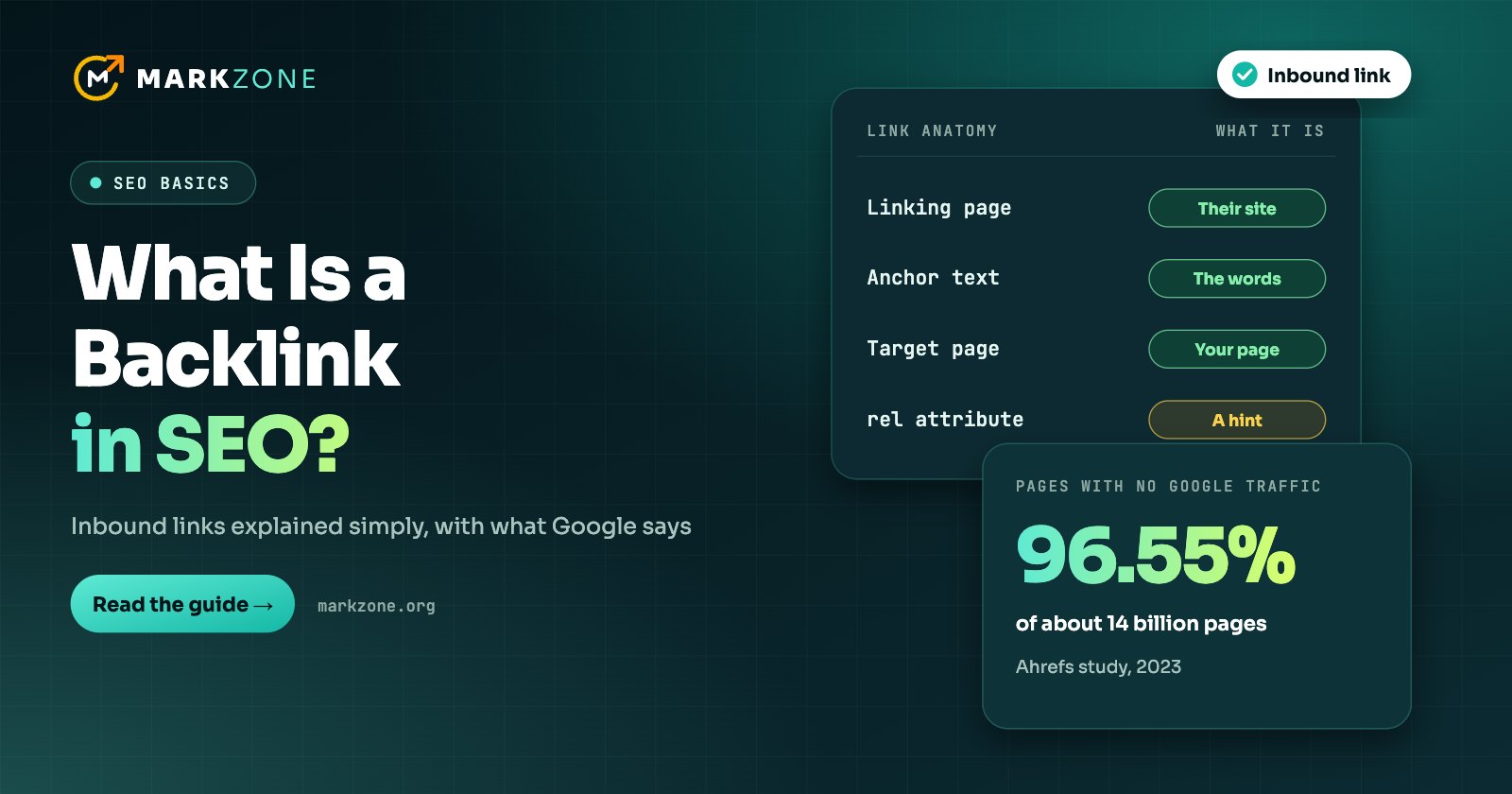
A backlink is a link from another website to yours. It is also called an inbound or incoming link.
Google uses them to find and judge pages. Links help Google discover your pages, and links from respected sites are one sign of quality.
Quality beats quantity. One link from a relevant site with real readers can be worth more than dozens from spammy ones.
A backlink is a link on another website that points to a page on your website. In SEO, backlinks matter because Google uses them in two ways: to discover your pages, and as one of the signals that a page is trustworthy and worth ranking. Not all backlinks are equal, though. A link from a respected site on the same topic counts for much more than a link from an unrelated or spammy site. Some links can even do more harm than good.
What is a backlink?
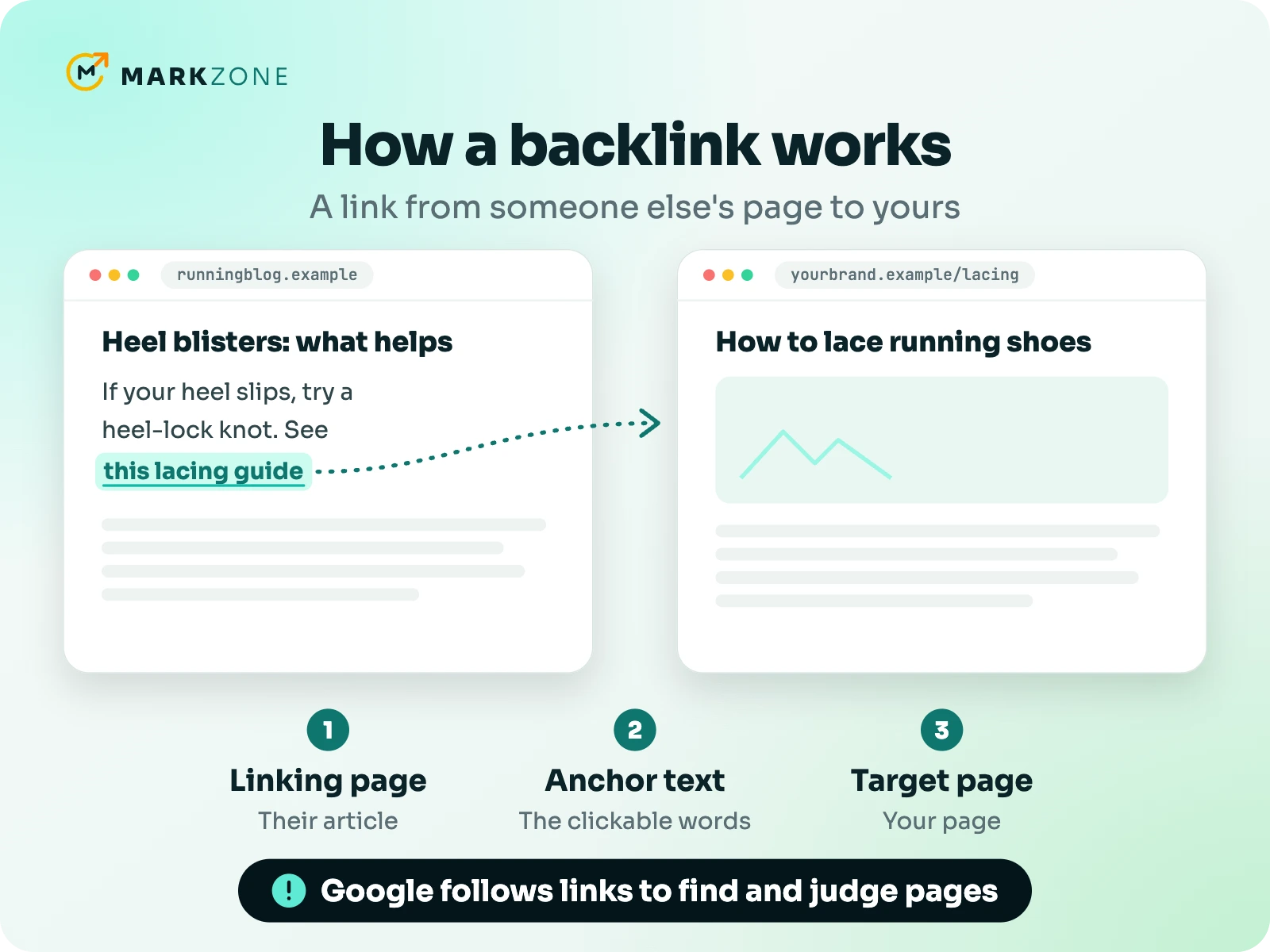
When a website links to yours, that link is a backlink for you. It is also called an inbound link or incoming link. The same link is an outbound link for the site that placed it. For example, if a running blog’s article on blisters links to your guide to lacing shoes, the running blog has given you a backlink.
Every backlink has the same basic parts:
| Part | Example | What it does |
|---|---|---|
| Linking page | A running blog’s article on blisters | The page your link sits on |
| Target page | Your guide to lacing running shoes | The page the link points to |
| Anchor text | “this lacing guide” | The clickable words, which describe your page |
| Link attribute | None, or nofollow, sponsored or ugc | Tells Google how the site wants the link treated |
Backlinks are different from internal links, which point from one page on your site to another page on the same site. Both help Google find your pages, but only backlinks show that other websites consider your content worth linking to.
Why backlinks matter for SEO
They help Google find your pages. Google’s guide to how Search works says it discovers new pages by following links from pages it already knows, as well as through sitemaps. A link from a page Google visits often can get your page found sooner.
They are a sign of quality. Google’s explanation of how Search ranks results covers this. In Google’s words, “one of the factors used to determine quality is understanding if other prominent websites link or refer to the content.” The idea goes back to PageRank, the link-based system Google started with, and it is still in use. In 2020, John Mueller of Google said “we do use PageRank internally, among many, many other signals,” as Search Engine Roundtable and Link-Assistant reported.
They send visitors. A link in a popular article can bring readers straight to your site, whatever it does for rankings. You can see these visits as referral traffic in Google Analytics.
Studies of search results point the same way. Ahrefs studied about 14 billion pages in 2023 and found that 96.55% get no traffic from Google. Pages linked from more websites tended to get more search traffic. That is a correlation, not proof, but it matches what Google says.
Dofollow and nofollow backlinks
A normal link, often called a dofollow link, can pass ranking value to the page it points to. Sites can add an attribute to tell Google to treat a link differently. Google’s guide to qualifying outbound links lists three:
- nofollow for links the site doesn’t want to vouch for.
- sponsored for paid links, such as ads and sponsored posts.
- ugc for links added by users, such as in comments and forums.
Google treats these attributes as hints rather than strict rules, so a nofollow link can still help in some cases, and it can still send visitors. We cover the details in do nofollow links help SEO. For the other kinds of backlinks, from editorial links to directories, see types of backlinks.
What makes a backlink valuable?
A few things decide how much a backlink is worth:
- Relevance. A link from a site and page about your topic counts for more than one from an unrelated site.
- A real site. The linking site should have its own readers and organic traffic, not exist only to sell links.
- Placement. A link inside the main text of an article is usually worth more than one in a footer, sidebar or author bio.
- Natural anchor text. Descriptive words that fit the sentence, not the same keyword on every link.
- A new linking site. The first link from a website usually adds more than another link from a site that already links to you.
Our guide to good backlinks goes through 12 signs of a high-quality link, with a checklist.
Can backlinks hurt your site?
They can if they are part of a scheme. Google’s spam policies treat links meant to manipulate rankings as link spam, including buying or selling links that pass ranking credit, excessive link exchanges and links made by automated programs. Google’s guide to disavowing links says that “in most cases, Google can assess which links to trust without additional guidance.” It suggests acting only when you have a considerable number of spammy or artificial links and they have caused, or are likely to cause, a manual action.
How to see your backlinks
- Google Search Console. The Links report shows your top linking sites, your most-linked pages and your most common link text. Google says it is a sample, not a complete list.
- Ahrefs or Semrush. Their backlink reports show links their own crawlers have found, with metrics for each linking site. Both offer limited free checks.
- Your analytics. Referral traffic in Google Analytics shows which links actually send visitors.
Backlink terms in plain English
| Term | What it means |
|---|---|
| Referring domain | A website that links to you at least once. Ten links from one site count as one referring domain. |
| Link profile | All the backlinks pointing to your site, with their sources and anchors. |
| DR and DA | Scores from Ahrefs and Moz that estimate how strong a site’s backlinks are. Google doesn’t use them. See what is Domain Rating. |
| Link equity | The value a link can pass to the page it points to, often called “link juice”. |
| Spammy links | Links from low-quality or automated sites, which Google usually ignores. |
How to get backlinks
The main ways are to create content worth linking to and to write guest posts for relevant sites. You can also get your link added to existing articles, replace broken links, and turn unlinked brand mentions into links. Our guide to link building strategies covers 17 tactics, and contextual link building explains why links inside the text matter most.
Frequently asked questions
Are backlinks still important in 2026?
Yes. Google still lists links from prominent websites as one of the factors it uses to judge quality. They are one signal among many, though, and they work best for pages that already answer the search well.
What is the difference between a backlink and a link?
Every backlink is a link, seen from the side of the site it points to. A link on your site to another site is an outbound link for you and a backlink for them.
How many backlinks do I need?
It depends on your keyword and competitors. How many backlinks you need explains how to estimate yours.
How long before backlinks start to work?
Usually one to three months. With the links we place, rankings often start to move 4 to 12 weeks after a link goes live. Our guide to how long backlinks take to work has the full timeline.
Can I buy backlinks?
Many sites sell them, including through us, but Google’s policies treat paid links that pass ranking credit as link spam unless they are marked sponsored or nofollow. Our guide to buying backlinks explains the risks.
Want your first quality backlinks?
New to link building? Send us your website, and we’ll suggest a few relevant sites to start with.

Muhammad Suleman is the founder of Markzone. He has done guest posting and link building since 2018 and has worked with hundreds of clients. Today his team handles 300–400 orders a month for brands and SEO agencies, with publisher sites in every major niche. He leads outreach, site checks and reporting, and writes about link building from his daily work with publishers and clients.