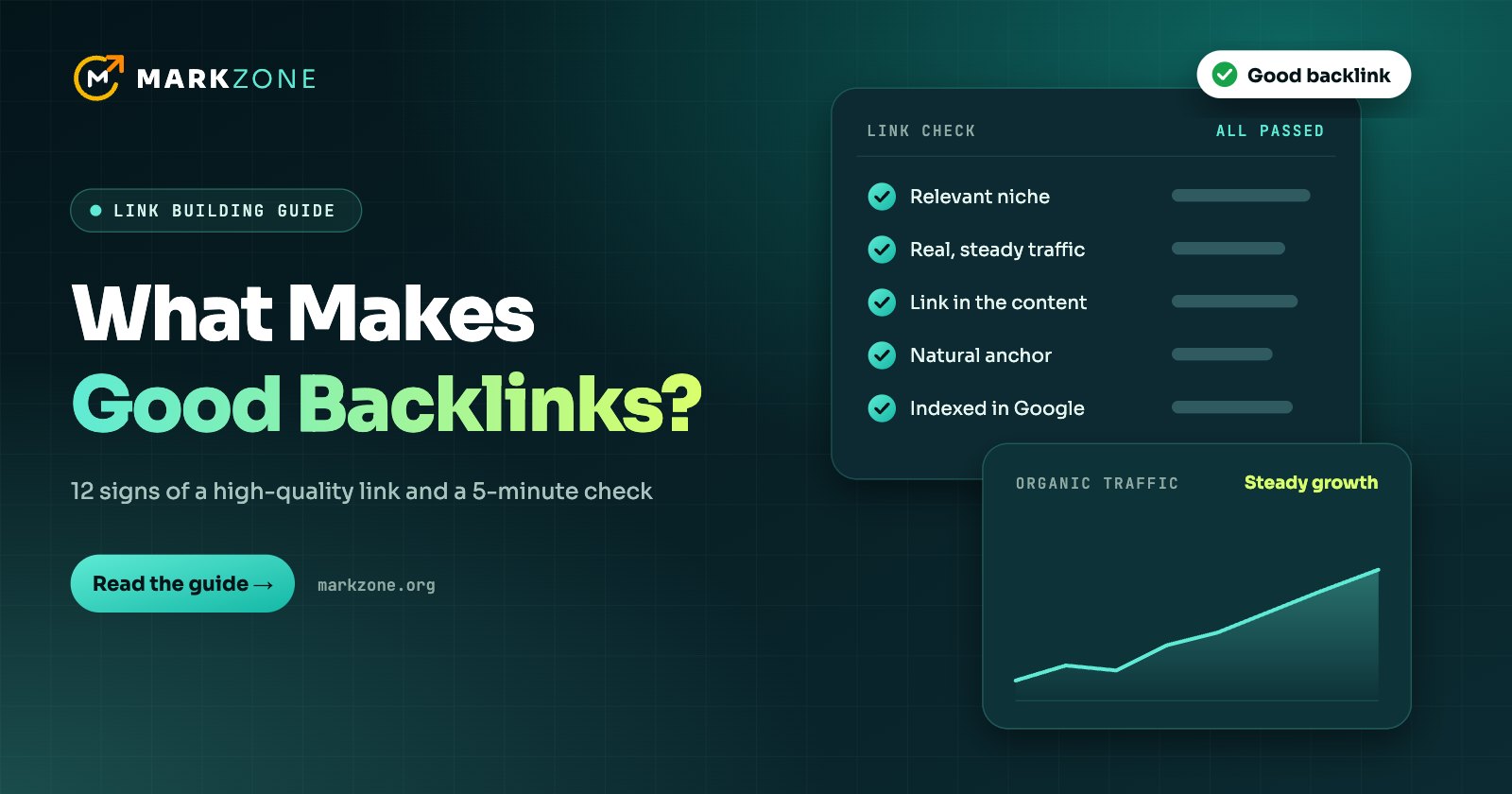
Relevance and real traffic come first. A link from a related site with real readers is worth more than a high-DR link from a site with no clear topic.
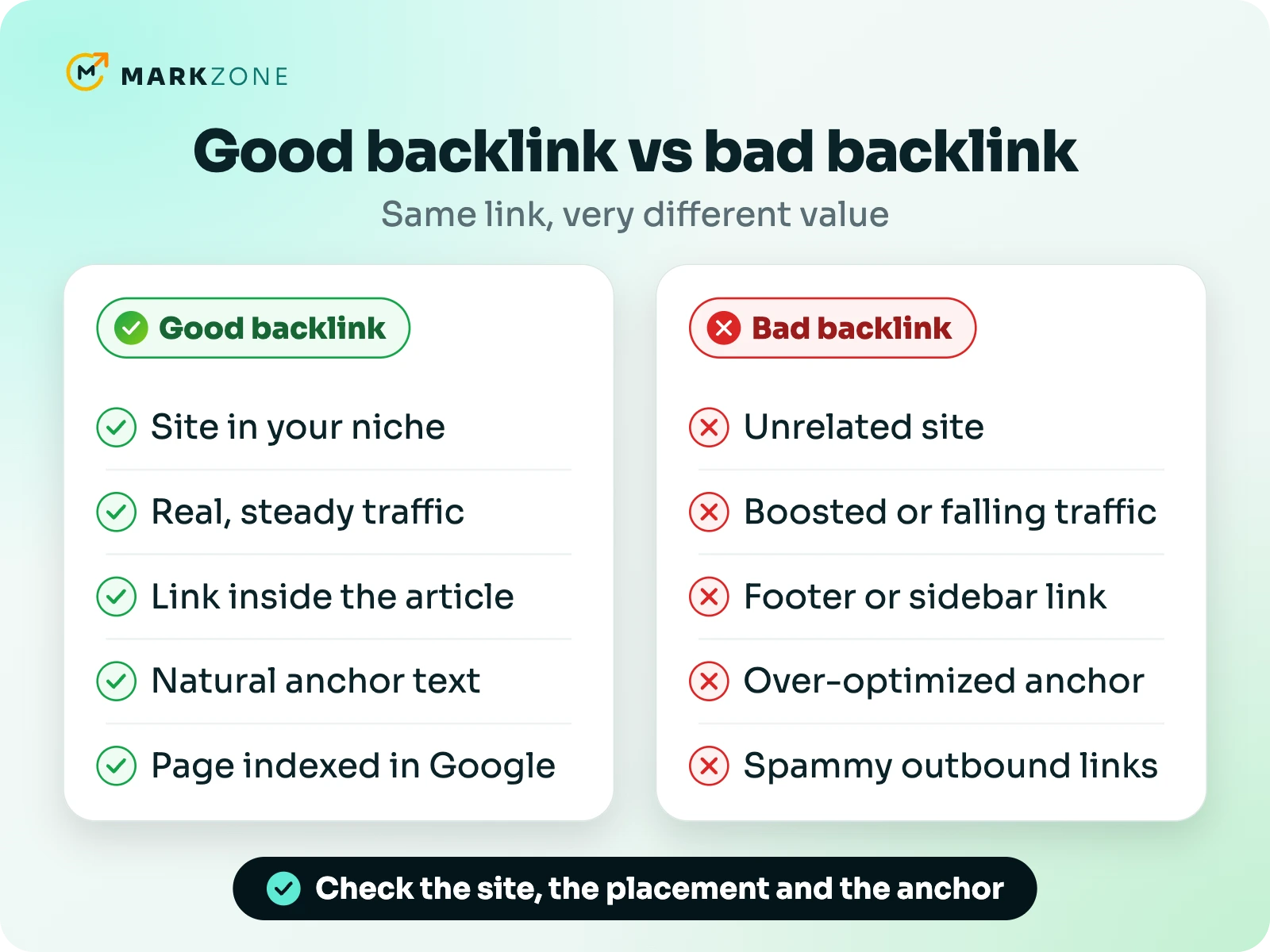
Where the link sits matters. A link inside the main text, with a natural anchor, on a page Google has indexed is worth far more than a footer or sidebar link.
Check before you build or buy. Most warning signs take about five minutes to spot: look at the traffic trend, recent posts and where they link.
A good backlink is a link from a real, relevant website with steady traffic, placed inside the main content of a page that Google has indexed, with natural anchor text. One link like that can do more for your rankings than dozens of links from unrelated or spammy sites. Google weighs where a link comes from, not just how many links you have.
The 22,000+ publisher sites in our catalog are where we place guest posts and link insertions, so we have a commercial interest in this topic. The key points below rest on Google’s own documents and outside research, and the catalog lists DR and Ahrefs traffic for most sites, so you can run these checks yourself.
Do backlinks still matter in 2026?
Yes. Google explains why in its guide to how Search ranks results. It says that “one of the factors used to determine quality is understanding if other prominent websites link or refer to the content.” Large studies point the same way:
- In a 2023 study of roughly 14 billion pages, Ahrefs found that 96.55% get no traffic from Google. It also found that pages linked from more websites tend to get more search traffic.
- A 2020 Backlinko study of 11.8 million search results found that the #1 result has an average of 3.8 times more backlinks than positions 2 to 10.
Both studies show correlation, not proof, and Ahrefs says so itself. Google’s Gary Illyes has also suggested that links count for less than they once did. At a conference in 2024, he was quoted as saying Google needs “very few links to rank pages.” Search Engine Roundtable and Search Engine Journal both reported it, though he later said he shouldn’t have said it. Results depend on the site, its content and the competition, so we never promise rankings. The quality of each link matters as much as the count, and that is what the rest of this guide is about.
12 signs of a good backlink
Use these signs to judge any link, whether you earn it, build it or buy it. A high-quality backlink usually meets most of them.
1. The site is about your topic
Relevance is the first thing to check. A link from a site in your industry makes sense to readers and to Google, and it can send visitors who actually care about what you sell. Ahrefs’ guide to link quality puts it simply: links from sites and pages on the same topic carry more weight with Google.
2. It gets real, steady organic traffic
Organic traffic suggests Google trusts the site enough to rank it, and it means real people may see and click your link. Look at the traffic trend in Ahrefs or Semrush, not a single number. A steady or growing line is a good sign. A sudden spike, or a sharp drop after a Google update, is a warning.
3. Its authority comes from real links
Metrics like Ahrefs’ Domain Rating (DR) and Moz’s Domain Authority (DA) rate a site’s strength from its backlinks. The same Ahrefs guide notes that a link from a high-authority site is generally more powerful than one from a low-authority site. But these numbers can be pushed up with spammy links, so look at where a site’s links come from: its top referring domains should be real, relevant websites. A high DR is only worth paying for when real links and real traffic sit behind it.
4. The page itself has links and traffic
A strong site doesn’t guarantee a strong page. Some pages have links and visitors of their own. A link on one of those is likely to pass more value than one on a page buried deep in the archive. Ahrefs says its page-level score, URL Rating, correlates with Google rankings better than its site-level Domain Rating. Check the page’s own backlinks and traffic, not just the domain’s. For a new guest post, check that the site links to new posts from its homepage or category pages.
5. The link sits inside the main content
Ahrefs says the most valuable backlinks are placed editorially within the content, not in the footer or sidebar. The words around it matter too: Google’s link best practices say “the words before and after links matter,” so your link should sit in a sentence about the same topic. Ask where your link will go before you pay, and avoid placements in author bios or link lists.
6. Google has indexed the page
A link on a page Google hasn’t indexed is unlikely to help you in Google. If a site’s recent posts are missing from Google, the site may have quality problems, and a new post with your link could be left out too.
7. The anchor text reads naturally
The clickable words should describe the page they point to, the way a writer would naturally put it. Google’s spam policies list “links with optimized anchor text in articles, guest posts, or press releases distributed on other sites” as an example of link spam. Mix brand, URL and descriptive anchors instead of repeating one keyword.
8. People actually click it
A good link sends visitors, not just ranking signals. A link in a popular, relevant article can bring readers who care about your topic. Once it is live, check the referral visits from that site in Google Analytics. A link that never gets a single click may sit where readers don’t look.
9. The site links out cleanly
Skim a few recent posts. If most of them link to casinos, payday loans, pills or adult sites, the site probably sells links to anyone who pays. Google may then ignore or distrust its links.
10. Your link isn’t buried among dozens of others
Every outbound link on a page shares in the value that page can pass on. Ahrefs notes that the number of outgoing links matters: the more URLs a page or site links to, the less each link gets. A useful article with a handful of outbound links is a better home for your link than a page with dozens.
11. It comes from a site that doesn’t link to you yet
Studies count linking websites, not just links: Backlinko found that “the number of domains linking to a page had a correlation with rankings.” So the first link from a new site usually adds more than a second or third link from a site that already links to you. Spread your budget across different relevant sites.
12. It is dofollow, or honestly marked
A normal (dofollow) link can pass ranking value, while a rel="nofollow" link generally doesn’t. In our catalog, 21,754 of the 22,073 sites give dofollow links. But if you paid for a link, Google asks for it to be marked as rel="sponsored" or nofollow. We explain those labels in what a sponsored post is.
Backlink quality checklist
Use this table to check any link in a few minutes. One red flag isn’t always a dealbreaker, but several together usually are.
| Sign | How to check | Red flag |
|---|---|---|
| 1. Topic | Read a few recent posts | Posts on everything from casinos to recipes |
| 2. Organic traffic | Traffic trend in Ahrefs or Semrush | No traffic, or a spike followed by a crash |
| 3. Real authority | The site’s top referring domains | DR built on spammy or unrelated links |
| 4. Page strength | The page’s own backlinks and traffic | A deep archive page that nothing links to |
| 5. Placement | Where the link sits in the article | Footer, sidebar, author bio or link list |
| 6. Indexed | Google the post’s exact title | Recent posts missing from Google |
| 7. Anchor text | The words you agree on | The same keyword anchor on every link |
| 8. Clicks | Referral visits in Google Analytics | No visits from the link over months |
| 9. Outbound links | Where recent posts link to | Casinos, payday loans or pills |
| 10. Link count | Outbound links on the page | Dozens of links on one page |
| 11. New domain | Your backlinks from that site | The site already links to you often |
| 12. Link type | The rel attribute on the link | Marked nofollow after you paid for dofollow |
How to check a backlink in five minutes
- Open the site in Ahrefs or Semrush and look at the organic traffic trend for the last 12 months.
- Search Google for the exact URLs of two or three recent posts to confirm they are indexed.
- Read two recent posts and look at where they link out.
- Confirm the link will sit in the body of the article, and agree the anchor text.
- After the link goes live, check that it points to the right page and has the attributes you agreed.
For checks that cover the seller too, such as replacement policies and proof of delivery, see our 8 checks before you buy a link.
Run the checklist on real listings: DR and, for most sites, Ahrefs traffic and price.
Where to get good backlinks
- Create something worth linking to. Original data, free tools and clear guides can earn links on their own over time.
- Write guest posts for relevant sites. Our guide to guest posting outreach shows how to find sites and pitch them.
- Get added to existing articles. A link insertion places your link in a post that is already published, often one with traffic. Our guide to guest posts vs link insertions weighs the two.
- Answer journalists’ requests. An expert quote in a news article can come with a link to your site.
- Fix broken links. Find dead links on relevant pages and suggest your page as a replacement.
- Turn mentions into links. If a site already mentions your brand without linking to you, ask the author to add a link.
- Buy carefully. Use the 12 signs above on every site, whoever you buy from, including us.
Frequently asked questions
Which backlink is best?
An in-content, dofollow link from a relevant site with real, steady traffic, on a page Google has indexed, with natural anchor text. Relevance and real traffic matter more than DR alone.
Do backlinks still matter in 2026?
Yes, though perhaps less than they once did. Google says links from other prominent websites are one of the factors it uses to judge quality. Large studies from Ahrefs and Backlinko also find that pages with more backlinks tend to rank higher and get more traffic. But Google’s Gary Illyes has been quoted as saying Google needs very few links to rank pages, so content and relevance come first.
Where can I buy good backlinks?
From publishers or services that show you the site before you pay, place your link in the main content and replace it if it is removed. Check every site against the 12 signs in this guide, whoever you buy from.
What is a good amount of backlinks?
There is no fixed number. Look at how many sites link to the pages that rank for your keyword, and aim to match them with relevant links over time rather than all at once.
Are nofollow backlinks good?
They can still send visitors and look natural in a link profile, but they generally don’t pass ranking value. Paid links should be nofollow or marked sponsored.
How long do backlinks take to work?
Usually weeks to months, not days. Google first has to crawl the page your link is on, and rankings tend to move gradually as good links build up. Track the page you linked to in Google Search Console instead of checking every day.
Want good backlinks without the guesswork?
Send us the page you want to rank, and we’ll suggest sites with DR, traffic and prices.

Muhammad Suleman is the founder of Markzone. He has done guest posting and link building since 2018 and has worked with hundreds of clients. Today his team handles 300–400 orders a month for brands and SEO agencies, with publisher sites in every major niche. He leads outreach, site checks and reporting, and writes about link building from his daily work with publishers and clients.