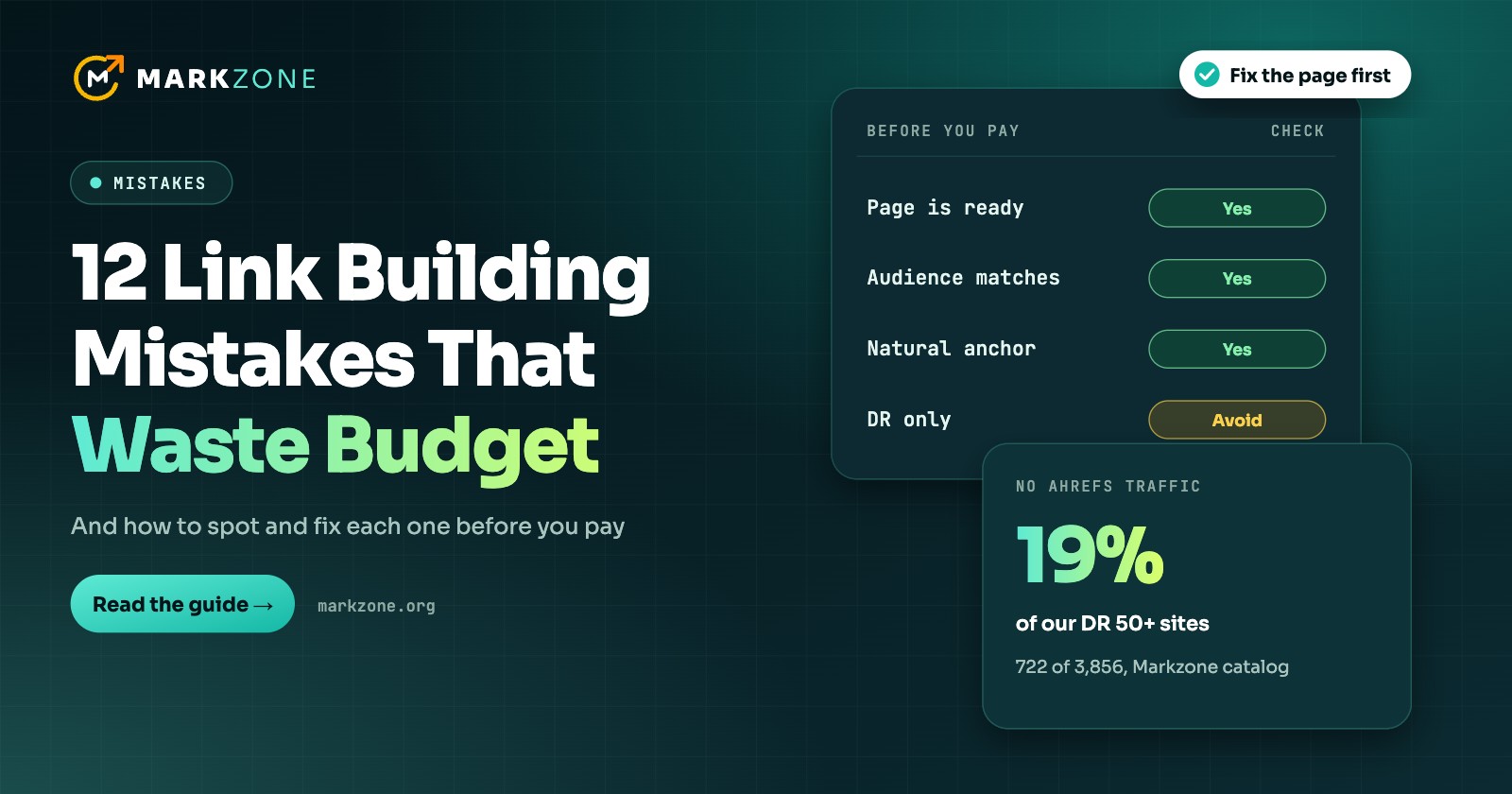
Most waste happens at the shortlist. Buying for DR, for the wrong country or from sites nobody reads spends money without reaching readers. Nearly one in five of our DR 50+ sites (722 of 3,856) gets no Ahrefs traffic.
Small terms add up. On sites that price both, insertions usually come in about 20% below the price of a new post. Crypto and CBD topics typically cost 40% more, though about 8% of the sites that price them charge no surcharge.
Some mistakes cost more than money. Automated link packages, excessive link swaps and unlabeled paid links that pass ranking credit all appear in Google’s list of link spam. Enough of them can trigger a manual action.
The link building mistakes that waste a budget mostly happen before you pay. Four stand out: building links to a page that can’t rank yet, choosing sites by DR alone, buying readers in the wrong country and paying for sites nobody visits. Others hide in the terms of the deal, and a few, like bulk packages and link swaps, also put your site at risk. Below are 12, each with a fix and, where we have one, a catalog figure that shows what it costs.
Selling links is our business: we offer link building through guest posts and link insertions. The catalog numbers below come from our price study of November 13, 2026, plus two figures from cheap link building, published November 8, 2026. They show what publishers list, not ranking results we have measured.
12 link building mistakes and how to fix them
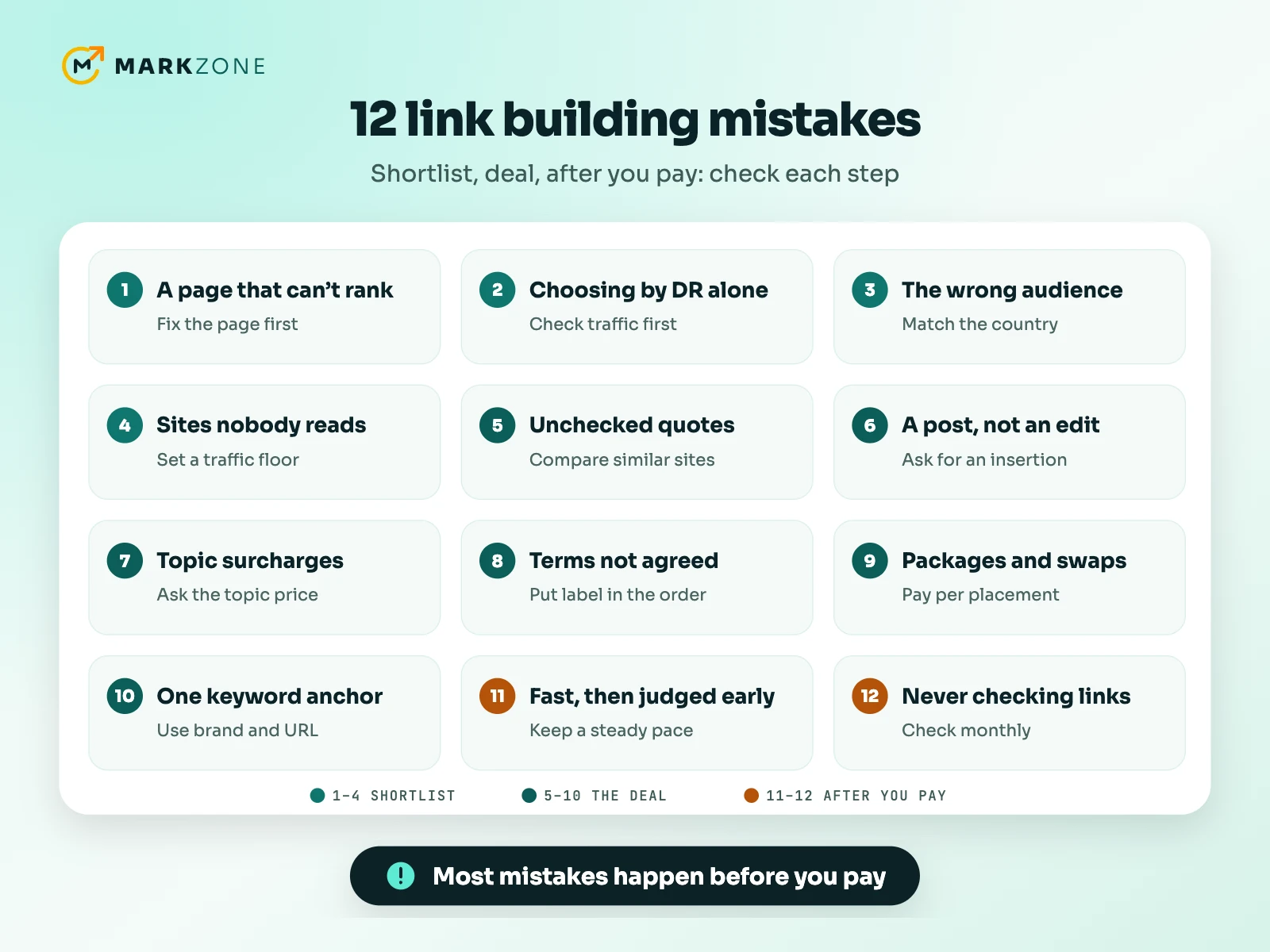
Mistakes 1 to 4 happen while you shortlist sites, 5 to 10 when you agree the deal, and 11 and 12 after you pay.
1. Building links to a page that can’t rank yet
Links can push a page up only if the page deserves to be there. If the top results for your keyword are product pages and yours is a blog post, no number of links will change what Google thinks the searcher wants. Pointing every link at your homepage or one sales page wastes money too; real sites earn links to their guides and tools. Fix: before you buy, compare your page with the top three results: the type of page, what it covers and how recently it was updated. Improve it first, then link to your most useful pages and pass value to sales pages with internal links.
2. Choosing sites by DR alone
DR is an Ahrefs score built from links, and links can be bought or faked. Among our DR 50+ sites, 722 of 3,856 (19%) have no Ahrefs traffic at all. Prices follow traffic far more than DR: the rank correlation between price and traffic is 0.42, and between price and DR only 0.21. A DR 70–79 site with fewer than 1,000 monthly visits typically costs $100, against $400 with 1,000 or more. So a high DR at a low price often signals low traffic. Fix: check traffic and its 12-month trend first, and use DR as a tie-breaker.
3. Buying the wrong audience
Relevance has two parts: the topic and the readers. A site on your topic whose readers live in another market sends you few customers. Country also moves the price. Median prices by main traffic country run from $25 for India and $50 for the United States to $105 for the United Kingdom and $390 for Germany. A $25 link can be good value for an Indian business and wasted spend for a US one. A German campaign costs nearly eight times as much per link as a US one at the median. Fix: look up where most of a site’s search visits come from, in Ahrefs or Semrush, and filter by your market before you look at price.
4. Paying for sites nobody reads
A link on a site without search traffic can’t send you visitors, and such sites are common. Our price study found no Ahrefs traffic on 7,133 of its 18,977 priced sites (38%), and their median price is $25. Paying more doesn’t solve it: only 35% of $200 sites and 15% of $20 sites reach 1,000 monthly visits. Fix: set a traffic floor before you look at price, for example 1,000 monthly visits, and make exceptions only for sites your customers already know.
5. Paying without checking the quote against similar sites
The same traffic can cost very different amounts. For sites with 5,000 to 9,999 monthly visits, the middle half of our catalog prices runs from $40 to $500 around a median of $200. For 10,000 to 49,999 visits, the range is $40 to $540. A quote near the top can be fair for a strong site in a pricey niche such as sports, where the median is $150 against $30 for technology. But it should come with a reason. Fix: compare every quote with sites of similar traffic, niche and audience country, and ask the seller to explain anything above the middle half.
6. Paying for a new post when an edit would do
When a site has already published an article on your topic that gets traffic, adding your link to it usually costs less than a new post. Link insertions are offered by 13,262 of the catalog’s 22,073 sites. Of the 8,387 that list both prices, 70% charge less for the insertion, and the typical saving is 20%. On a site that charges $200 for a post, that typical discount is $40 per link. Fix: before you order a post, search the site for an article on your topic (site:theirdomain.com plus your keyword) and ask for an insertion price. Guest posts vs link insertions weighs when each one fits.
7. Paying a topic surcharge you could avoid
Among sites that list a separate price, the median crypto or CBD price is 40% above the site’s standard price. The middle half of crypto surcharges runs from 30% to 50%. Yet 624 crypto sites and 552 CBD sites, about 8% of each group, charge their standard price. Worked example: ten posts on sites with a normal price of $100 cost about $1,400 at the median surcharge, against $1,000 on sites that add none. Fix: ask for the topic price up front, and put sites without a surcharge at the top of your shortlist.
8. Not agreeing on placement and label before you pay
Placement first: a link in an author bio or a “useful links” list carries little context. Agree in writing that it goes inside the article body, in a sentence on your topic. Then the label, which decides whether a paid link breaks Google’s rules. Google’s spam policies count “Exchanging money for links, or posts that contain links” as link spam. They also call buying and selling links “a normal part of the economy of the web for advertising and sponsorship purposes.” Such links are allowed “as long as they are qualified” with rel="nofollow" or rel="sponsored". Links in our catalog are dofollow by default unless the publisher marks them otherwise, and you can ask for a sponsored label on any order. Most publishers don’t say. Of our 22,073 sites, 240 state that they mark paid posts as sponsored, 7,190 state that they don’t, and 14,643 don’t say. Fix: write the placement, the anchor and the rel attribute into the order, then check the live link against it.
9. Buying bulk packages and link swaps
A package of hundreds of links for the price of one real guest post is usually filled by automation, link networks or comment spam. Google’s link spam list names “Using automated programs or services to create links to your site.” It also names “Excessive link exchanges (“Link to me and I’ll link to you”) or partner pages exclusively for the sake of cross-linking.” Links that Google identifies as spam are neutralized, as its December 2022 link spam update explained, so the money buys nothing. A pattern of them can also bring a manual action. Fix: pay for individual placements on sites you can see and check, and link to partners only where the link helps your readers.
10. Repeating one keyword anchor across your links
Google’s link best practices ask writers to “resist the urge to cram every keyword that’s related to the page that you’re linking to.” They also note that keyword stuffing breaks its spam policies. Ten paid links that all read “best chef knives” look arranged, because nobody links that way unprompted. Fix: anchor most links with your brand name, the bare URL or a short description of the page. Keep exact-match keyword anchors for the occasional sentence where they read naturally.
11. Spending fast, then judging too soon
Two timing mistakes waste money from opposite ends: buying a year’s links in one month, and cutting the budget before the links could have worked. Publishing is rarely the delay: over 96% of the publishers that state a turnaround (16,127 sites) quote 48 hours or less. After that, Google has to crawl the page and process your link before it can count. Fix: set a monthly pace you can keep for a year, and judge results by month, not by day. How many backlinks per day is safe sets that pace from your competitors’ link growth, and how long backlinks take to work times each step.
12. Never checking links after they go live
Links get removed, moved or switched to nofollow, and posts drop out of Google’s index. If you don’t check, you keep counting links you no longer have. Fix: check each link the day it goes live (right page, right sentence, agreed rel attribute). Search the post’s exact title in Google a few weeks later to confirm it is indexed, and review lost links once a month. If a link vanishes, ask the seller to replace it; our orders carry an 8-month link guarantee.
See DR, Ahrefs traffic and price side by side, so you can rule sites out before you pay.
Five quotes, checked: a worked example
Say you run a US kitchenware store and receive five offers. The offers are invented; every benchmark is a real median or range from our catalog.
| Offer | What the seller lists | Quote | Catalog benchmark | Verdict |
|---|---|---|---|---|
| A | DR 74, 300 monthly visits | $100 | DR 70–79 with under 1,000 visits: median $100 | Priced for its traffic, not its DR. Skip if the DR is why you’re buying (mistake 2) |
| B | DR 41, no search traffic | $25 | No search traffic: median $25 | A normal price for a site nobody finds in Google (mistake 4) |
| C | DR 39, 3,000 monthly visits, mostly from India | $25 | Main traffic from India: median $25; 1,000 to 4,999 visits: median $130 | Real readers at a low price, in the wrong market for a US store (mistake 3) |
| D | DR 48, 7,000 monthly visits, US audience, your topic | $700 | 5,000 to 9,999 visits: median $200, middle half $40 to $500 | The right kind of site, quoted above the middle half: compare or negotiate (mistake 5) |
| E | DR 52, 2,000 monthly visits, US audience, an existing article on your topic | Post $130 or insertion $104 | Insertions cost less at 70% of sites that price both, typically 20% less | Take the insertion if the article fits (mistake 6) |
Only D and E pass the audience and traffic checks. A, B and C are fairly priced for what they are, and that is the trap: a fair price for a site that can’t reach your customers is still wasted.
Frequently asked questions
Can link building mistakes get my site penalized?
Yes, if they form a pattern. Search Console’s Manual actions report describes the “Unnatural links to your site” action as “a pattern of unnatural, artificial, deceptive, or manipulative links pointing to your site.” Single bad links are usually just ignored. Real cases, from Overstock in 2011 to Rap Genius in 2013, are in our backlinks example guide.
Should I pay for a “toxic link” cleanup?
Usually not. Google’s disavow guide reserves disavowing for a considerable number of spammy links that have caused, or will likely cause, a manual action, and toxicity scores come from SEO tools, not from Google.
Is buying links through a vendor a waste of money?
Not in itself, but it costs more: BuzzStream’s 2026 pricing review says “The vendor markup seems to average about 56%.” What you pay us also covers outreach, checking each site, and an 8-month link guarantee. If you have time to find, vet and chase publishers yourself, keeping the work in-house and buying direct can cost less.
Sources
- Spam policies for Google web search (Google Search Central, last updated August 28, 2026)
- Link best practices for Google (Google Search Central, last updated December 10, 2025)
- December 2022 link spam update releasing for Google Search (Google Search Central Blog, December 14, 2022)
- Manual actions report (Google Search Console Help, undated)
- Disavow links to your site (Google Search Console Help, undated)
- Link Building Pricing (BuzzStream, last updated October 20, 2026)
- Guest Post Prices: What 18,977 Sites Charge (Markzone price study, November 13, 2026: DR and traffic prices, rank correlations, country and niche medians, niche edits, crypto and CBD surcharges, labels, turnaround, 8-month guarantee)
- Cheap Link Building: What $20 vs $200 Links Get You (Markzone, published November 8, 2026: 15% of $20 sites and 35% of $200 sites with 1,000+ monthly visits)
Want links without the costly mistakes?
Send us your site before you buy anything, and we’ll check your shortlist against these 12 points.

Muhammad Suleman is the founder of Markzone. He has done guest posting and link building since 2018 and has worked with hundreds of clients. Today his team handles 300–400 orders a month for brands and SEO agencies, with publisher sites in every major niche. He leads outreach, site checks and reporting, and writes about link building from his daily work with publishers and clients.