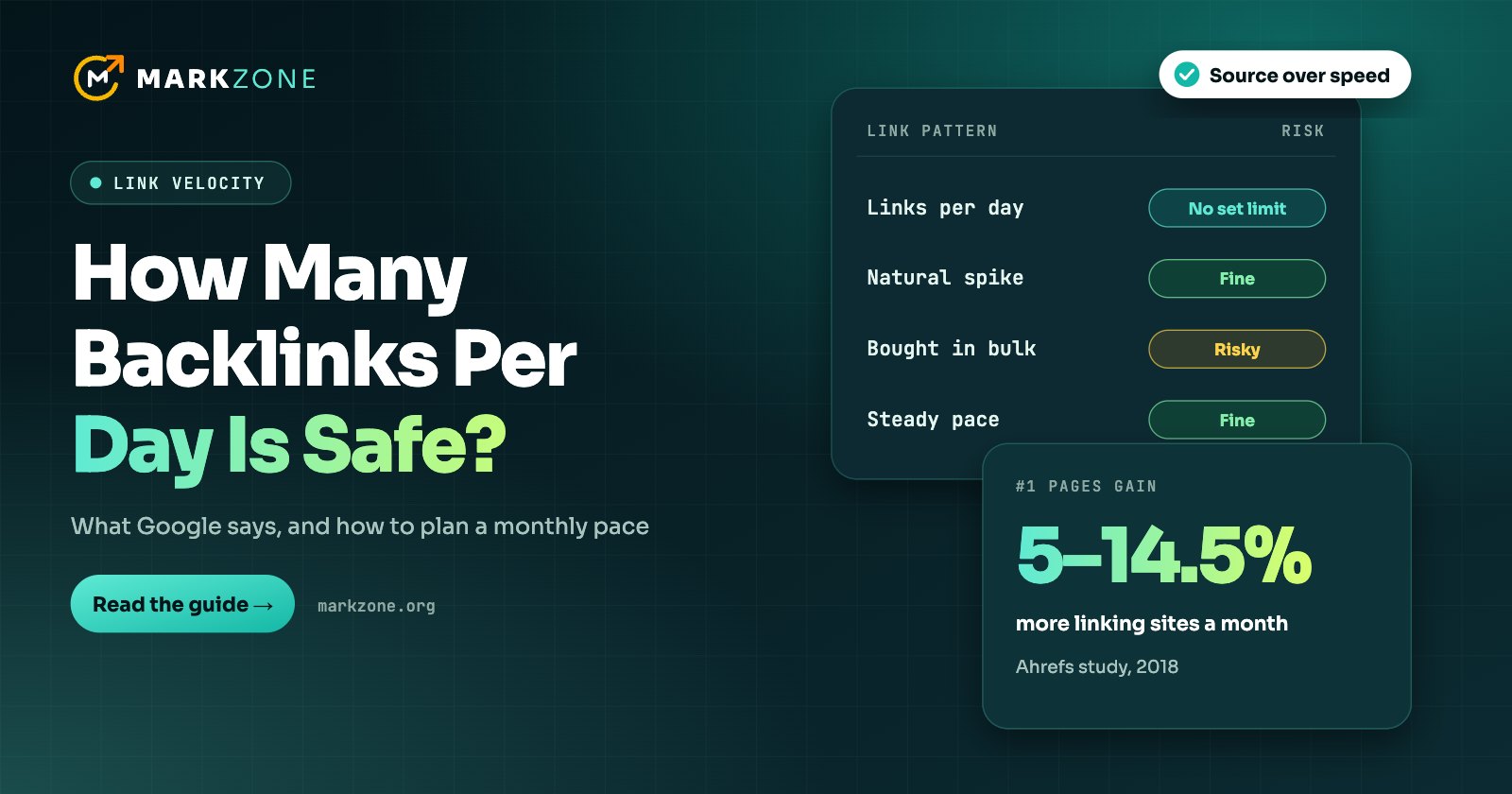
There is no safe daily number. Google has said it doesn’t judge links by how many arrive in a period of time, but by what kind of links they are.
A spike isn’t always bad. A post that takes off can earn many links fast. A sudden flood of links with nothing to explain it looks like bought or automated links.
Set a monthly pace from three things. How many links the top pages have and gain each month, how many links and how much age your own site has, and your budget.
There is no number of backlinks per day that is safe or unsafe on its own. Google’s John Mueller has said that what matters is not how many links you get in a period of time, but the kind of activity behind them. A burst of natural links is fine, while bought, swapped or automated links can cause problems at any pace. The pace still has to fit your site, though: a small site that suddenly gets far more links than it has ever had is taking a risk. So instead of a daily limit, set a monthly pace based on your competitors, your own site and your budget.
More links per day would mean more sales for us, since links are what we sell. The honest answer is that where the links come from matters most, and the right pace depends on your site.
What Google says about link velocity
Link velocity, or backlink velocity, is how fast a site gains new backlinks. Many site owners worry that gaining links too quickly will trigger a penalty.
Mueller was asked about exactly this in 2019. A site that had done no link building for two years had just built 200 backlinks in two days. He said the number of links in a period of time wasn’t the issue. What mattered was the type of activity, such as buying links or swapping them through a link network. Search Engine Roundtable and Search Engine Journal both reported his comments. He also said that 200 links that fast didn’t sound like natural links. Google’s algorithms might act on such links or ignore them, he added, and its manual actions team could take action too.
In other words, speed can be a clue, but the links themselves are the problem. Google’s spam policies list the activities it treats as link spam. They include “using automated programs or services to create links to your site” and “excessive link exchanges.” They also include “links with optimized anchor text in articles, guest posts, or press releases distributed on other sites.” None of them mentions a number of links per day.
Is a sudden spike in backlinks bad?
Not by itself. A Google patent on ranking with historical data, filed in 2003, describes a large spike in backlinks as a possible sign of a hot topic. Its example is a health agency’s site gaining links quickly after an outbreak. It also says a spike can be a sign of link spam. A patent shows what Google has explored, not what it uses today, but the point holds: the reason behind a spike matters.
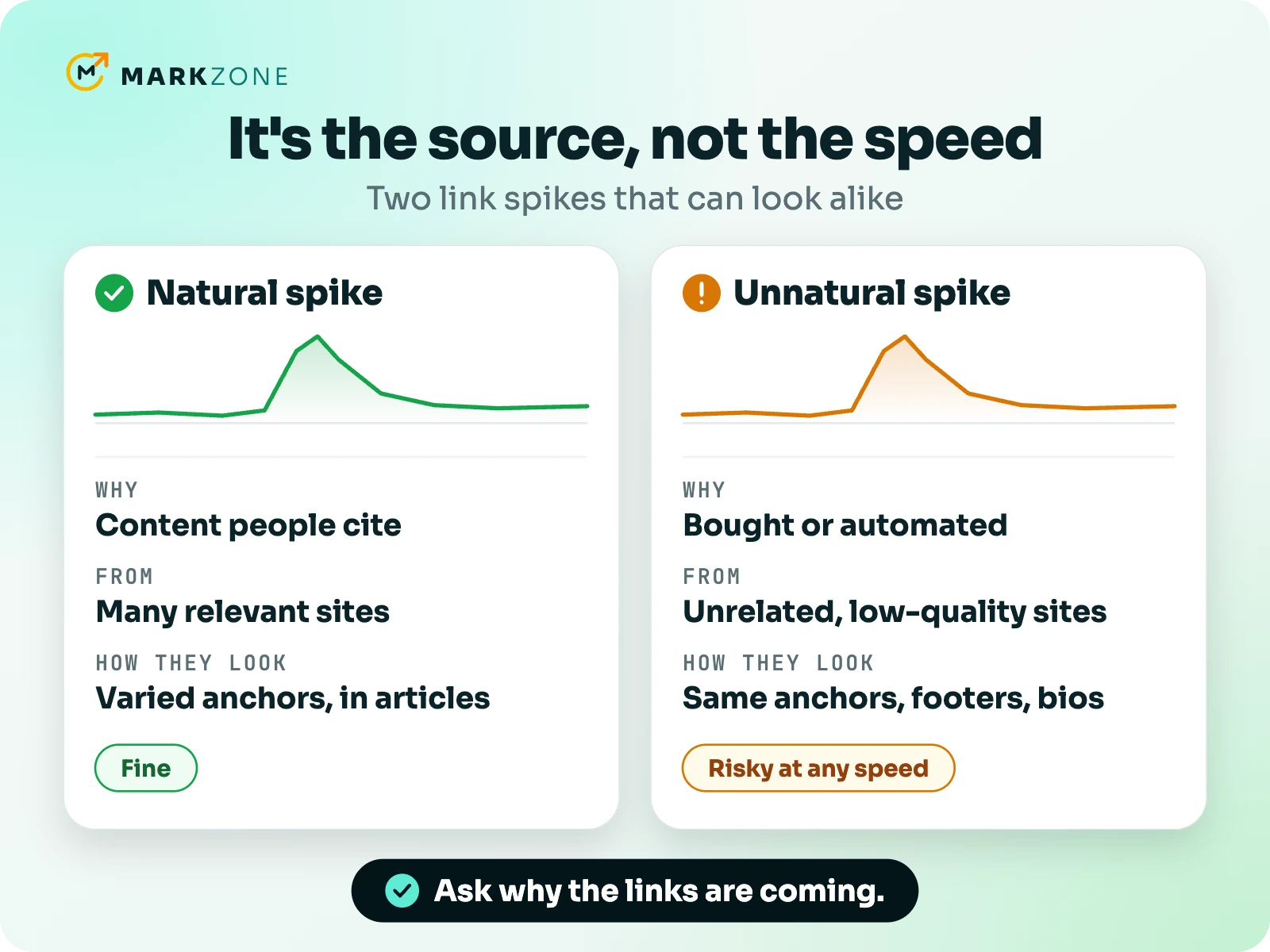
Natural spikes usually have a clear cause, such as a post that goes viral, a news story, a product launch or a study that others cite. The links come from many different sites, with different anchor text, mostly inside articles. Unnatural spikes look different. They bring many links from unrelated or low-quality sites, the same keyword anchor again and again, and links in footers or author bios. Nothing on your site explains the attention.
How many backlinks per month should you build?
No single number fits every site. When we plan links for a client, we look at three things:
- Your competition. Check how many referring domains the top 10 pages for your keyword have, and how many new ones they gain each month. Ahrefs and Semrush show both. As a rough guide, look at a 2018 Ahrefs study of 200,000 top-ranking pages. It found that pages in position 1 gained between 5% and 14.5% more followed referring domains each month. So a page with links from 100 sites might gain about 5 to 15 new ones a month.
- Your own site. Look at how many links it has now and how old it is. The pace has to fit the site: in our experience, a site with only 10 links that suddenly gets 50 new ones a month is taking a real risk. Start lower and build up as the site grows.
- Your budget. Pick a pace you can keep up. The pages you compete with keep gaining links, so a pace you can hold for a year is worth more than one big push followed by nothing.
If your page has fewer linking sites than the pages above it, you also need to close that gap over time. Our guide to how many backlinks you need shows how to work it out.
For example, say the top pages have links from about 50 websites and each gains about four new ones a month, while your page has 15. If you build eight relevant links a month, you gain about four a month on them, and you would catch up in roughly nine months.
Pick a few sites a month from listings that show DR, traffic, price and delivery time.
Should you drip-feed backlinks?
You don’t need to space links out to exactly one a day. Google has said it doesn’t judge links by time period, and a drip-fed schedule doesn’t make bad links safe. What matters more is the monthly total compared with your site’s size, and the quality of each link.
Spreading links out does help with budget and workload: you can check each site properly, see results before you spend more and keep a steady flow going. If you order several links from us at once, each one goes live when its publisher publishes it, and our catalog shows the delivery time for most sites. Links also take time to work, as we explain in how long backlinks take to work.
When fast link building is a problem
These patterns are risky at any speed, and they tend to show up as spikes:
- Hundreds of links in a few days from sites you never checked.
- Bulk link packages, private blog networks and link swaps.
- Links made by tools, such as comment, forum or profile spam.
- The same keyword anchor text across many guest posts.
- Sitewide links in the footers or templates of other sites.
If you see these in your backlinks, the speed isn’t the problem, the links are. Our guide to cheap link building explains which low-cost links are worth buying and which to avoid.
How to check your link velocity
- Ahrefs: the referring domains chart in Site Explorer shows how many sites link to you over time, and the backlinks report can show only new links.
- Semrush: Backlink Analytics shows new and lost referring domains over time.
- Google Search Console: the Links report lets you export your most recently discovered links.
Check once a month. Look for jumps you can’t explain, such as dozens of new links from sites you don’t recognize, and compare your pace with the pages you want to outrank.
Frequently asked questions
How many backlinks per day is safe for a new website?
There is no safe daily number, but new sites need the most care with pace. Start with a few relevant links a month and build up as the site grows, rather than jumping to dozens of links in the first month.
Is it bad to get 100 backlinks in one day?
Not if they come naturally, for example after a post goes viral. If you paid for 100 links in a day, especially on a small site, both the links and the sudden jump are a risk.
Can too many backlinks hurt my website?
They can if the links are bought or manipulative, or if a small site suddenly gets far more links than it has ever had. Since 2016, Google’s Penguin system has devalued spammy links rather than demoting whole sites. Google also says that in most cases it can work out which links to trust on its own. But a pattern of bought or manipulative links can still lead to a manual action for unnatural links, which can affect part or all of a site.
Is it bad if I stop building links for a while?
Not in itself. In the 2019 answer, Mueller said that going two years without building links wouldn’t count against a site. But the pages you compete with keep gaining links, so a long pause can let them pull ahead.
How many backlinks per month is normal?
There is no normal number. In Ahrefs’ 2018 study, pages ranking near the top gained anywhere from 0% to 14.5% more followed referring domains a month. So the right number depends on how many links your competitors already have.
Want a steady flow of checked links?
Tell us your monthly budget, and we’ll suggest a pace that fits your site and your competitors.

Muhammad Suleman is the founder of Markzone. He has done guest posting and link building since 2018 and has worked with hundreds of clients. Today his team handles 300–400 orders a month for brands and SEO agencies, with publisher sites in every major niche. He leads outreach, site checks and reporting, and writes about link building from his daily work with publishers and clients.