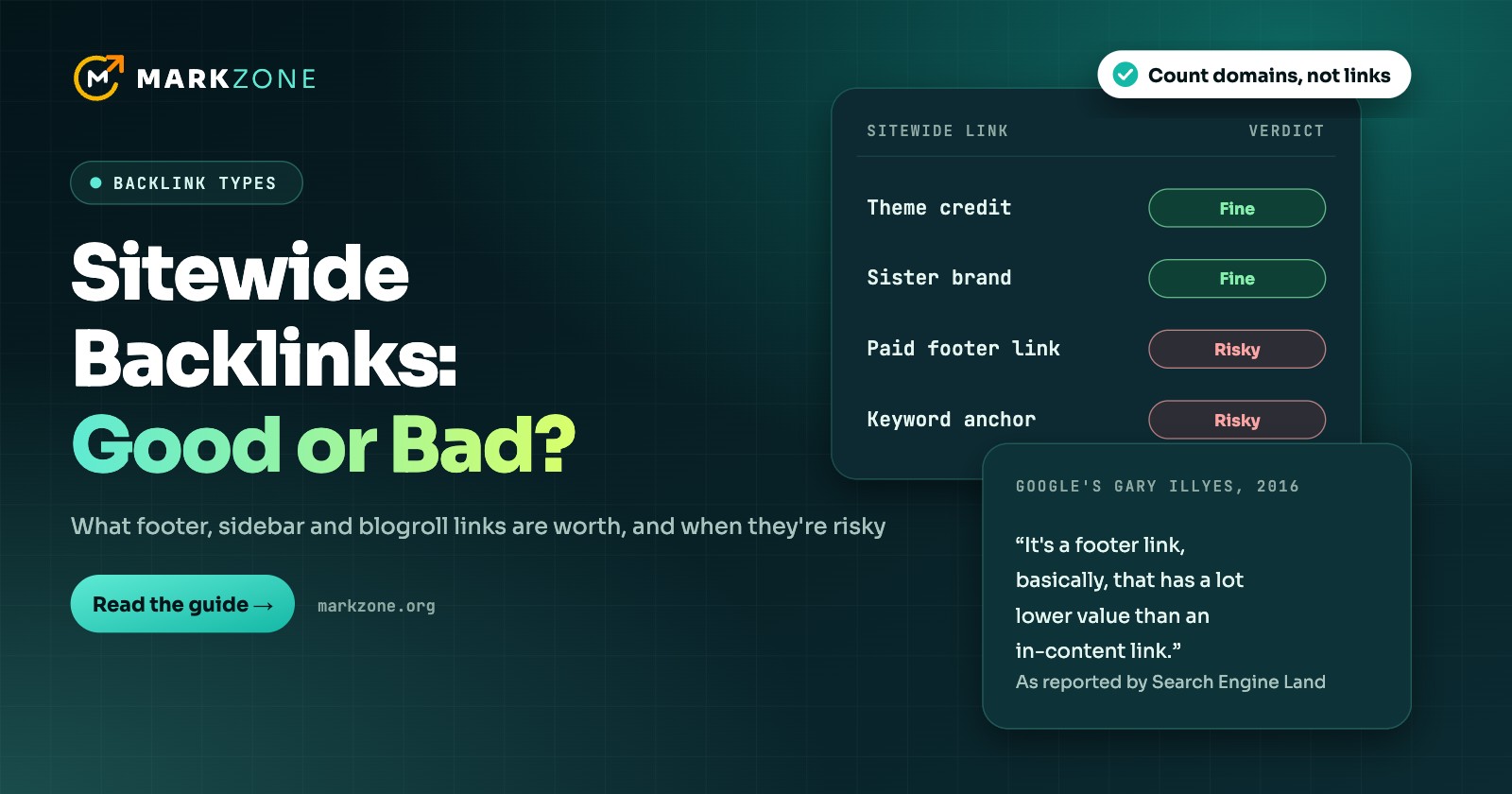
Most are harmless, and few are worth much. Credits, sister-site links and blogrolls are normal. When one domain sends 50 links, Google’s Matt Cutts said in 2012, Google “might choose to only count it once.”
Google names the risky kind. Its spam policies list “Widely distributed links in the footers or templates of various sites” as link spam. They also list keyword-rich widget links and links required by contract.
Price an offer per linking site. A sitewide link adds one referring domain. In our catalog, an article link on a site with 10,000 to 49,999 monthly visits typically costs $200 before writing.
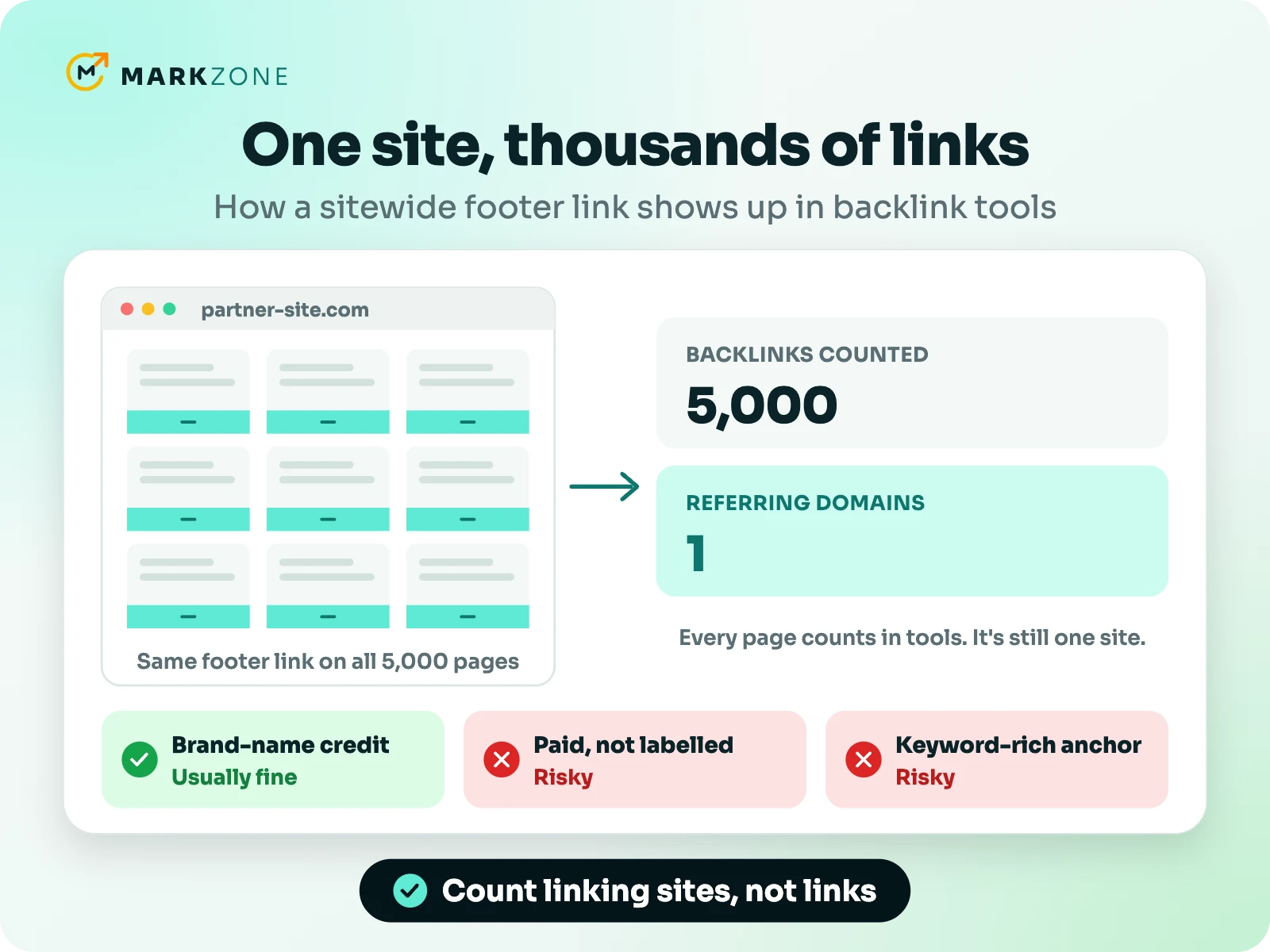
Sitewide backlinks are links that appear on every page, or nearly every page, of another website, usually in its footer, sidebar, header or blogroll. Most are harmless: a “website by” credit, a theme’s “powered by” line or links between sister brands are an ordinary part of the web. A footer link on a 5,000-page site can show up as 5,000 backlinks, but it is still one linking site. Google has said it may count the repeats as one. The risk starts when sitewide links are paid without a label, stuffed with keywords or spread across many sites. Google’s spam policies list “Widely distributed links in the footers or templates of various sites” as an example of link spam.
We sell guest posts and link insertions, both of which put links inside articles, so we gain when buyers pick those over sitewide links.
- What counts as a sitewide backlink
- Do sitewide backlinks help SEO?
- Google on sitewide links: a dated record
- When a sitewide link becomes link spam
- What a sitewide link is worth: price it per linking site
- How to find sitewide links pointing to your site
- How to handle the sitewide links you have
- Frequently asked questions
- Sources
What counts as a sitewide backlink
A sitewide backlink lives in a site’s template rather than in one article, so it repeats on every page built from that template. It is one of several types of backlinks, and its kinds carry very different risks:
| Type | Example | Usually fine? |
|---|---|---|
| Theme or platform credit | “Made by Squarespace” in a site’s footer | Yes |
| Designer credit on client sites | “Website by Studio X” | Yes, with nofollow |
| Links between your own sites | A group’s brands in a shared header | Yes, if few and useful to visitors |
| Blogroll or partner list | A sidebar list of related blogs | Yes, if not traded for links |
| Widget or badge | An embedded calculator with a link back | Only with nofollow on the embedded link |
| Rented footer or sidebar link | A text link paid for by the month | Only with rel="sponsored" or rel="nofollow" |
Do sitewide backlinks help SEO?
A little, at most, and the repeats add almost nothing. In a November 2012 video, Matt Cutts said: “if we see 50 links from a domain, we still might choose to only count it once.” In October 2016, Gary Illyes said Google labels links by type, and “it’s a footer link, basically, that has a lot lower value than an in-content link.” Neither put a number on the difference, and Google hasn’t published one since.
Reports make sitewide links look bigger than they are. Search Console defines a duplicate as “a link from the same source URL to the same target URL.” So every page that carries a footer link counts as a separate link there. Still, the site counts once as a referring domain. Article placements arrive one or two at a time. In our catalog, 59% of publisher sites take one link to your site per post and 37% take two, so 96% take no more than two.
Google on sitewide links: a dated record
| When | Who, and where | The statement |
|---|---|---|
| 2 Oct 2012 | Google Search Central Blog, guidelines update (footer line reported by Search Engine Roundtable, 9 Oct 2012) | The revised link schemes page named “Widely distributed links in the footers of various sites” |
| 13 Nov 2012 | Matt Cutts, Webmaster Help video (WebProNews) | An off-topic sitewide link “can affect the assessment on whether you want to trust the out-going links from that site” |
| 17 Jul 2013 | Matt Cutts, video (Search Engine Land) | Linking 20 of your domains together is likely a “cross linking scheme”; country sites should use flags or a drop-down rather than footer links |
| 27 Feb 2015 | John Mueller, office-hours hangout (Search Engine Roundtable, 3 Mar 2015) | On designer credits in client footers: “definitely put a nofollow rule for those links” |
| 25 Jan 2016 | Zineb Ait Bahajji, on Twitter (Search Engine Roundtable, 27 Jan 2016) | Wrote in French that sitewide header and footer links generally don’t carry much weight (our translation) |
| 8 Sep 2016 | Google Search Central Blog | Some widgets add links “that a webmaster did not editorially place”; add nofollow or remove them |
| 10 Oct 2016 | Gary Illyes (Search Engine Land) | Google’s systems label footer links as footer links |
| 31 Jan 2023 | Lizzi Sassman, Google’s January 2023 SEO office hours (Google’s transcript; Search Engine Roundtable, 1 Feb 2023) | Theme credits are “not something that you need to worry about”; for links you control, “we recommend that you add nofollow to these types of links” |
| Updated 28 Aug 2026 | Google’s spam policies | Footer and template links, widget links and contract-required links are all on the link spam list |
When a sitewide link becomes link spam
Google’s spam policies define link spam as “creating links to or from a site primarily for the purpose of manipulating search rankings.” Four of their examples fit sitewide links:
- “Widely distributed links in the footers or templates of various sites”
- “Keyword-rich, hidden, or low-quality links embedded in widgets that are distributed across various sites”
- “Requiring a link as part of a Terms of Service, contract, or similar arrangement without allowing a third-party content owner the choice of qualifying the outbound link”
- “Text advertisements or text links that don’t block ranking credit”
So the warning signs are payment without a label, keyword anchors, the same link spread across many unrelated sites, and off-topic placement. Sassman’s example of an anchor to avoid was “made by the best Florida SEO”. Cutts’s 2012 example was an English “Rent cheap apartments” link across a Polish site: “To a regular person, that looks pretty bad.” The worst outcome is a manual action for “a pattern of unnatural, artificial, deceptive, or manipulative links pointing to your site.”
Paid links follow one rule, whether they sit in a footer or an article. Google calls buying and selling links “a normal part of the economy of the web” only “as long as they are qualified” with rel="nofollow" or rel="sponsored". Article links in our catalog are dofollow by default unless a publisher marks them differently, and a sponsored label can be requested on every order. Of our 22,073 publisher sites, 240 say they mark guest posts as sponsored, 7,190 say they don’t and 14,643 don’t say. So ask before you pay. A sponsored label is simply what Google asks paid links to carry.
What a sitewide link is worth: price it per linking site
A sitewide link adds one referring domain, however many pages carry it, so compare its price with one article link on a similar site. This part is our arithmetic; Google gives no exchange rate between footer and article links.
These prices are from our guest post price study of 13 November 2026, grouped by the linking site’s Ahrefs search traffic. The last column is the same division as in our link building pricing guide. It shows how many article links, each on a different site, $1,000 buys at the typical price before writing (rounded down).
| Linking site’s monthly search traffic | Typical guest post price | Middle half of prices | Linking sites per $1,000, before writing |
|---|---|---|---|
| None | $25 | $20 to $60 | 40 |
| 1 to 999 | $60 | $25 to $180 | 16 |
| 1,000 to 4,999 | $130 | $40 to $340 | 7 |
| 5,000 to 9,999 | $200 | $40 to $500 | 5 |
| 10,000 to 49,999 | $200 | $40 to $540 | 5 |
| 50,000 to 99,999 | $325 | $60 to $785 | 3 |
| 100,000 to 999,999 | $590 | $215 to $1,000 | 1 |
| 1 million or more | $1,000 | $360 to $1,400 | 1 |
To test an offer, divide what the sitewide link would cost over the months you’d keep it by the typical price for the site’s traffic band. The answer is how many article links on different sites the same money would buy.
Worked example. The quote is invented for illustration; the benchmark is from our catalog. A site with 20,000 monthly visits offers a footer link for $150 a month, or $1,800 a year. In that traffic band, the typical guest post in our catalog costs $200. So $1,800 would pay for nine article links on nine different sites, before writing. The footer link adds one linking site, and a rented one ends when the payments do.
Two more checks. If that site already links to you from an article, its sitewide link adds no new referring domain at all. And ask whether the site has readers: 7,133 of the 18,977 priced sites in our catalog (38%) show no Ahrefs traffic.
Browse publishers by niche, traffic and DR, with most article prices shown up front.
How to find sitewide links pointing to your site
In Search Console’s Links report, Top linking sites is “sorted by count of links.” Click a site with a large count to see which of your pages it links to. Hundreds of links to one or two pages is the classic sitewide pattern. Top linking text sorts anchors by count, so a repeated footer keyword can rise near the top. In Ahrefs, the Backlinks report’s default “Group similar links” filter folds repeats into one row; expand it to see the pages. Its help page notes that one link “might get duplicated multiple times because of the structure of the linking website,” for example on archive pages.
Then open a few of the linking pages. This table is our rule of thumb, not Google’s:
| What one linking site shows | Most likely | How to confirm |
|---|---|---|
| 1 or 2 links | One article: 96% of our catalog’s publishers allow at most two links per post | Open the page |
| Dozens of links, all from tag, archive or search pages | One article link repeated by the site’s structure | Find the original article; nothing to fix |
| Hundreds or thousands of links from ordinary pages, all to one or two of your pages | A footer, sidebar, blogroll or template link | Open any page and look at the footer and sidebar |
| A jump in links with no new linking sites | A new template link, or a linking site that added pages | Compare this month’s link export with last month’s |
How to handle the sitewide links you have
| Situation | What to do |
|---|---|
| A theme or platform credit on someone else’s site | Leave it |
| Your own “website by” credits on client sites | Use your company name, add nofollow, and don’t make a followed credit a contract condition |
| Links between your own sites | Keep the ones that help visitors, with brand-name anchors; use a country selector for country sites |
| A paid footer or sidebar link | Ask for rel="sponsored", or end it. Google says nofollow is “still an acceptable way to flag them, though sponsored is preferred” |
| A keyword-rich sitewide anchor you placed | Ask for your brand name instead, or remove the link |
| Spam sitewide links you didn’t build | Usually nothing. Google’s Links report help says “For known spam sites, Google typically will ignore the links, but you might want to remove or disavow these links.” Disavow only for a manual action or a likely one |
Frequently asked questions
Can selling footer links get the selling site penalized?
Yes. Google’s manual actions include “Unnatural links from your site,” for “a pattern of unnatural artificial, deceptive, or manipulative outbound links on your site.” The fix is to remove the links or change them “so that they no longer pass PageRank.” For example, add rel="nofollow" or a more specific attribute.
Are blogroll links bad?
Not when the blogs are related and the owner chose them. A blogroll built from swaps is different: Google’s spam policies name “Excessive link exchanges (“Link to me and I’ll link to you”) or partner pages exclusively for the sake of cross-linking.” Where a swap crosses that line is covered in backlink exchange.
Do the menu and footer links on my own site count against me?
No. Those are internal links, which help visitors and Google reach your key pages. Keep footer links to the pages that matter, with plain labels. How value moves between your own pages is covered in backlink equity.
Sources
- Google Search Central: Spam policies for Google web search (last updated 28 August 2026; checked 20 November 2026)
- Google Search Central: Qualify your outbound links to Google (last updated 10 December 2025)
- Google Search Console Help: Manual actions report (checked 20 November 2026)
- Google Search Console Help: Links report (checked 20 November 2026)
- Google Search Central Blog: A reminder about widget links (8 September 2016)
- Google Search Central Blog: Google Webmaster Guidelines updated (2 October 2012; announces the reorganized and expanded link schemes article)
- Search Engine Roundtable: Google Guidelines Now With “Widely Distributed Links In The Footers” (9 October 2012; quotes the new footer line)
- WebProNews: Matt Cutts On How Google Handles Site-Wide Links Both Algorithmically And Manually (Chris Crum, 13 November 2012; the live page blocks automated readers, so it was read through the Wayback Machine capture of 17 August 2025)
- Search Engine Land: Google’s Matt Cutts: Linking 20 Domains Together Likely A “Cross Linking Scheme” (Barry Schwartz, 17 July 2013; read through the Wayback Machine capture of 7 October 2025)
- Search Engine Roundtable: Google: Definitely Put A Nofollow On Web Design By Links (3 March 2015; transcript of the hangout answer)
- TheSEMPost: Do you Design Websites? No Follow Your “Designed By” Footer Links (Jennifer Slegg, 27 February 2015; reports the question from “the Google webmaster hangout today”)
- Search Engine Roundtable: Google: Links In Footers Or Sitewides Are Not Given That Much Weight (27 January 2016; quotes Zineb Ait Bahajji’s tweet of 25 January 2016)
- Search Engine Land: Google labels your links, such as ‘footer’ or Penguin-impacted (Barry Schwartz, 10 October 2016; the live page returned 403, so it was read through the Wayback Machine capture of 15 October 2016)
- Google Search Central: January 2023 Google SEO office hours (Google’s transcript, last updated 31 January 2023; video “English Google SEO office-hours from January 2023” published 31 January 2023)
- Search Engine Roundtable: Google: Nofollow Site Credit Links Footer Links If You Control Them (1 February 2023)
- Ahrefs Help: How the “Group similar links” filter in the Backlinks report works (updated 3 September 2026; checked 20 November 2026)
- Markzone: Guest post price study (catalog snapshot of 13 November 2026: prices by traffic band, links per post, link types and sponsored labels; prices exclude article writing)
- Markzone: Link building pricing (live post; the same division of $1,000 by each traffic band’s typical price)
Want links that sit inside the article?
Tell us your niche and target pages, and we’ll suggest relevant sites where your link goes in the body of a real post.

Muhammad Suleman is the founder of Markzone. He has done guest posting and link building since 2018 and has worked with hundreds of clients. Today his team handles 300–400 orders a month for brands and SEO agencies, with publisher sites in every major niche. He leads outreach, site checks and reporting, and writes about link building from his daily work with publishers and clients.