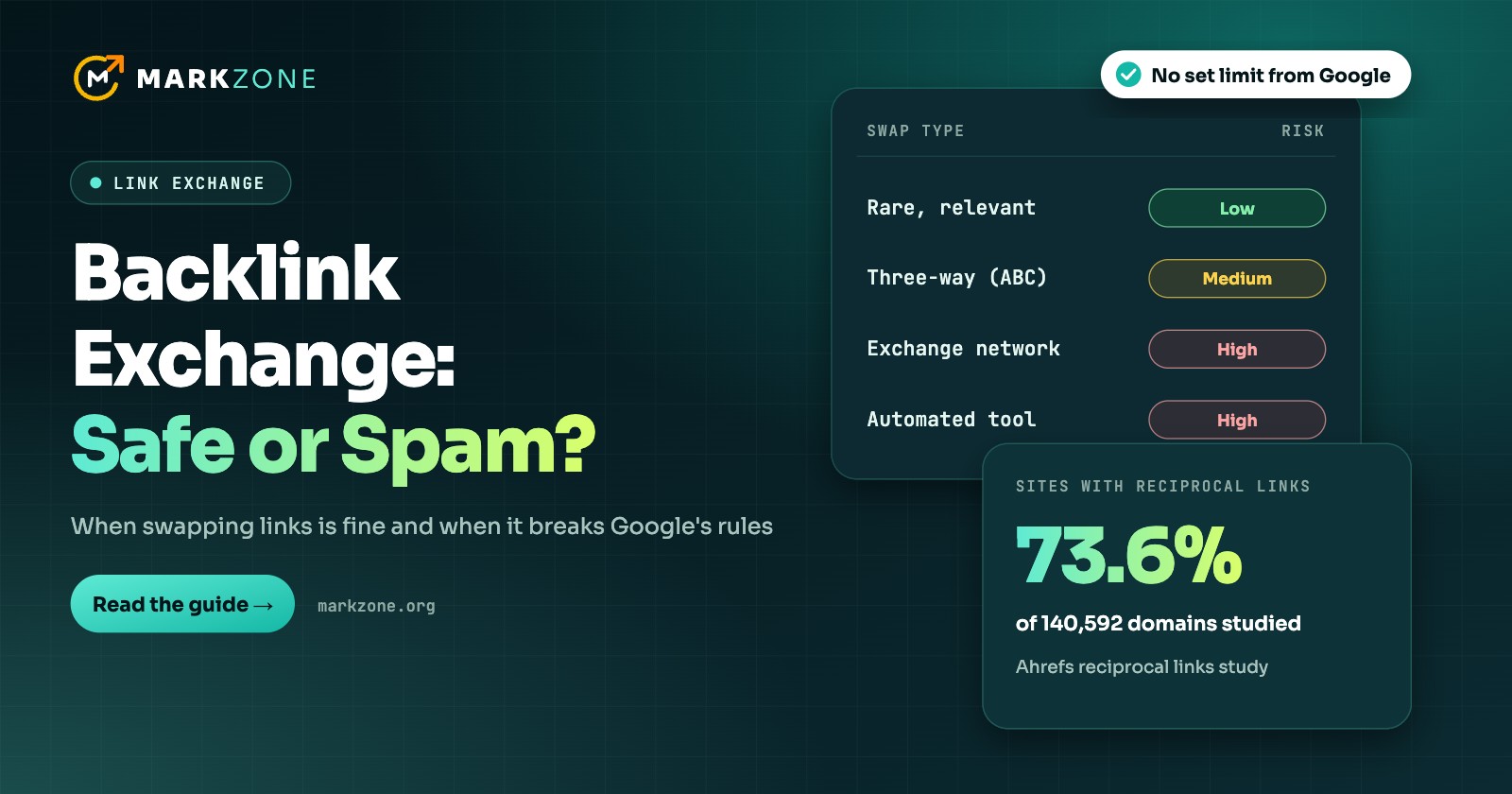
A natural swap is fine. A system is not. Google’s spam policies list “excessive” link exchanges as link spam, and Google’s John Mueller has called a link-for-link deal “essentially against our webmaster guidelines.”
The usual result is wasted work. Mueller says Google’s algorithms “try to ignore those links.” A manual action is possible when swaps make up most of a site’s links.
Price both sides first. In our catalog, a guest post on a site with 1,000 to 4,999 monthly search visits typically costs $130, against $60 for one with 1 to 999. Swap with a smaller site and you give more than you get.
A backlink exchange, or link swap, is a deal in which two or more sites agree to link to each other. Google’s spam policies list “Excessive link exchanges (“Link to me and I’ll link to you”)” as link spam. So the problem is scale and purpose, not every link between sites that know each other. A rare link to a relevant partner, placed because it helps your readers, is fine. A standing arrangement to trade links for rankings, by hand or through software, is what Google tries to ignore and can act on.
Markzone sells guest posts and link insertions, so we gain when readers buy links instead of swapping them. Where this guide gives our view rather than Google’s, it says so.
What is a backlink exchange?
Each side gives a link to get one: a cycling blog links to a bike shop’s repair guide, and the shop links back. Three-way deals and software networks are variations, covered in the types table below.
Many reciprocal links involve no deal. Ahrefs checked 140,592 domains with an estimated 10,000 or more monthly visits from Google, counting followed links only. Of those, 73.6% had some reciprocal links, and 27.4% had an overlap of 15% or more. Overlap here means the share of the domains a site links to that also link back. Ahrefs’ own blog scored 19.25%. The study (updated March 2020) shows that two-way links are normal, not that arranged swaps are safe.
What Google has said about link exchanges, 2007 to 2026
Google’s wording has hardly changed in nearly two decades. Its enforcement has.
| Date | Source | What it said |
|---|---|---|
| November 2007 | Google’s “Link schemes” help page, earliest archived copy (9 November 2007) | Listed “Excessive reciprocal links or excessive link exchanging (“Link to me and I’ll link to you.”)” |
| 16 October 2012 | The same page, revised | Dropped “reciprocal links,” listed “Excessive link exchanging” and added “Using automated programs or services to create links to your site” |
| 22 January 2020 | John Mueller on Twitter, reported by Search Engine Roundtable | “Reciprocal links aren’t necessarily bad.” Of the link schemes around them: “They’re pretty obvious to our systems.” |
| July 2021 | Mueller in a Search Central hangout, transcribed by Search Engine Roundtable (12 July 2021) | A link-for-link deal is “essentially against our webmaster guidelines,” and algorithms “try to ignore those links.” Asked about topical relevance: “It doesn’t matter.” If such links are “the majority of the links” to a site, the webspam team “might apply manual action” |
| 28 January 2022 | Mueller in SEO office hours, reported by Search Engine Journal (31 January 2022) | On linking back to sites that link to you for your visitors’ sake: “That’s perfectly fine. It’s also kind of natural.” |
| 14 December 2022 | Google’s December 2022 link spam update | Google put its SpamBrain system to work “to neutralize the impact of unnatural links on search results” |
| Today (last updated 28 August 2026) | Google’s spam policies, part of Search Essentials since 13 October 2022 | “Excessive link exchanges (“Link to me and I’ll link to you”) or partner pages exclusively for the sake of cross-linking” and “Using automated programs or services to create links to your site” |
What follows for a swap:
- “Excessive” has never had a number. Limits such as keeping swaps under 10% of your links are rules of thumb, not Google’s.
- Relevance doesn’t rescue a system. Mueller drew the line between deals and natural links, not between relevant and irrelevant ones.
- The link you give carries risk too. For the “Unnatural links from your site” manual action, Google tells owners to remove or nofollow links that break its policy, “such as excessive link exchanges.”
Types of link exchanges
| Type | How it works | Risk |
|---|---|---|
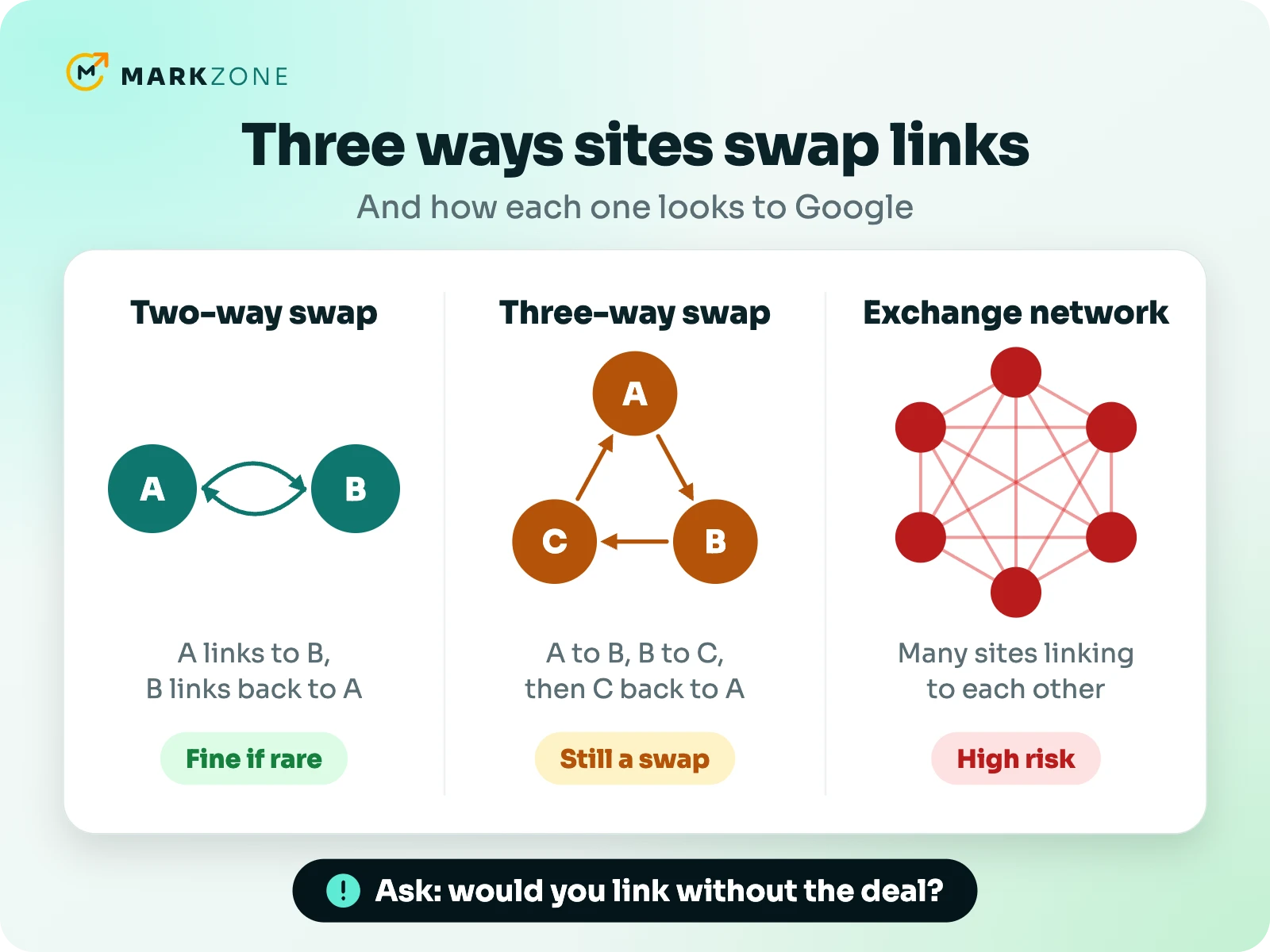
| Two-way swap | A links to B, and B links back | Low if rare and editorial; high if it’s how you get most links |
| Three- or four-way swap | A to B, B to C, C back to A, often via sites one person owns | Still an exchange, with the pattern hidden |
| Guest post swap | Each site publishes the other’s article, with a link | Lower if both posts are worth reading |
| Partner or links page | A page listing sites that list you back | Named in Google’s policy |
| Exchange network or tool | Software places links between members’ sites | Highest: close to Google’s “automated programs” example |
What a swap is worth: price both sides
A swap is a trade, so value what you give as well as what you get. Our guest post price study gives a yardstick: what the 18,977 priced sites in our catalog charged for one guest post on 13 November 2026, by monthly search traffic in Ahrefs. These buyer prices include our outreach, checks and 8-month guarantee; buying direct can cost less.
| Monthly search traffic | Priced sites | Typical price |
|---|---|---|
| None | 7,133 | $25 |
| 1 to 999 | 7,257 | $60 |
| 1,000 to 4,999 | 2,377 | $130 |
| 5,000 to 9,999 | 798 | $200 |
| 10,000 to 49,999 | 1,016 | $200 |
| 50,000 to 99,999 | 199 | $325 |
| 100,000 to 999,999 | 172 | $590 |
| 1 million or more | 25 | $1,000 |
A worked example with these medians. Your blog gets about 3,000 monthly search visits and the partner’s about 400. A post on a site like yours typically sells for $130 and one on the partner’s for $60, so a one-for-one swap trades about $130 of link value for $60. If the partner has no search traffic, it’s $130 for $25. Swapping insertions instead doesn’t close the gap: an insertion typically costs 20% less than a new post on the same site, so both sides shrink alike. Count your time too: at an example rate of $50 an hour, a $60 link is worth 1.2 hours of outreach and vetting.
Paying doesn’t make a link safe either. Google’s spam policies call buying and selling links “a normal part of the economy of the web” for advertising and sponsorship, but only “as long as they are qualified” with rel="nofollow" or rel="sponsored". Links in our catalog are dofollow by default unless the publisher marks them otherwise, and you can ask for a sponsored label on any order. Is buying backlinks safe sets out the details.
Our rules of thumb for an offer:
| If… | Then | Why |
|---|---|---|
| You’d link to the page without the deal | Link, without making theirs a condition | Mueller (2022): natural linking back is “perfectly fine” |
| You mainly want the partner’s visitors | Swap with rel="nofollow" on both links | Google’s 2019 definition: nofollow means no endorsement, “including passing along ranking credit” |
| The partner sits in a lower traffic band than you | Skip, or swap only with nofollow | You give more than you get, and 7,133 of the 18,977 priced sites in our catalog (38%) show no Ahrefs traffic |
| The offer comes from a network, tool or “link exchange sites” list | Skip | Google names “automated programs or services” |
| Swaps would become a large share of your referring domains | Stop | Mueller: manual action is possible if they’re “the majority” |
To compare an offer with a one-way placement, filter our catalog by niche, DR and traffic, or send us your site and niche for a shortlist.
How to do a link exchange safely
- Start with people you already work with. Suppliers, stockists, clients and trade groups make the best partners, because their links have a reason to exist. Offer your link without asking for one back: “Readers often ask us where to get their bikes serviced, so we’ve linked to your repair guide. If our maintenance checklist would help your readers, feel free to link to it.”
- Check traffic, not just DR. Look at the partner’s topic, what else it links to and whether it gets search traffic. In our catalog, 722 of the 3,856 sites with a DR of 50 or more show no Ahrefs traffic. The checklist in what makes a good backlink covers the rest.
- Put the link where it helps. Use the body of a relevant article, with your brand name, the article title or a plain description as anchor. Demanding an exact-match keyword anchor on every swap builds a pattern.
- Measure your overlap. Export the domains that link to you (Search Console’s Links report shows up to 1,000 top linking sites) and, with a site crawler, the outside domains you link to. Divide the domains on both lists by the domains you link to, as Ahrefs did. At 15% or more you’d be among the 27.4% of Ahrefs’ sample with the most overlap, as a rough guide. On its own that’s fine; what matters is how many exist only because of a deal.
- One partner, one link, in the content. No repeat swaps, and no footer, sidebar or blogroll links. “Widely distributed links in the footers or templates of various sites” is another of Google’s link spam examples.
- Keep a record. Note the partner, both URLs, the anchor and the date, and recheck both links every few months. If the partner turns spammy, remove or nofollow your link.
Automated backlink exchange tools compared
Here are four AI writing platforms that run exchange networks, as their own pages described them on 16 November 2026:
| Tool | How links get placed | Pace and limits it states | Entry and exit |
|---|---|---|---|
| RankYak | “on full autopilot”; links “go live automatically” | “the same site links to you at most once a month” | An “automated risk check” screens sites; one switch turns it off |
| SEO Rocket | Exchanges links “automatically,” “managed through a credit system” | 1 to 3 partner links per article on your site, default 2 | You set a minimum Domain Rating and can exclude niches; placed links stay if you opt out |
| RightBlogger | The AI suggests a partner link as you write; “you decide whether to use it” | “a sensible monthly limit”; most sites “wait a month or more” for a first link | Domain Rank 15 or higher and a domain verified in Search Console |
| Outrank | Its AI places your link in articles it writes for other customers; hosting their links earns credits | Credits “refresh daily”; paid backlink plans “add extra credits every month” | Matching by topic; no other rule stated |
These rules cut obvious footprints, and RightBlogger, which leaves each placement to you, is the least automated. None changes why the links exist: each site links to the others because it joined a network. That sits close to Google’s “automated programs or services” example, and Mueller’s 2021 answer suggests topic matching doesn’t change the verdict. In our reading, where a plan sells extra credits, money is buying links, so the paid-link rule applies too. Our view: don’t connect a site you depend on to an automated exchange.
Red flags in a link exchange offer
- The partner links to everything. A pet blog whose recent posts link to loans, software and casinos.
- “Links from our network.” Several sites offered at once, often with one owner.
- No traffic, or not indexed. The page meant for your link gets no search visitors or doesn’t show in a site: search.
- A new “partners” page built only to hold swapped links.
- A fee on top. Money plus a swap is a paid link.
A partner who marks your link nofollow or sponsored is not a red flag. That label is what Google’s rules allow.
Frequently asked questions
Do reciprocal links cancel each other out?
No. Asked in January 2022 whether linking back to sites that link to him would cost his inbound links value, Mueller said “That’s perfectly fine” and called it “a natural kind of link.” The risk sits in arranged swaps at scale.
Should I disavow links from old swaps?
Usually not. Google’s disavow help says “In most cases, Google can assess which links to trust without additional guidance.” It keeps the tool for spammy links that “have caused a manual action, or likely will cause a manual action.” Clean up your own side instead: remove or nofollow outbound links that exist only because of a deal. How to disavow backlinks covers the rest.
How many link exchanges are too many?
Google gives no number. Two working tests: each swap should make sense without the deal, and swapped links should stay a small minority of your referring domains, far from the “majority” Mueller described.
Sources
- Google Search Central: Spam policies for Google web search (last updated 28 August 2026)
- Google Search Console Help: Manual Actions report (checked 16 November 2026)
- Google Search Console Help: Disavow links to your site (checked 16 November 2026)
- Google Search Console Help: Links report (checked 16 November 2026)
- Google “Link schemes” help page, Wayback Machine capture (captured 9 November 2007)
- Google “Link schemes” help page, Wayback Machine capture (captured 1 November 2012; page footer “updated 10/16/2012”)
- Search Engine Roundtable: Google: Reciprocal Links Aren’t Necessarily Bad But… (23 January 2020)
- Search Engine Roundtable: Google: Really, Link Exchanges Are Against Our Guidelines (12 July 2021)
- Search Engine Journal: Google Affirms Reciprocal Linking Is Natural In Many Cases (31 January 2022)
- Google Search Central Blog: Refreshed guidelines for site owners (13 October 2022)
- Google Search Central Blog: December 2022 link spam update (14 December 2022)
- Google Search Central Blog: Evolving “nofollow”: new ways to identify the nature of links (10 September 2019)
- Ahrefs: Reciprocal Links: Will They Hurt Your SEO? (A Study by Ahrefs) (updated 11 March 2020)
- RankYak: Backlink exchange (checked 16 November 2026)
- SEO Rocket Help: Backlink Exchange (checked 16 November 2026)
- RightBlogger: Backlink Exchange (checked 16 November 2026)
- Outrank: Backlink building (checked 16 November 2026)
- Markzone guest post price study (catalog snapshot of 13 November 2026)
Want links you don’t have to trade for?
Tell us your site and niche, and we’ll suggest publisher sites with real traffic.

Muhammad Suleman is the founder of Markzone. He has done guest posting and link building since 2018 and has worked with hundreds of clients. Today his team handles 300–400 orders a month for brands and SEO agencies, with publisher sites in every major niche. He leads outreach, site checks and reporting, and writes about link building from his daily work with publishers and clients.