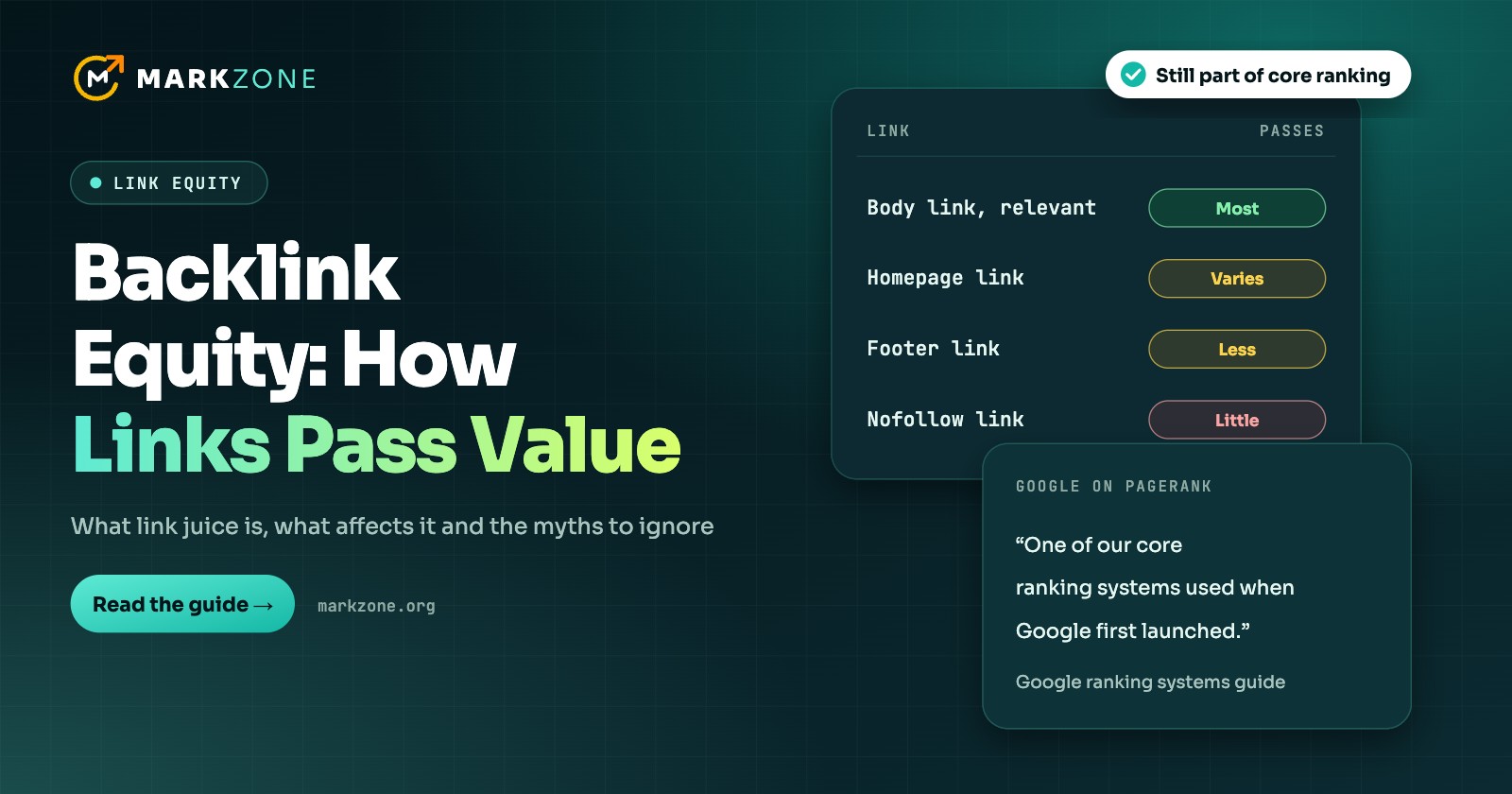
A link passes a share of its page’s value. In Google’s original PageRank formula, each page splits its score across every link it carries, so a well-linked page with few links passes the most.
Several things cut it. A crowded page, a footer or sidebar spot, a page Google hasn’t indexed, a nofollow or sponsored attribute, or a link Google treats as spam.
Domain scores are estimates, not equity. In our catalog, 19% of the sites rated DR 50+ (722 of 3,856) show no Ahrefs traffic, and the 74 at DR 90+ typically cost $30. Judge the page your link will sit on.
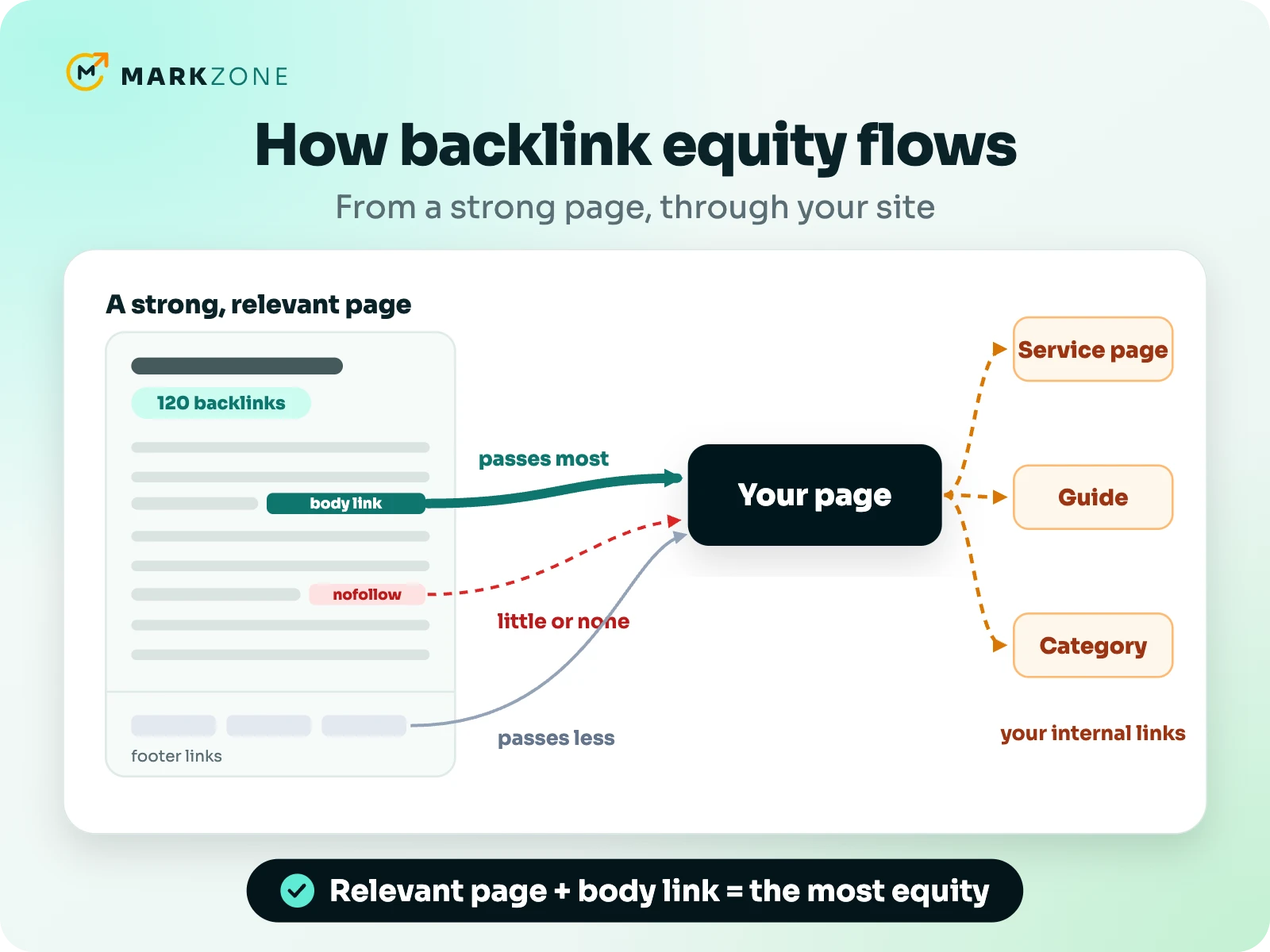
Backlink equity, also called link equity or link juice, is the value a link passes from one page to another. It comes from PageRank, the link-based system Google launched with and still uses. Each page hands on part of its score through its links. So a link from a page that many good pages link to is worth more than one from a page nobody links to. What reaches you also depends on how many links share the page, where yours sits, and whether Google indexes the page and counts the link. Nofollow and sponsored links, and links Google treats as spam, usually pass nothing. Once equity reaches your site, your internal links decide where it goes.
We sell link placements, so how buyers value links affects our business. Google’s statements are quoted with dates, and our figures come from the guest post price study we ran on our catalog on 13 November 2026.
- Where link equity comes from: PageRank
- What raises or cuts the equity a link passes
- Domain scores vs the page your link sits on: what our catalog shows
- Guest post or existing article: where the equity is
- Link juice myths that still circulate
- How equity moves through your own site
- Can you measure backlink equity?
- Frequently asked questions
- Sources
Where link equity comes from: PageRank
Google’s guide to its ranking systems describes PageRank as “one of our core ranking systems used when Google first launched,” and says: “How PageRank works has evolved a lot since then, and it continues to be part of our core ranking systems.”
The formula is in the 1998 paper where Sergey Brin and Lawrence Page first described Google, The Anatomy of a Large-Scale Hypertextual Web Search Engine:
PR(A) = (1 – d) + d × (PR(T1)/C(T1) + … + PR(Tn)/C(Tn))
T1 to Tn are the pages linking to page A, C is “the number of links going out of” each one, and d is a damping factor: “We usually set d to 0.85.” So each linking page divides its score by its number of links, and 85% of each share passes on. In the paper’s words, “a page can have a high PageRank if there are many pages that point to it.” The same holds “if there are some pages that point to it and have a high PageRank.”
Worked example: strength vs crowding
With made-up scores (Google’s real ones aren’t public), the original formula gives:
| Linking page | Its score | Links on the page | Passed through each link (0.85 × score ÷ links) |
|---|---|---|---|
| Strong page, few links | 10 | 5 | 1.7 |
| Strong page, crowded | 10 | 50 | 0.17 |
| Weaker page, few links | 2 | 5 | 0.34 |
| Weaker page, crowded | 2 | 50 | 0.034 |
Google’s systems are far more complex now, but two lessons hold. Strength counts: with the same number of links, the strong page passes five times as much as the weaker one. Crowding counts as much: the weaker page with five links passes twice as much per link as the strong page with fifty. And the original model counts every link on the page in C, menus and footers included.
Not every link on a page is equal
The 1998 formula splits a page’s score evenly. Google’s “reasonable surfer” patent, US 7,716,225 (filed June 2004, granted May 2010), assumes instead that “not all of the links associated with a document are equally likely to be followed.” It describes a link weight that “may reflect the probability that the link will be selected.” The weight is judged from features such as position, for example “in a footer, in a sidebar, etc.” A patent isn’t proof of what Google runs today, and Google Patents lists this one as expired since March 2025. But it is why body links are widely expected to pass more than footer links; our guide to contextual link building covers what Google has said about placement.
What raises or cuts the equity a link passes
| Factor | Passes more | Passes less or nothing | Source |
|---|---|---|---|
| The linking page’s own backlinks | A page other sites link to | A new or orphaned page | The 1998 formula |
| Links sharing the page | A handful | Dozens, menus and footers included | The 1998 formula |
| Placement | In the body, where readers click | Footer, sidebar, author box | Reasonable surfer patent (not proof) |
| Fit with the page | A link that belongs in the article | A link unrelated to the article | Same patent: unrelated links are rarely followed |
| Indexing | A page Google has indexed | A page it hasn’t | John Mueller of Google, January 2022 |
| Attribute | A followed link | nofollow, sponsored or ugc | Google, September 2019 |
| Trust | A link Google counts | A link Google judges unnatural | Google, December 2022 |
Mueller wrote in January 2022 that he wouldn’t assume links on unindexed pages “do anything.” Google has read nofollow, sponsored and ugc as hints since September 2019, mostly keeping such links out of ranking; do nofollow links help SEO covers when they still pay off. And its December 2022 link spam update said its algorithms and manual actions “aim to nullify these unnatural links at scale.”
Domain scores vs the page your link sits on: what our catalog shows
PageRank works page by page, but most buyers shop by a site-wide score such as Ahrefs’ Domain Rating (DR). Our catalog shows how far the two drift apart:
- A rating can come from somewhere else. The 74 priced sites at DR 90 to 100 typically charge $30. Several are hosted on shared domains like it.com or us.com and appear to inherit the parent domain’s rating, which says little about the page your link would sit on.
- A high rating doesn’t mean Google sends visitors. Of the 3,856 catalog sites at DR 50 and above, 722 (19%) have no Ahrefs traffic.
- Prices follow traffic, not ratings. Price and Ahrefs traffic have a rank correlation of 0.42; price and DR only 0.21.
Traffic isn’t part of PageRank, but it is a cheap sign that Google indexes and ranks some of a site’s pages. For the page itself, check what no site-wide score shows: whether the URL is indexed, who links to it, and how many links it already carries.
Guest post or existing article: where the equity is
A new guest post starts with no backlinks of its own. Its equity comes through the host site’s internal links, mostly from the blog’s front page and category pages, and those thin out as newer posts push it down. An older article may also have links from other sites, which no new post can offer. That is the case for a niche edit on a page that has earned links.
The existing page is usually the cheaper option too: on sites that price both, an edit typically costs about 20% less than a new post (guest posts vs link insertions has the numbers).
Worked example. The two offers are made up; the prices are catalog medians, or estimated from them as shown.
| Offer A | Offer B | |
|---|---|---|
| Format | New guest post | Link added to an existing article |
| Site | DR 70 to 79, under 1,000 monthly visits | DR 40 to 49, 1,000+ monthly visits |
| Typical price | $100 | About $156: the typical post there costs $195, and an edit typically costs 20% less |
By DR, offer A looks stronger and cheaper. By the formula’s logic, B can be the better buy if its article is indexed and has backlinks of its own. Your link then joins a page that already holds equity, on a site Google sends visitors to. If the article has no links, B’s advantage is the site’s traffic, not the page. Look up the exact URL in a backlink tool before you pay.
Paid links and equity. Google’s rule for a paid link is a rel="sponsored" or rel="nofollow" attribute. Its spam policies describe the buying and selling of links as “a normal part of the economy of the web,” then add the condition: “as long as they are qualified.” A qualified link is generally kept out of ranking, so a paid link that follows the rule buys readers and visibility rather than equity. Our catalog’s links are followed by default unless the publisher marks them otherwise, and any order can carry a sponsored label if you ask. Two in three of our publishers don’t say how they label. Of 22,073 sites, 240 say they add a sponsored label to guest posts, 7,190 say they don’t, and 14,643 leave it unstated.
Link juice myths that still circulate
- “Nofollowing your own links saves equity.” This was called PageRank sculpting. In June 2009, Google’s Matt Cutts explained the change with a page of ten PageRank points and ten links, five nofollowed. Originally, “the five links without nofollow would have flowed two points of PageRank each”. After a change made more than a year earlier, they “would flow one point of PageRank each.” Nofollowed links still count in the split, and their share no longer goes to the others.
- “Linking out leaks your rankings.” Google’s link best practices say: “Linking to other sites isn’t something to be scared of.”
- “Redirects bleed equity.” In July 2016, Google’s Gary Illyes put it in one line: “30x redirects don’t lose PageRank anymore.”
- “DR is link equity.” DR is Ahrefs’ rating of a whole site, built from its own crawl; the catalog figures above show how far that can drift from a page’s equity.
- “A homepage link is always strongest.” A homepage often has the most backlinks, but it links to many pages, so its value is split many ways. A well-linked article with few links can pass more to one page.
How equity moves through your own site
Backlinks usually land on a few pages, often your homepage and popular guides; internal links pass the equity on.
- Find where it enters. Search Console’s Links report lists your top linked pages, and Ahrefs’ Best by links report ranks your pages by backlinks.
- Link from those pages toward the pages you most want to rank, in sentences where the link helps a reader. Google’s link guide asks that every page you care about get at least one link from another page on your site.
- Keep key pages close to strong ones. In the original formula, each extra hop splits the value again and passes on only 85% of it.
- Don’t nofollow internal links. Cutts’s advice in the same 2009 post: “In general, I would let PageRank flow freely within your site.”
Can you measure backlink equity?
Not directly. Google stopped publishing PageRank in 2016; the Toolbar PageRank feed was fully off by 15 April. What remains are estimates from each tool’s own crawl, checked on the tools’ own pages on 20 November 2026:
| Metric | Made by | Rates | Built from |
|---|---|---|---|
| URL Rating (UR) | Ahrefs | A page | “the same basic PageRank principles,” with a damping factor. Counts internal and external links and respects nofollow |
| Domain Rating (DR) | Ahrefs | A site | Linking sites, each sharing its rating equally among the sites it links to |
| Authority Score | Semrush | A site or a page | Link power, estimated organic traffic and spam factors |
None of these tools knows which links Google ignores, so use them to compare options, then check the page itself.
Frequently asked questions
Is link juice still a thing?
As an idea, yes. Google still lists PageRank among its core ranking systems, and “link juice” is slang for what PageRank passes. What has changed is how much Google discounts: unindexed pages, qualified links and links its systems judge unnatural.
Does a link from a site with no search traffic pass equity?
It can, because traffic isn’t in the formula. But a site without search visitors may have pages Google hasn’t indexed, and links on those probably don’t count. In our catalog that’s 7,133 sites, 38% of the 18,977 with a price, so check that the page itself is in Google before you pay.
Does a link on a noindexed page pass equity?
Not for long. Mueller said in December 2017 that a page kept on noindex eventually leaves the index: “we will remove it completely. And then we won’t follow the links anyway.” Search the page’s source for “noindex”, and check the X-Robots-Tag response header, before you buy a link on it.
Sources
- Google Search Central: A guide to Google Search ranking systems (checked 20 November 2026)
- Brin and Page: The Anatomy of a Large-Scale Hypertextual Web Search Engine (1998; the formula, “We usually set d to 0.85” and the “high PageRank” sentence checked in the paper’s full text on 20 November 2026)
- Google Patents: US7716225B1, Ranking documents based on user behavior and/or feature data (filed 17 June 2004, granted 11 May 2010; listed as “Expired – Lifetime”, adjusted expiration 16 March 2025)
- Search Engine Roundtable: Google: Links Have To Be On Indexed Pages To Be Counted (11 January 2022; Mueller’s tweets of 10 January 2022)
- Google Search Central Blog: Evolving “nofollow” (10 September 2019)
- Google Search Central Blog: December 2022 link spam update (14 December 2022)
- Google Search Central: Spam policies for Google web search (checked 20 November 2026)
- Matt Cutts: PageRank sculpting (15 June 2009)
- Google Search Central: Link best practices (checked 20 November 2026)
- Search Engine Roundtable: Google: Any 3xx Redirect Does Not Lose PageRank At All (27 July 2016; Illyes’s tweet of 26 July 2016)
- Search Engine Roundtable: Google Fully Turns Off Feed To Toolbar PageRank (18 April 2016)
- Search Engine Roundtable: Google: Long Term Noindex Will Lead To Nofollow On Links (28 December 2017)
- Google Search Console Help: Links report (checked 20 November 2026)
- Ahrefs Academy: Best by links (checked 20 November 2026)
- Ahrefs Help: What is URL Rating (UR)? (checked 20 November 2026)
- Ahrefs Help: What is Domain Rating (DR)? (dated 3 September 2026; checked 20 November 2026)
- Semrush Knowledge Base: Authority Score (checked 20 November 2026)
- Markzone: Guest post price study (catalog snapshot of 13 November 2026: DR 90+ median and shared domains, DR 50+ sites without traffic, sites without traffic, rank correlations, DR-by-traffic medians, niche edit vs post prices, link type and sponsored-label counts)
Want links from pages with equity to pass?
Tell us your target pages. We’ll suggest placements on relevant pages with real traffic and backlinks.

Muhammad Suleman is the founder of Markzone. He has done guest posting and link building since 2018 and has worked with hundreds of clients. Today his team handles 300–400 orders a month for brands and SEO agencies, with publisher sites in every major niche. He leads outreach, site checks and reporting, and writes about link building from his daily work with publishers and clients.