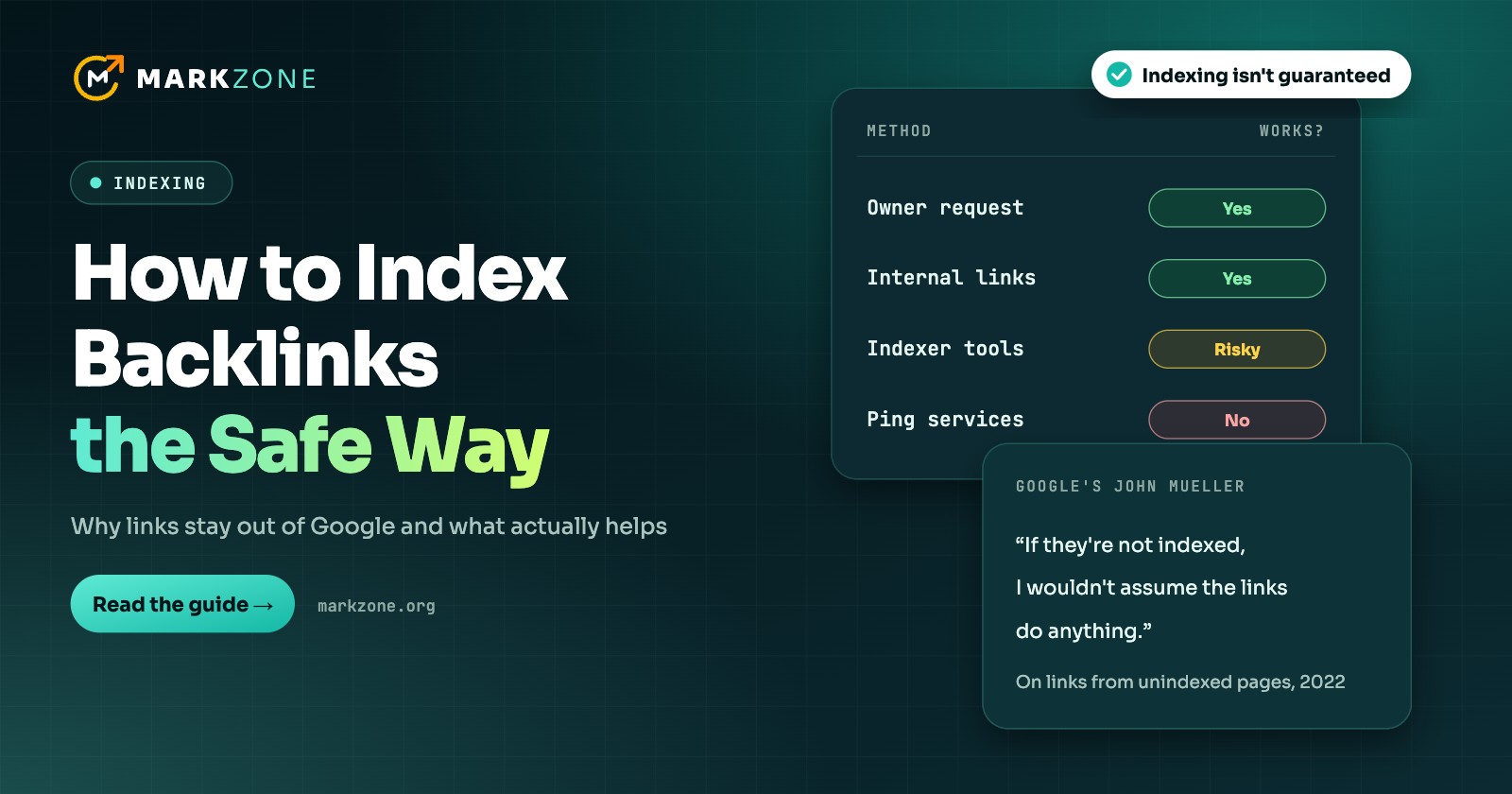
Google indexes pages, not links. A link on an unindexed page probably does nothing, and only that site’s owner can ask Google to index it.
Vet the site first. No Ahrefs search traffic shows for 7,133 of the 18,977 priced sites in our catalog (38%), or for 722 of the 3,856 at DR 50+. Search Google for three of a site’s recent posts before you order.
Wait by link type, then chase. A new page is usually found within about 20 hours, but a known page is usually re-read only after about 30 days. Chase a guest post after a week and an inserted link after about six weeks.
To index a backlink, Google has to crawl and index the page that links to you. You can’t ask Google to do that for another site’s page: its documentation says “You can’t request indexing for URLs that you don’t manage.” So the route runs through the publisher. Choose sites whose recent posts are in Google, and check the page on the day it goes live. Then ask the owner to link to it from their own pages, keep it in the sitemap and request indexing in Search Console. Pinging tools and paid indexers are a poor bet: Google announced the end of sitemap pings in 2023, and its Indexing API is limited to job posting and livestream pages.
Placing guest posts and link insertions is our business, so a placement Google never indexes is our problem as well as yours. Google’s statements below are dated and linked, and our figures come from our catalog study of 13 November 2026.
Why the linking page has to be indexed
Google discovers URLs in two main ways: through links on pages it has already crawled, and through sitemaps. Its own example of discovery is “a hub page, such as a category page, links to a new blog post.” But finding a page doesn’t mean keeping it. Google’s guide to how Search works says: “Indexing isn’t guaranteed; not every page that Google processes will be indexed.”
Asked in January 2022 about links on pages Google hadn’t indexed, John Mueller of Google replied: “If they’re not indexed, I wouldn’t assume the links do anything.” He added that links on indexed pages can be ignored too. Indexing gets your link in the door; it doesn’t promise that the link counts.
How to check whether the page is indexed
- Search for the exact URL. Type site: and the full address, such as site:https://example.com/blog/post-name/, with or without www exactly as the site uses it, since Google says the two return different results. A hit means the page is indexed. A miss isn’t final, because Google says a match is “not guaranteed.”
- Search for a sentence in quotes. Pick one unique to that page. This finds the page even if Google indexed it under a different URL.
- Ask the owner for a URL Inspection result. It shows whether the URL is on Google, why not if it isn’t, and the “Last crawl” date. For a link added to an old article, that date is the key: Google’s copy includes your link only if the last crawl came after the link went live.
- Look in your own Links report. Google calls it a sample that can leave out “non-indexed pages,” so a missing link proves little.
Bulk “index checkers” don’t have a better source. In January 2022, Mueller said “there’s no API for testing if a page is indexed, so SEO tools can’t do that without breaking our TOS.” Google’s URL Inspection API, launched on 31 January 2022, only covers sites you manage in Search Console, so it can’t check a publisher’s page. Check a sample by hand instead. Backlink tools such as Ahrefs show their own crawler’s view, not Google’s, as we explain in backlinks not showing in Ahrefs.
What the owner’s URL Inspection result means
These are the URL Inspection results that matter for a backlink:
| What the owner sees | What it means | What to ask for |
|---|---|---|
| URL is on Google, last crawl after your link went live | Google’s copy includes your link | Nothing. Give the link time to count |
| URL is on Google, last crawl before your link went live | Google hasn’t been back since your link was added | An updated sitemap date and a Request indexing |
| Discovered – currently not indexed | Google knows the URL but hasn’t crawled it yet, and “rescheduled the crawl” | Links to the page from the homepage or a category page |
| Crawled – currently not indexed | Google read the page and left it out | A stronger page, more internal links, or a different page |
| URL marked ‘noindex’ | The page tells Google not to index it | Removal of the noindex |
| URL blocked by robots.txt | Google can’t read the page or your link | A change to robots.txt |
| Duplicate, Google chose different canonical than user | Google indexed another URL instead | A fixed canonical, or a different page |
When to chase: a timeline by link type
Publishing is rarely the slow part: 16,127 sites in our catalog state a turnaround, and more than 96% of them put it at two days or less. Gary Illyes presented Google’s own timing data at Search Central Live in October 2026. As an attendee’s recap records it, a new URL is typically discovered within about 20 hours, while a known URL is typically refreshed after about 30 days. For both, the slowest cases run to “weeks to never.” Google’s help pages add that after a request, “Indexing typically takes only a day or so, but can take much longer in some cases.” They add that crawling “can take anywhere from a few days to a few weeks.”
Google sets no deadline, so these are our rules of thumb:
| Time since the link went live | Guest post (a new page) | Link insertion (an existing page) |
|---|---|---|
| Day 0 to 1 | Run the day-one checks below | Run the same checks, and confirm the page is already indexed |
| Day 7 | Not indexed? Ask for a link from the homepage or a category page, and a Request indexing | Wait. Google sees your link at its next visit |
| Day 21 | Still not indexed? Ask for the URL Inspection result | Wait |
| Day 45 | Treat it as a page problem: fix it or replace it | Ask for the Last crawl date. If it predates your link, ask for an updated sitemap date and a Request indexing |
Our post on how long backlinks take to work says to ask the publisher after “a few weeks”; that is the day-21 check here. The day-7 nudge comes earlier because a new URL is typically discovered within about 20 hours, so a guest post still missing after a week is already slower than usual.
Worked example (a made-up order, using the figures above). Order a guest post and a link insertion on 1 December. Most catalog sites state a turnaround of two days or less; allow a day more, and both are live by 4 December. If the guest post isn’t in Google by 11 December, message the publisher. For the insertion, Google typically refreshes a known page after about 30 days, so check its Last crawl date in mid-January.
Five ways to get a backlink indexed faster
1. Choose sites whose pages Google indexes
Of the 18,977 priced sites in our catalog, only 4,587 (24%) get 1,000 or more search visits a month in Ahrefs. Another 7,257 sit between 1 and 999, and 7,133 (38%) show none. A high DR doesn’t settle it: 722 of the 3,856 sites at DR 50+ (19%) show no traffic either. No traffic doesn’t prove a site is missing from Google, but that is the group where checking matters most.
Run a site: search on the URLs of three recent posts. Our rule of thumb: if two are missing, choose another site. Sites with search traffic cost more. The typical guest post costs $25 on sites without it, $60 at 1 to 999 monthly visits and $130 at 1,000 to 4,999, according to our guest post price study.
2. Check the page on the day it goes live
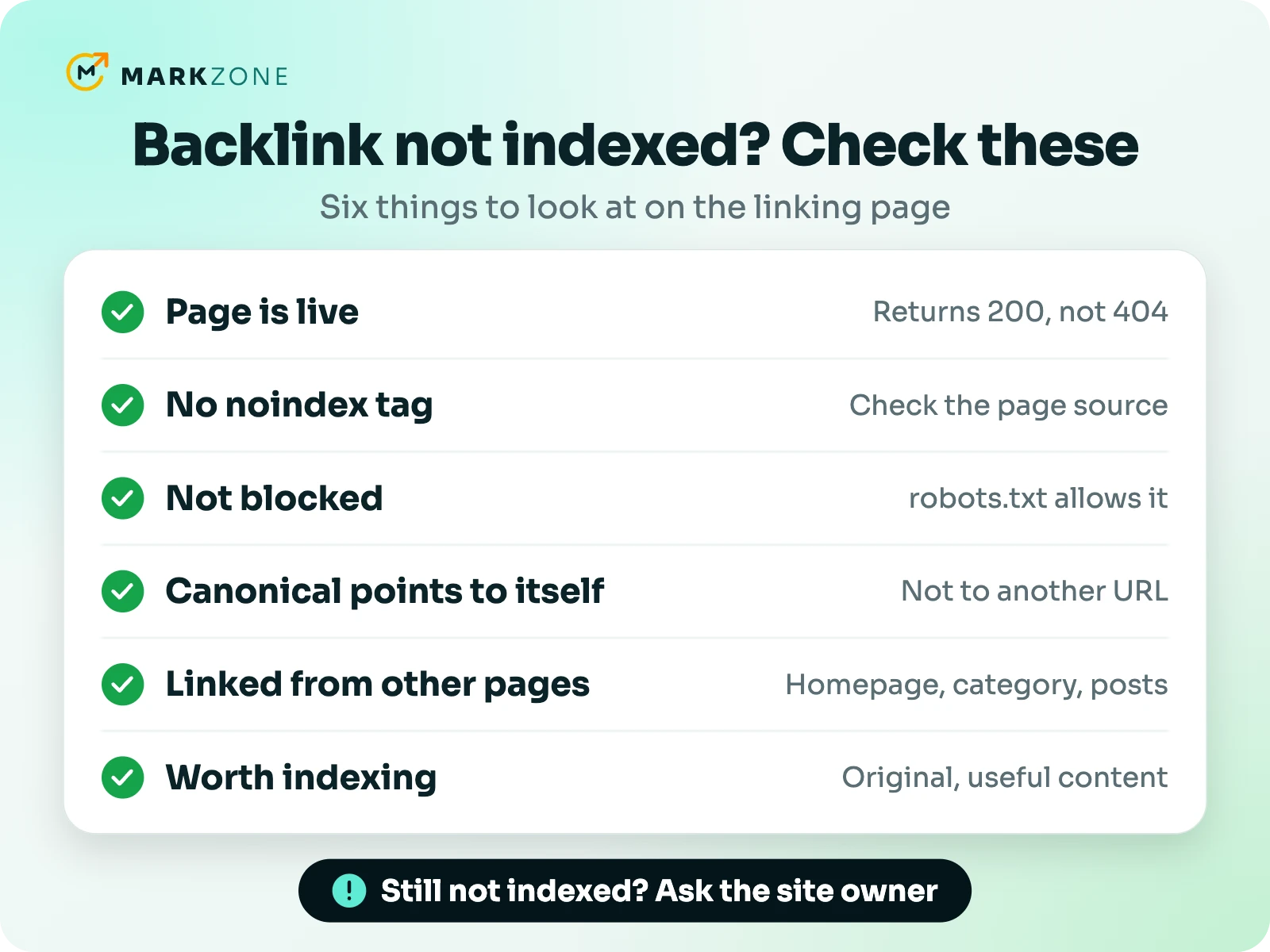
Confirm your link is on the page with the attribute you agreed, search the page source for “noindex” and “canonical”. Then check that the site’s robots.txt file doesn’t block the page. A blocked page can still turn up in a site: search, because Google says it “might still find and index a disallowed URL if it is linked from other places on the web.” It just can’t read the page, so it can’t see your link.
3. Ask for links from the site’s own pages, and send real visitors
A page the site links to itself, on the homepage, in a category or from a busy related post, gets found sooner. When you write a guest post, suggest one or two of the site’s own articles that could link to it. Share the article with your own audience too. Since March 1, 2020, Google has treated nofollow as a hint for crawling and indexing, so even nofollow social links may help it find the page.
4. Keep the sitemap current
New posts usually enter the sitemap automatically. For a link added to an old article, ask the publisher to update that page’s lastmod date. Google said in June 2023 that it uses lastmod “as a signal for scheduling crawls to URLs that we previously discovered,” and that site owners who “updated some links” should update it.
5. Ask the owner to request indexing
Only an owner or full user of the site’s Search Console property can do this, in URL Inspection. There is a daily limit, and one request is enough: Google says “requesting a recrawl multiple times for the same URL won’t get it crawled any faster.”
What doesn’t work: a dated record
| Date | What Google said or did | What it means |
|---|---|---|
| 26 Jun 2023 | Announced the end of the sitemap ping endpoint, saying “the vast majority of the submissions lead to spam” | Ping tools do nothing for Google |
| Sep 2024 | Added to its Indexing API documentation: “All submissions through the Indexing API undergo rigorous spam detection.” | An indexer that pushes ordinary pages through the API uses it outside its documented purpose |
| Sep 2024 | The cached-page view stopped working, months after Google removed cache links | Ask for a URL Inspection result instead of checking the cache |
| Oct 2026 | Illyes put the slowest end-to-end indexing at “months or never (quality)” | Quality, not tools, decides the slow cases |
Cheap links aimed at the page that links to you are no better: low-quality directory and bookmark links, and links made by automated programs, are on the link spam list in Google’s spam policies.
If the page still isn’t indexed
After day 45, the page is the problem, not the timing, so work through the URL Inspection table above. If the owner can’t fix it, ask for your link on an article that is already indexed and gets traffic, or for a replacement under the seller’s terms.
The 8-month link guarantee built into our catalog prices covers removal, as published: we replace a removed link or refund you. Before you order, from us or anyone else, ask what happens if a page stays live but never gets indexed.
Indexing is only the first step; how long backlinks take to work covers what happens to rankings after that.
Frequently asked questions
Should I disavow links on pages Google hasn’t indexed?
No. Mueller’s January 2022 answer came in reply to a question about spammy links on unindexed pages, and he said he “wouldn’t assume the links do anything.” Disavowing is meant for manual actions for unnatural links, not for links Google may never have counted.
Do nofollow or sponsored backlinks get indexed?
Indexing applies to the page, not the link, so the attribute makes no difference to it. Under Google’s spam policies, buying and selling links is “a normal part of the economy of the web” only “as long as they are qualified” with rel="nofollow" or rel="sponsored". Links in our catalog are dofollow by default unless the publisher marks them otherwise, and you can ask for a sponsored label on any order. Do nofollow links help SEO explains how Google handles each attribute.
Can I use Google’s Indexing API to index my backlinks?
No. The API “can only be used to crawl pages with either JobPosting or BroadcastEvent embedded in a VideoObject.” You’d also need to verify ownership of the linking site in Search Console, and abuse “may result in access being revoked.” In May 2026, Mueller said it is “inundated by bloggers trying to act like legitimate sites.”
Sources
- Google Search Central: Ask Google to recrawl your URLs (last updated 10 December 2025)
- Google Search Central: In-depth guide to how Google Search works (checked 16 November 2026)
- Search Engine Roundtable: Google: Links Have To Be On Indexed Pages To Be Counted & Not All Indexed Links Are Counted (11 January 2022; quotes Mueller’s tweets of 10 January 2022)
- Google Search Central: How to use the site: search operator (last updated 10 December 2025)
- Google Search Console Help: URL Inspection tool (checked 16 November 2026)
- Google Search Central Blog: Welcoming the new Search Console URL Inspection API (31 January 2022)
- Google Search Console Help: Page indexing report (checked 16 November 2026)
- Google Search Console Help: Links report (checked 16 November 2026)
- Search Engine Roundtable: Google Cache Is Fully Dead (24 September 2024)
- ROAST: Google Search Central Live Deep Dive, Barcelona – Day 3 Recap (2 October 2026; an attendee’s notes of Gary Illyes’s timing data)
- Google Search Central: Robots.txt introduction and guide (last updated 10 December 2025)
- Google Search Central Blog: Sitemaps ping endpoint is going away (26 June 2023)
- Google Search Central Blog: Evolving “nofollow” – new ways to identify the nature of links (10 September 2019)
- Google Search Central: Indexing API Quickstart (last updated 7 November 2026)
- Search Engine Roundtable: Google Indexing API: Submissions Go Undergo Rigorous Spam Detection (12 September 2024)
- Search Engine Roundtable: Google Indexing API Is Inundated By Bloggers (15 May 2026)
- Google Search Central: Spam policies for Google web search (last updated 28 August 2026)
- Markzone: Guest post price study (catalog snapshot of 13 November 2026: traffic tiers and prices, DR 50+ sites, turnaround, link policy, 8-month guarantee)
- Markzone: Guest posting for SEO (published post; states that a post or link removed within 8 months is replaced or refunded)
Want placements on sites Google actually crawls?
Send us your site and niche. We’ll suggest publishers whose recent posts show up in Google.

Muhammad Suleman is the founder of Markzone. He has done guest posting and link building since 2018 and has worked with hundreds of clients. Today his team handles 300–400 orders a month for brands and SEO agencies, with publisher sites in every major niche. He leads outreach, site checks and reporting, and writes about link building from his daily work with publishers and clients.