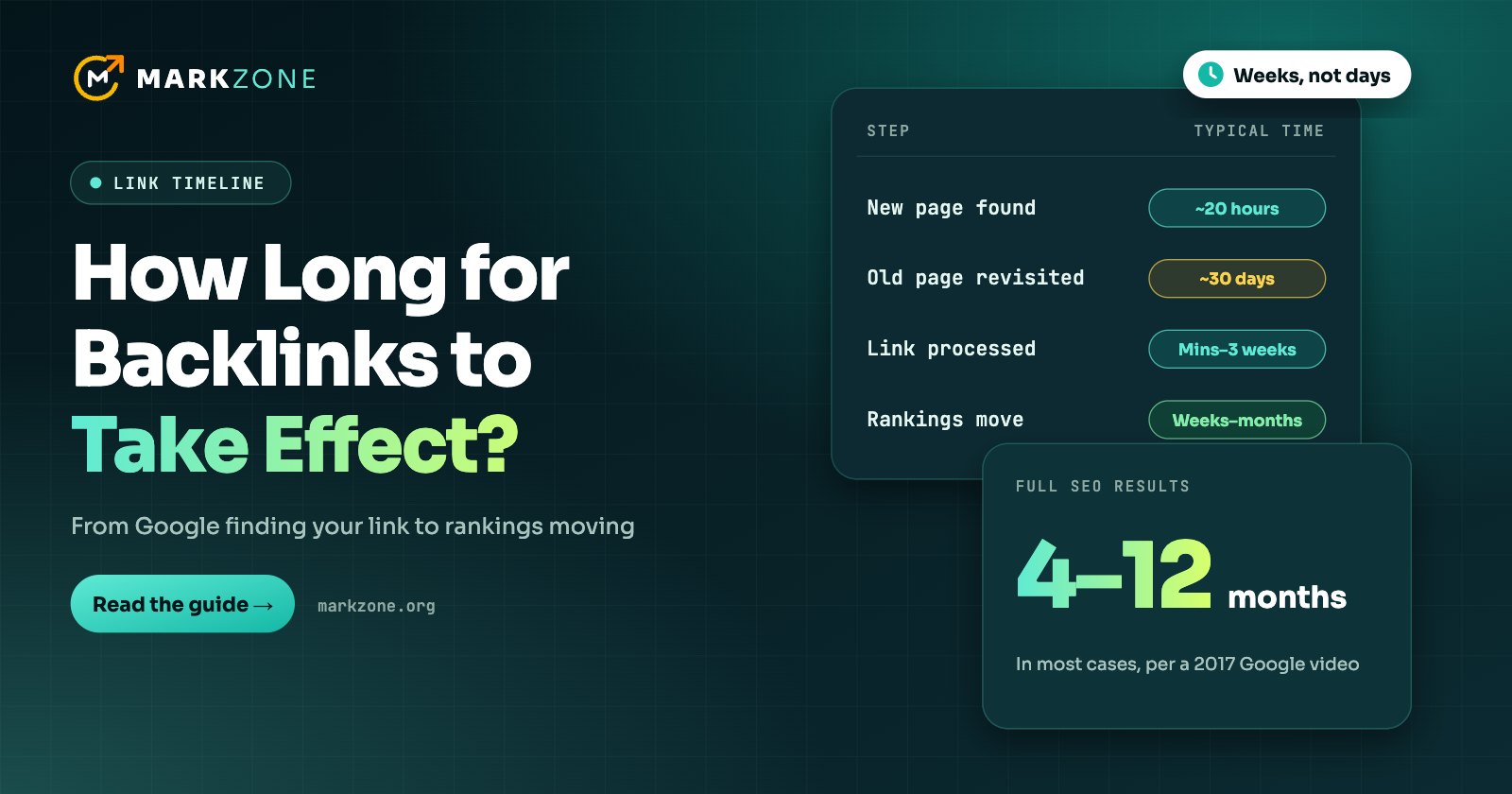
Usually one to three months. Google has to crawl the page your link is on and process the link before it can count, and rankings then move gradually.
The link type changes the first step. Google has to discover a new guest post, while a link added to an old page waits for Google’s next visit to that page.
One link works slowly. In a small test reported on Moz, a link took about 10 weeks on average to lift a page one position.
Backlinks usually take one to three months to take effect, not days. In our experience, the first change in rankings often shows somewhere between 4 and 12 weeks after a link goes live. Before that, Google has to crawl the page your link sits on and process the link. That typically takes from a few hours to a few weeks. Rankings then move gradually as good links add up.
It would suit a link seller like us to promise fast results. Instead, this guide sets out what Google has said about each step, and what we see after our own links go live.
How long backlinks take to work, step by step
A backlink goes through several steps before it can move your rankings. These are typical times, not promises:
| What happens | Typical time | |
|---|---|---|
| 1. The link goes live | The publisher posts your article or adds your link to a page | Depends on the publisher |
| 2. Google crawls the page | Google finds the new page, or comes back to a page it already knows | Hours to weeks |
| 3. Google processes the link | Google records the link and the page it points to | Minutes to 1–3 weeks |
| 4. Rankings start to move | Google weighs the new link with everything else about your page | Often 4 to 12 weeks |
| 5. Full results | The combined effect of your links and other SEO work | Often 4 to 12 months |
The crawl and link times come from Gary Illyes of Google. He shared typical timings at the Search Central Live Deep Dive in Barcelona in October 2026, as recorded in a recap by the agency ROAST. They are an attendee’s notes rather than a Google document. He also pointed out that the steps depend on each other: a page can’t be indexed before it is crawled, so delays add up. Google’s guide to asking Google to recrawl URLs gives a similar range for crawling: “Crawling can take anywhere from a few days to a few weeks.”
Once Google has seen a link, it doesn’t save it for a later update. John Mueller of Google has said that Google processes links continuously, as Search Engine Journal reported. So there is no fixed waiting period before a new link can have an effect. The slow part is what comes next.
The 4 to 12 weeks for rankings is what we see with our clients, and outside tests point the same way. In an older test reported on Moz, Kristina Kledzik of Distilled tracked 76 links to similar pages on her company’s blog. On average, it took around 10 weeks for a page to move up one position, as Smart Insights summarized. Results from one blog won’t hold for every site, so treat that as a rough guide. For SEO as a whole, Maile Ohye of Google gave a longer timeline in a 2017 video on hiring an SEO. In most cases, she said, it takes four months to a year to put improvements in place and then see potential benefits, as Search Engine Roundtable reported.
New guest posts vs. links added to old pages
Here the kind of link you buy makes a difference. A guest post is a brand-new page, so Google has to discover it first. Google’s guide to how Search works says it discovers new pages through links from pages it already knows and through sitemaps. Illyes put typical discovery of a new URL at about 20 hours.
A link insertion goes into a page Google already knows, so your link is usually seen the next time Google comes back to that page. Illyes put the typical revisit of a known URL at about 30 days.
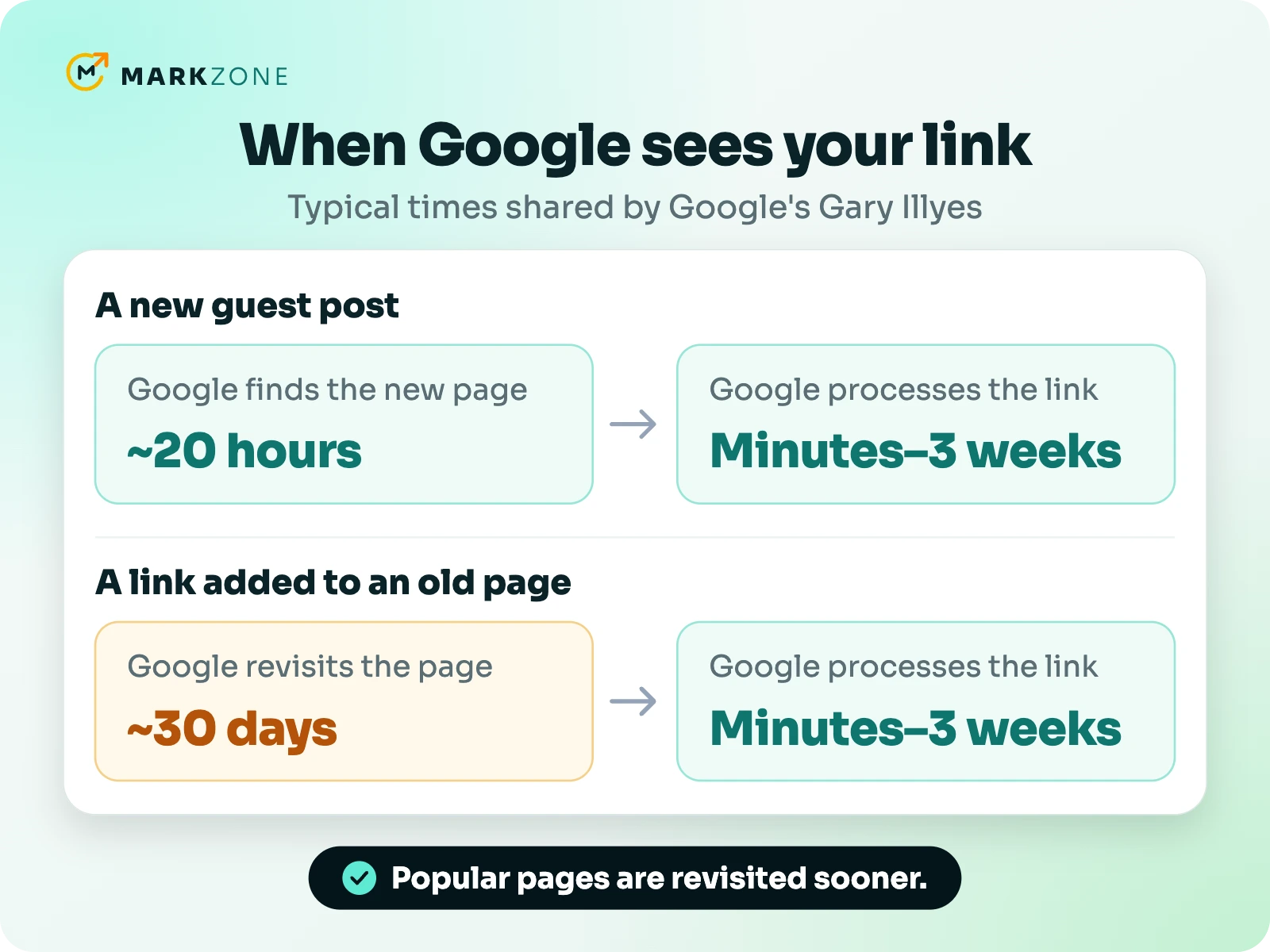
Popular pages get revisited sooner. Google’s crawl budget guide says “URLs that are more popular on the Internet tend to be crawled more often to keep them fresher in our systems.” So a link added to a page that gets traffic and links can be seen quickly, while a link on a forgotten old page may wait for weeks. For a new guest post, it helps when the publisher links to it from their homepage or a category page and lists it in their sitemap. Our guide to guest posts vs. link insertions compares the two options in more detail.
What affects how fast links work
- How relevant the site is. A link from a site in your topic, with real traffic, counts for more than one from a site that links to anything. Our guide to good backlinks covers what to check.
- How competitive your keyword is. The top pages for a hard keyword have links from many more websites, so you have more ground to make up. Our guide to how many backlinks you need shows how to work out your gap.
- How many good links you build. One link on its own rarely moves a page far, as the Moz test shows. Relevant links from more websites make a clearer difference.
- How good your page is. Links work best on a page that already answers the search. If your page is thin or misses what searchers want, fix that first.
- How established the competition is. In Ahrefs’ study of ranking pages, 72.9% of pages in Google’s top 10 were more than three years old, and the average page in position 1 was five years old. The pages you are up against have had years to collect links.
How to check if Google has found your link
- Check that the page is indexed. Search Google for the article’s exact title in quotes. If the page appears, Google has indexed it and seen the links on it.
- Look in Search Console. The Links report shows sites that link to yours, but Google says it shows a sample, not every link. A missing link doesn’t mean Google hasn’t found it.
- Check a backlink tool. In our experience, a new link usually shows up in Ahrefs within a few days to four weeks. Tools like Ahrefs and Semrush use their own crawlers, so they show what they have found, not what Google has.
- Watch the page you linked to. Track its rankings for its main keywords week by week, not day by day.
If your backlinks still aren’t working
If a few months have passed and nothing has moved, check the links themselves:
- Is the page indexed? If Google hasn’t indexed the page, your link is unlikely to count. If the title search above still finds nothing after a few weeks, ask the publisher to add the page to their sitemap or request indexing in their Search Console.
- Is the link still live? Check that it is still on the page and still points to the right URL. In our experience, removals are rare.
- Is the link followed? A link marked nofollow or sponsored is only a hint to Google, so don’t count on it for rankings. We explain why in do nofollow links help SEO.
- Does the site sell links to anyone? In its December 2022 link spam update, Google said its SpamBrain system can detect sites used to pass outgoing links, and that credit from unnatural links is lost. Links from such sites may never count.
What to do while you wait
Waiting doesn’t mean doing nothing. Keep building relevant links at a steady pace you can keep up, rather than in one big burst, and keep improving the page you are linking to. Link to it from your own related pages too, so readers and Google can reach it easily. And give each change time before you judge it: if you rewrite the page and add links in the same week, you won’t know which one helped.
Frequently asked questions
Can backlinks work in a week?
Google can find and process a link within days, but the ranking change from one link is usually small and slow to show. A week is too early to judge.
Do I need to submit my backlinks to Google?
No. Only a site’s owner can request indexing for its pages in Search Console, and Google finds new pages through links and sitemaps without your help. If the page with your link isn’t indexed after a few weeks, ask the publisher to check it.
How long does a guest post take to go live?
It depends on the publisher. Our catalog shows the delivery time for most sites before you order.
Do backlinks stop working over time?
They can. A link can stop counting if it is removed, if the page it is on drops out of Google’s index, or if Google decides it is unnatural. Check your most important links every few months.
Want to get your next links live?
Links can only start working once they’re live. Send us your site, and we’ll suggest where to start.

Muhammad Suleman is the founder of Markzone. He has done guest posting and link building since 2018 and has worked with hundreds of clients. Today his team handles 300–400 orders a month for brands and SEO agencies, with publisher sites in every major niche. He leads outreach, site checks and reporting, and writes about link building from his daily work with publishers and clients.