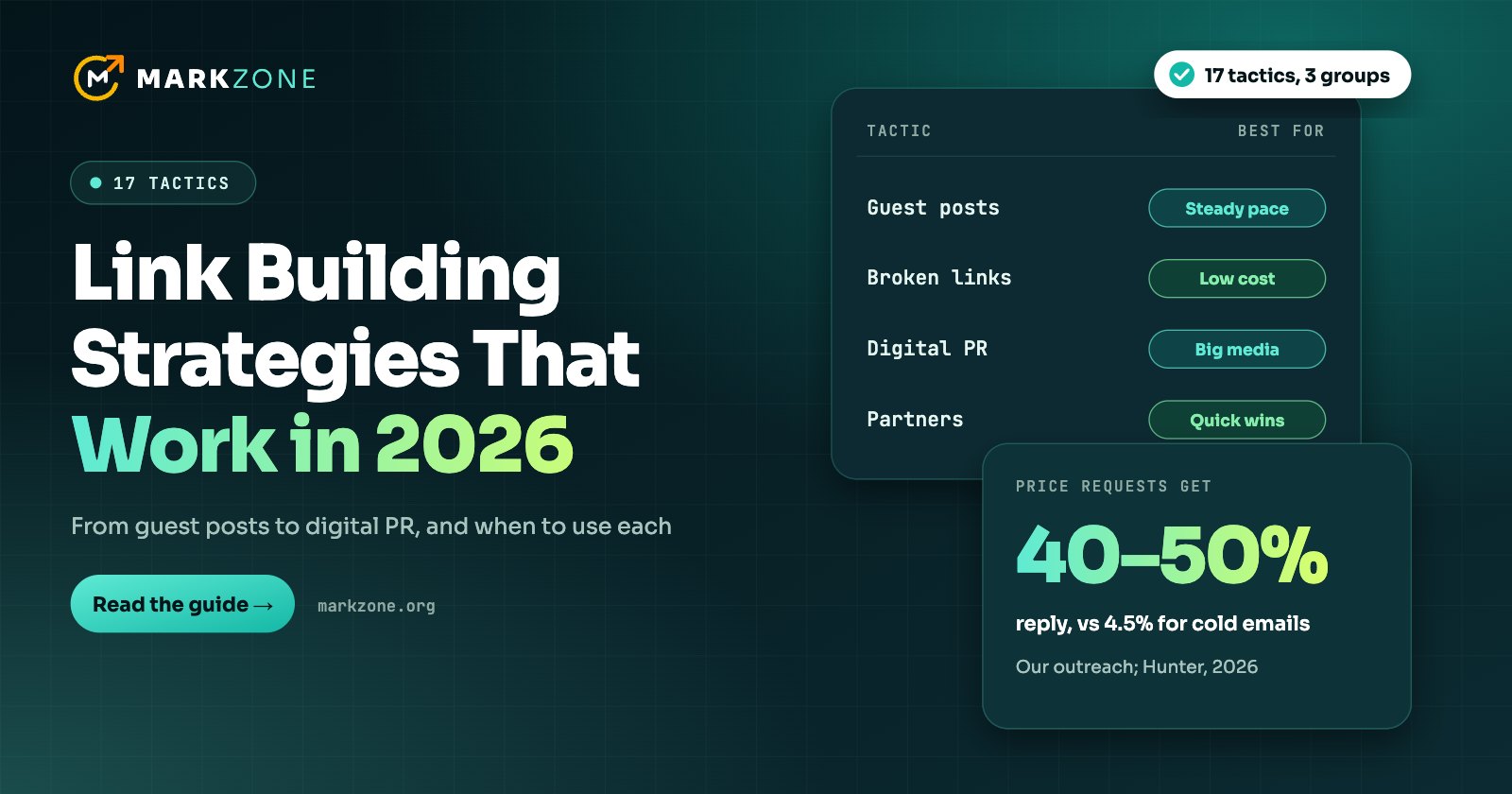
There is no single best tactic. The right mix depends on your budget, your time and what your site already has to offer.
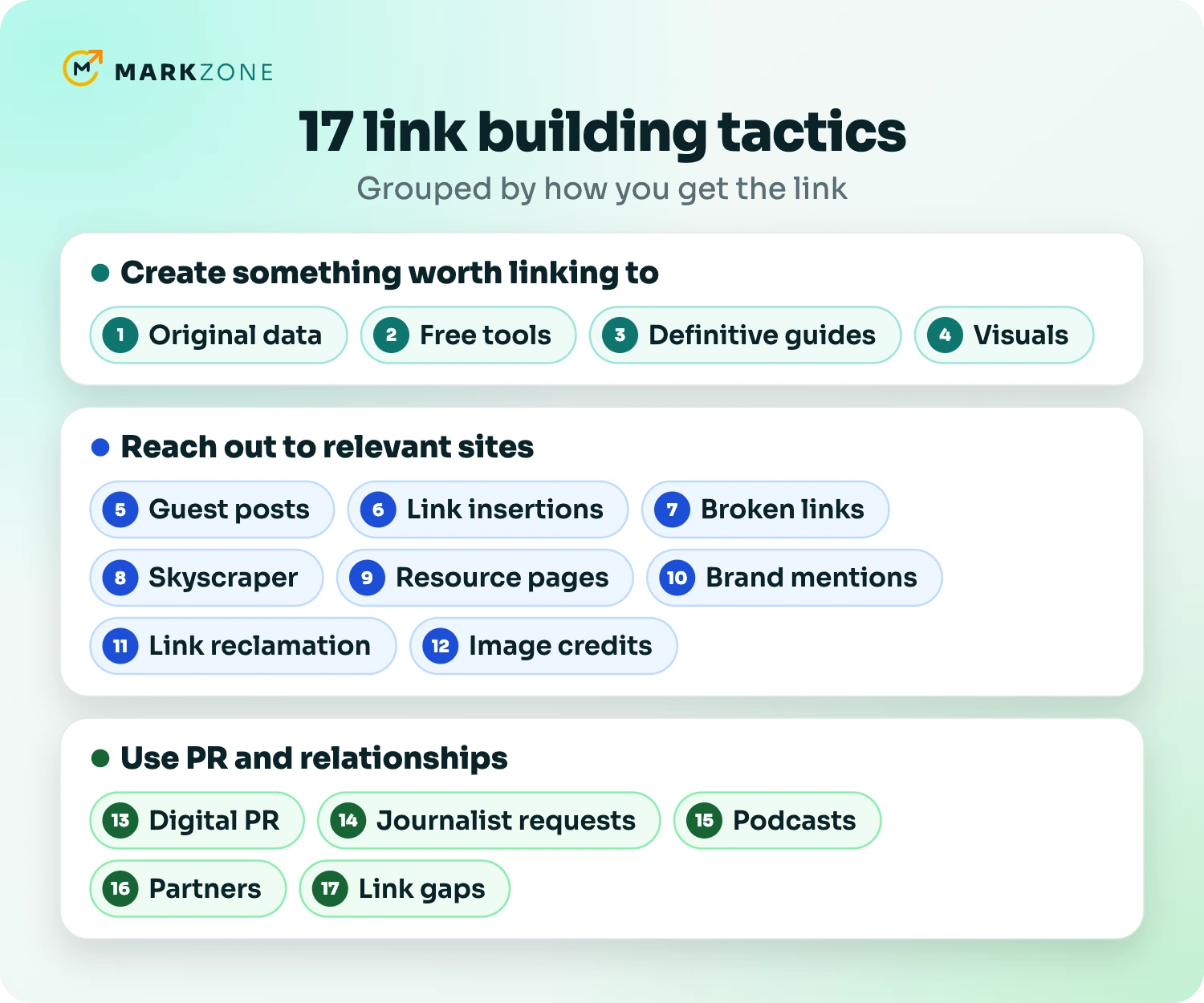
Create, reach out, or build relationships. Every tactic below earns links with content, asks for them through outreach, or comes from PR and partners.
Stay inside Google’s rules. Google treats automated links, excessive link swaps and keyword-rich widget links as link spam, whatever the tactic is called.
The link building strategies that work in 2026 fall into three groups. The first is creating content people want to cite, such as original data and free tools. The second is reaching out to relevant sites with guest posts, link insertions, broken link fixes and brand mentions. The third is PR and relationships, from journalist requests to podcasts and partners. The best mix depends on your budget and time, but every tactic below aims for the same thing: links from relevant sites that real people read.
Of the 17 tactics below, we sell two: guest posts and link insertions. You can run the other 15 yourself, and for each one we say when it fits.
What is a link building strategy?
A link building strategy is your plan for getting other websites to link to yours. It sets which pages need links, which tactics you will use to get them, and how many links you will aim for each month. The tactics are the methods. A good strategy picks the few that suit your site, rather than trying all 17 at once.
Create something worth linking to
These tactics take the most work up front, but the links can keep coming for years without more outreach.
1. Publish original data
Writers need numbers to back up their points, and they link to the source. Run a survey, analyze data you already have, or turn public data into something new, and explain your method so others can trust it. We did this with our own catalog: our comparison of $20 and $200 links is built from the data on our publisher sites.
Best for: businesses with data, customers or an audience they can survey.
2. Build a free tool or template
Calculators, checkers, generators and templates solve a problem on the spot, so people link to them from guides and resource lists. Keep the link in your own page, though: Google’s spam policies list “keyword-rich, hidden, or low-quality links embedded in widgets that are distributed across various sites” as link spam.
Best for: sites with a developer or a simple, repeatable task to automate.
3. Write the definitive guide
A guide that covers a topic better than anything else becomes the page other writers cite instead of explaining it themselves. Check what the top results miss, answer the follow-up questions, and add examples, visuals and sources.
Best for: topics where you have real expertise and the current results are thin or dated.
4. Make visuals others want to use
Clear charts, diagrams and infographics get reused in other people’s articles. Make them easy to share, add your brand, and ask for a credit link when someone uses one.
Best for: explaining processes or data that are hard to put in words.
Reach out to relevant sites
Outreach means contacting site owners or editors with a reason to link. Cold pitches get few replies. Hunter’s State of Email Outreach 2026 report puts the average reply rate at 4.5%. An older Backlinko and Pitchbox study found that 8.5% of outreach emails got a response. A clear offer does better: when our team asks site owners for their guest post price, 40 to 50 of every 100 reply. Our guest posting outreach guide covers how to write these emails.
5. Guest posting
You write an article for a relevant site and include a link back to your own in the body. Some sites accept free pitches, while many charge a fee. Google’s spam policies treat links with optimized anchor text in guest posts as link spam, so keep your anchors natural. Our guide to guest posting for SEO covers it step by step.
Best for: steady links on sites in your niche, where you choose the topic and the anchor.
6. Link insertions (niche edits)
Instead of a new post, a site adds your link to an article it has already published. The page is already indexed and may already have traffic and links of its own. At the publishers we work with, a link insertion usually costs a little less than a guest post on the same site, and some charge the same for both. We compare the two in guest posts vs. link insertions.
Best for: getting a link on a page that already has some history.
7. Broken link building
Find pages in your niche that link to pages that no longer exist, then tell the owner and suggest your page as a replacement. Most SEO tools can list broken outbound links for any site. Start with the biggest sites in your topic, check that your page covers what the dead page did, and keep the email short. You are fixing a problem for them, which makes the request easy to say yes to.
Best for: low-cost outreach in niches with lots of older content.
8. The skyscraper technique
Find a page that has earned many links, create something clearly better, and contact the sites that link to the original. The method, made popular by Brian Dean of Backlinko, works only when your page really is better, not just longer.
Best for: topics where the most-linked page is outdated or incomplete.
9. Resource pages
Many sites keep pages that list useful links on a topic. Search for your topic with words like “resources” or “useful links,” check that the page is maintained, and suggest your guide or tool if it truly fits.
Best for: guides, tools and templates that teachers, associations or bloggers would recommend.
10. Unlinked brand mentions
Some articles mention your brand, product or people without linking. Find them with a mention-tracking tool or Google Alerts, then politely ask the writer to add a link. They already know you, which makes this one of the easiest requests to make.
Best for: brands that already get some press or reviews.
11. Link reclamation
Links get lost when pages move, URLs change or articles are edited. Check your lost backlinks in an SEO tool, and redirect old URLs on your own site to the right pages. Then ask sites to update links that now point to a dead page.
Best for: older sites, or any site that has changed its URLs.
12. Image link building
Use a reverse image search to find sites using your photos, charts or infographics without credit, then ask them to add a link to the source. Many people are happy to credit an image they chose to use.
Best for: sites that publish original photos or graphics.
Pick sites from our catalog, and we handle the placement while you work on the other tactics.
Use PR and relationships
These tactics build links through people: journalists, show hosts and the businesses you already work with.
13. Digital PR
Create something newsworthy, such as a study, a timely expert comment or a creative campaign, and pitch it to journalists who cover the topic. Some publications mark outside links as nofollow, but coverage still brings readers, brand searches and other writers who may link to you later.
Best for: brands with a story, data or an expert who can speak to the news.
14. Journalist requests
Services such as HARO, Connectively and Qwoted send you reporters’ requests for expert sources. HARO and Connectively are now both run by Featured. Answer fast, stick to the question and give a quote the writer can use as it is. Not every quote comes with a link, so treat this as PR first.
Best for: founders and specialists who can answer questions quickly and well.
15. Podcasts and interviews
Podcast hosts and bloggers need guests, and episode pages and show notes often link to the guest’s site. Pitch shows in your niche with two or three topics you can speak about with authority.
Best for: people who are comfortable talking about their work.
16. Partners, suppliers and customers
The businesses you already work with can link to you: supplier and partner pages, integration directories, case studies and testimonials. Ask your partners whether they list the companies they work with, and offer a testimonial for a product you actually use.
Best for: any business with real partners, from local shops to software companies.
17. Competitor link gaps
Use a link gap tool, such as Ahrefs’ Link Intersect or Semrush’s Backlink Gap, to find sites that link to several of your competitors but not to you. They already link in your topic, so they make good prospects for the outreach tactics above.
Best for: building a target list before any outreach campaign.
Which strategies should you start with?
- New site, small budget: start with partners, resource pages, unlinked mentions and a few guest posts on relevant sites.
- Expert with little time: journalist requests and podcasts turn what you already know into links.
- Site with data or a product: original research and free tools can earn links for years.
- Site that needs links on a schedule: guest posts and link insertions are the easiest to plan month by month. Our guide to how many backlinks per day is safe shows how to set the pace.
Before you pick, work out how many links you actually need. Our guide to how many backlinks you need to rank shows how to measure the gap.
How to measure what works
Track each tactic separately so you know where your time and money go. For every campaign, note the emails sent, replies, links won and total cost, then work out the cost per link. Each month, check how many new referring domains you gained in Ahrefs or Semrush, and watch the rankings and traffic of the pages you built links to. Links take time to show results, as we explain in how long backlinks take to work, so judge a tactic over a few months before you drop it.
Tactics to avoid
Some shortcuts still circulate, but Google’s spam policies name them as link spam. They include “using automated programs or services to create links to your site,” excessive link exchanges and low-quality directory or bookmark links. Forum comments with optimized links are on the list too. Bulk link packages and private blog networks usually rely on the same methods. Our guide to cheap link building shows how to tell a cheap link worth buying from one that is a waste of money.
Frequently asked questions
What is the best link building strategy?
There is no single best one. Original data and PR can earn strong links but take time; guest posts and link insertions are easier to plan; brand mentions and partners are quick wins. Most sites do best with a mix.
What are the main types of link building?
There is no official list, but most tactics fall into three groups: creating content people link to, reaching out to relevant sites, and PR and relationships.
Is link building still worth it in 2026?
Yes. Google says that one of the factors it uses to judge quality is whether other prominent websites link to or refer to the content. Links from relevant sites still help pages rank.
Is buying links a link building strategy?
It is common, but Google treats paid links that pass ranking credit as link spam unless they are marked as sponsored or nofollow. We explain the risks in is buying backlinks safe.
How many links should I build each month?
It depends on your competitors, your own site and your budget. Look at how many sites link to the pages that rank for your keyword and how fast they gain new links, then set a pace you can keep up.
Want help with the outreach part?
Send us your website and niche, and we’ll come back with relevant sites, prices and a plan for the first month.

Muhammad Suleman is the founder of Markzone. He has done guest posting and link building since 2018 and has worked with hundreds of clients. Today his team handles 300–400 orders a month for brands and SEO agencies, with publisher sites in every major niche. He leads outreach, site checks and reporting, and writes about link building from his daily work with publishers and clients.