Integrations are the link source only software has. In the listings we read on 20 November 2026, Slack and Google Workspace linked to the vendor with ordinary followed links, while Zapier marked its links nofollow.
Free tools, data and integrations earn the links; comparison and feature pages convert. Build links to the pages people cite, then pass that value on with internal links.
Price paid links by traffic, not niche. Technology sites in our catalog have a typical price of $30, but sites with 10,000 to 49,999 monthly search visits typically charge $200. Google wants paid links marked rel="sponsored" or rel="nofollow".
SaaS link building is how a software company earns links from other websites. Software has sources most businesses lack: app marketplaces and partner pages, “best [category] software” lists, its own comparison and alternatives pages, free tools, and data only the product can produce. These earn links to pages that help people decide. Internal links then carry that value to the feature, pricing and signup pages, which rarely attract links on their own. Paid guest posts can fill gaps, as long as you label them the way Google asks.
Markzone sells guest posts and link insertions, the paid route in section 6. Sections 1 to 5 cost product work and time, not payments to us.
- Which SaaS pages should get links?
- 1. App marketplaces and partner pages
- 2. Comparison and alternatives pages
- 3. “Best software” lists and review sites
- 4. Free tools and templates
- 5. Data from your product, and “powered by” credits
- 6. Guest posts and paid placements
- Where to start, by stage
- How to measure it
- Frequently asked questions
- Sources
Which SaaS pages should get links?
| Page | Where its links come from | Its job |
|---|---|---|
| Integration pages | Partner marketplaces, partner help docs, co-written posts | Reach the partner’s users and rank for “[partner] + [your category]” searches |
| Free tools and templates | Bloggers, communities, resource pages | Collect links for years and pass them on |
| Data reports | Journalists and analysts who cite figures | Build authority on your topic |
| Comparison and alternatives pages | Mostly internal links | Win the searches made just before a purchase |
| Feature, pricing and signup pages | Internal links | Turn visitors into trials and demos |
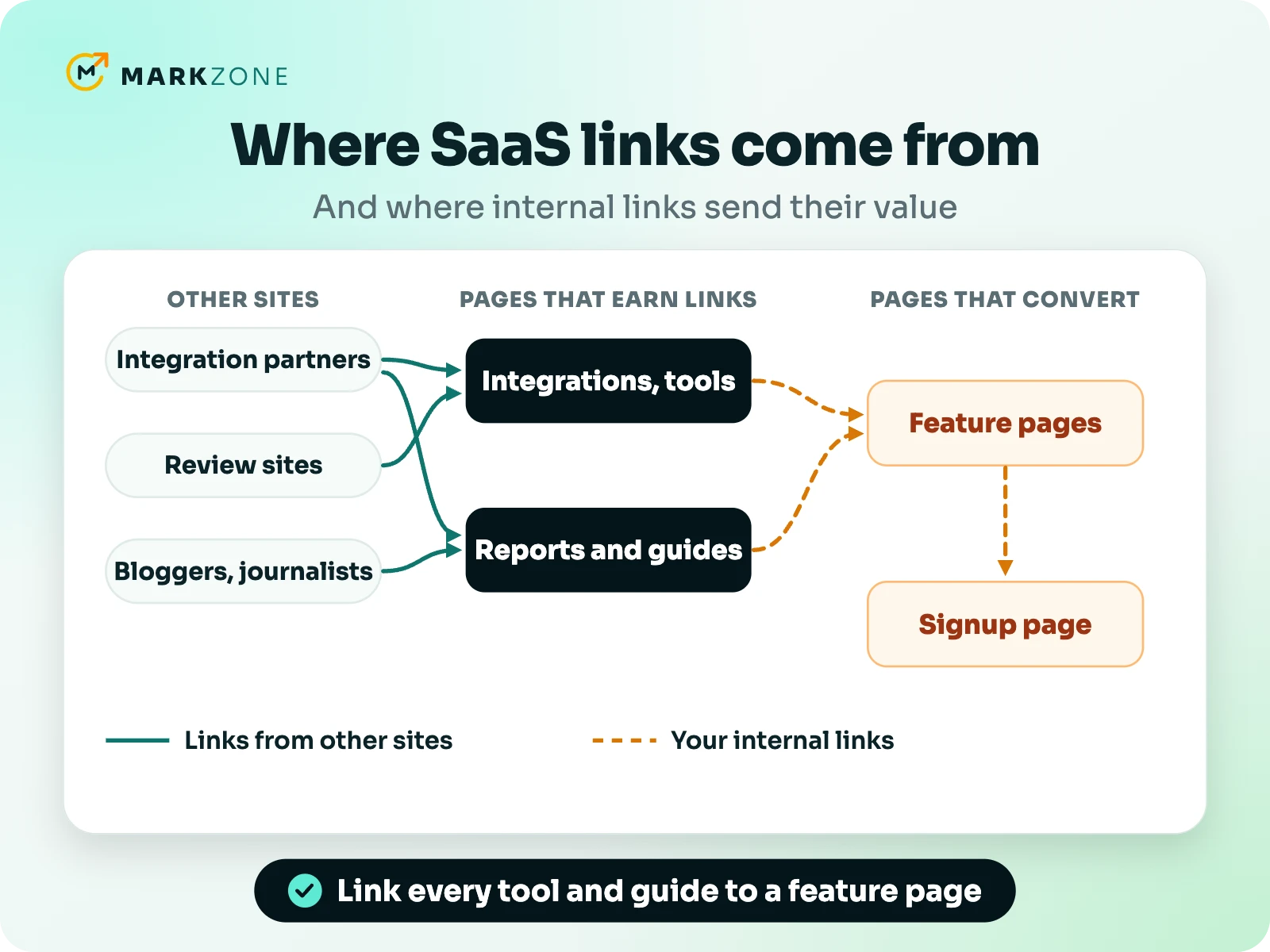
Give every tool, report and integration page one plain internal link to the feature page it relates to. How much value a link carries depends on the page it sits on, which backlink equity explains.
1. App marketplaces and partner pages
Each integration gives another company a reason to link to you: its marketplace, its partner directory, its help center and sometimes its blog. The marketplaces set different bars for a listing, and the listings we sampled link out differently. We read the HTML of one or two listings on each on 20 November 2026:
| Marketplace | To get listed | Link from the listing to the vendor (listing checked) |
|---|---|---|
| Slack Marketplace | Since July 2026, “at least 10 installations on active workspaces” (used in the past 28 days, not sandboxes) | Followed: no rel attribute (Asana) |
| HubSpot App Marketplace | “at least three active, unique installs” by accounts unaffiliated with you, active in the past 30 days | Not checked: the page builds its content with JavaScript |
| Zapier app directory | “at least 3 users with live Zap workflows” to submit, then 90 days in beta | Nofollow: rel="nofollow noopener noreferrer" (Trello, Pipedrive) |
| Google Workspace Marketplace | Google reviews each app and its listing | Followed: no rel attribute (Asana) |
| Shopify App Store | Shopify reviews each app | Mixed: website (Klaviyo) and documentation links carried only noopener noreferrer; pricing links were nofollow (Klaviyo, Judge.me) |
| Atlassian Marketplace | Atlassian approves each listing | Mixed: the vendor page’s “Visit website” link was followed; links inside the app description were nofollow (Tempo) |
Noopener and noreferrer are browser instructions about opening the page and passing on the referrer (MDN); the values Google reads as qualifiers are sponsored, ugc and nofollow. One or two listings per marketplace is a sample, not a survey, so check your own: right-click the link on your listing, choose Inspect and read its rel value.
A listing is only the start. Ask each partner for a place on its integrations or partners page, a help-center article on using the two products together, and a joint post for its blog. Publish your own page for each integration, with setup steps and use cases, so those pages have something specific to link to. Keep it to integrations that work: Google’s spam policies name “partner pages exclusively for the sake of cross-linking” as link spam.
2. Comparison and alternatives pages
“[Your product] vs [competitor]” and “[competitor] alternatives” pages catch buyers just before they choose. They seldom attract many links themselves, so they live on internal links from your tools, guides and integration pages.
Google’s reviews system applies to pages like these. Google says reviews can be “head-to-head comparisons, or ranked-lists of recommendations.” Its system works to show people reviews that “share in-depth research, rather than thin content that simply summarizes a bunch of products, services or other things.” Google’s guide lists “a merchant who guides people between competing products” among review writers, and asks reviewers to:
- “Explain what sets something apart from its competitors.”
- “Cover comparable things to consider, or explain which might be best for certain uses or circumstances.”
- Back a pick for “the best” with “first-hand supporting evidence.”
So test the competitor yourself and show screenshots. Compare the three or four factors buyers actually weigh, and say plainly who should choose the other product. Put a date on the page so you update prices when they change.
3. “Best software” lists and review sites
Search “best [category] software” and “[competitor] alternatives,” and list the articles that rank. Pitch each author facts they can check: your price, the one job you do better, and who your product doesn’t suit. Offer a trial account so they can test it. Two rules apply:
- A trial is for testing, not payment. Google’s spam policies list “Exchanging goods or services for links” as link spam, so never make a free plan or credit depend on a link.
- Affiliate links are sales links. Many of these lists earn commissions. In July 2021 Google asked sites in affiliate programs “to qualify these links with
rel="sponsored", regardless of whether these links were created manually or dynamically.” Run an affiliate program for signups, not rankings. A sponsored link still sends buyers.
Review platforms such as G2, Capterra and TrustRadius reach people comparing tools, so keep your profiles complete and ask happy customers for reviews. We couldn’t check their link markup: all three refused our automated requests on 20 November 2026.
4. Free tools and templates
A calculator, checker, generator or template that solves one small job for your buyers can keep earning links long after launch. BuzzStream’s January 2025 SaaS guide reports that Talkwalker’s free tool “has built over 1.7k linking root domains over the years.” Three rules:
- Stay close to the product. An invoicing app’s invoice generator attracts future customers. A tool for a different audience attracts links but no trials.
- Show the result first. Put the signup offer after the answer, not in front of it, so people can use and cite the tool.
- Keep embed credits plain. If the tool has an embed code, use your brand as the credit link. Google lists “Keyword-rich, hidden, or low-quality links embedded in widgets that are distributed across various sites” as link spam.
5. Data from your product, and “powered by” credits
Your app sees things nobody else can measure, such as how long teams take to finish a task or which weekday is busiest. Publish an anonymized benchmark with its sample size, method and date, and repeat it each year on the same URL so its links add up.
Many products also print a credit on what customers publish: a form footer, a booking page, a status page. Google’s list of link spam includes “Widely distributed links in the footers or templates of various sites.” Keep those credits branded and consider nofollow. Their job is to win signups from people who see the product in use.
6. Guest posts and paid placements
Writing for sites your buyers read still works when the article teaches something and links to a guide, tool or integration page rather than your pricing page. Our guide to guest posting for SEO covers choosing the sites. If you pay for placement, our price study of the catalog, taken on 13 November 2026, shows what software-adjacent sites charge. It has no separate SaaS or software row. Technology is the closest:
| Catalog niche | Sites | Typical price | Middle half |
|---|---|---|---|
| Technology | 3,752 | $30 | $20 to $100 |
| Marketing | 500 | $30 | $20 to $100 |
| Business | 1,195 | $60 | $25 to $200 |
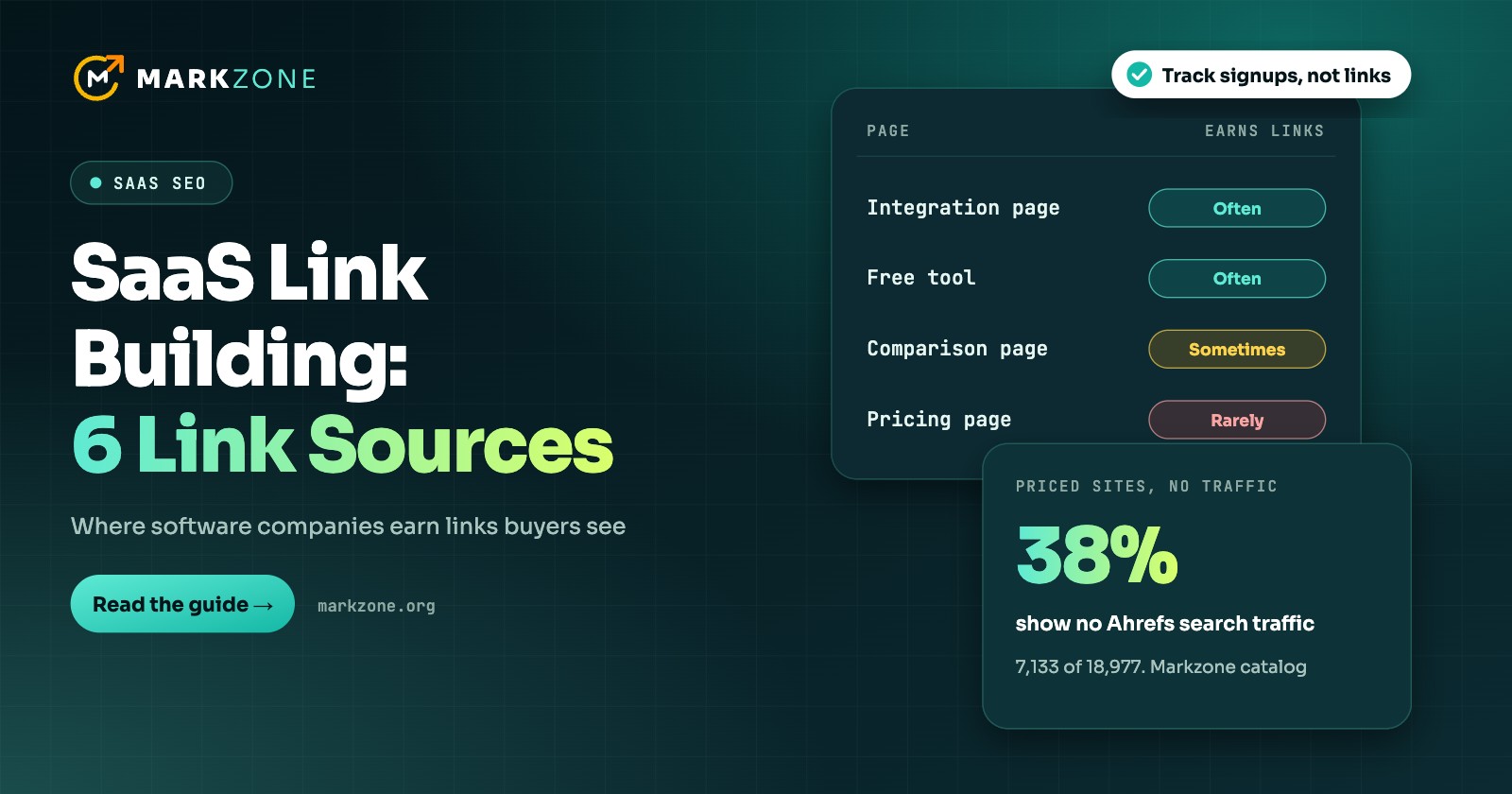
Technology is the largest niche after General and news: 3,752 of the 18,977 priced sites, about one in five. Its $30 median is below the catalog-wide $50, but a low niche price tells you nothing about readers. The study reports niches without a traffic breakdown, and across the whole catalog, price follows traffic: 7,133 of the 18,977 priced sites (38%) show no Ahrefs traffic, and they typically charge $25.
Worked example (not a client’s order). Six links in a quarter, two each to your Slack integration page, your free tool and your best guide. They are priced at catalog medians, before writing, which the study’s prices don’t include:
| Sites you choose | Per link | Six links |
|---|---|---|
| Technology sites, traffic unchecked | $30 | $180 |
| Any niche, 1,000 to 4,999 monthly visits | $130 | $780 |
| Any niche, 5,000 to 49,999 monthly visits | $200 | $1,200 |
| Any niche, 100,000 to 999,999 monthly visits | $590 | $3,540 |
Moving from unchecked tech sites to sites with 1,000 to 4,999 monthly visits adds $600 to the quarter. Choose from the second or third row, then check that the readers are your buyers: a developer blog won’t sell an HR tool, whatever its traffic.
Google doesn’t ban paid placements; it asks you to label them. For advertising and sponsorship, its spam policies accept paid links as “a normal part of the economy of the web,” with one condition: “as long as they are qualified” with a rel="nofollow" or rel="sponsored" attribute. Catalog placements come as dofollow links unless the publisher marks them otherwise, and you can request a sponsored label on any order.
In our 13 November snapshot, 86% of the 22,073 catalog sites showed a fixed price, next to their traffic and DR.
Where to start, by stage
| Stage | Start with | Leave for later |
|---|---|---|
| First customers | An integration page for each live integration; HubSpot and Zapier listings once you reach 3 active installs or 3 users with live Zaps; founder-written guest posts | Yearly data reports; paid campaigns |
| Ten or more active installs | The Slack Marketplace; comparison pages for your two biggest rivals; one free tool | Paid links chosen by DR alone |
| Established | A yearly benchmark from product data; co-marketing with partners; paid placements where a backlink gap analysis shows rivals ahead | Directories nobody in your market uses |
How to measure it
Track three things monthly. First, new referring domains to your integration, tool, report and comparison pages. Second, rankings for “[category] software,” “[competitor] alternatives” and “[partner] integration” searches. Third, trials and demos from organic and referral visits, by landing page. Listings with noreferrer hide where a visitor came from, so add UTM tags to any listing links you control. Judge the work by signups from those pages, not by the number of links.
Agencies with SaaS clients can use our white-label link building service, which sends unbranded reports. If you’re comparing providers, outsourcing link building covers how to vet them.
Frequently asked questions
How much does SaaS link building cost?
Marketplace listings, comparison pages and partner content cost product and writing time. Paid placements in our catalog typically cost $30 on technology sites, $30 on marketing sites and $60 on business sites, but traffic moves the price most: $200 is typical at 10,000 to 49,999 monthly visits and $590 at 100,000 to 999,999. Writing is extra.
Do app marketplace links help SEO?
It depends on the listing’s markup. The Slack and Google Workspace listings we checked used followed links, and Zapier’s used nofollow. A nofollow listing still earns installs. And since September 2019, Google has said all of sponsored, ugc and nofollow “are treated as hints about which links to consider or exclude within Search.”
Can our partner agreement require a backlink?
Ask, don’t require. Google’s spam policies list this as link spam: “Requiring a link as part of a Terms of Service, contract, or similar arrangement without allowing a third-party content owner the choice of qualifying the outbound link”. Offer partners a badge and a suggested link, and let them choose the attribute.
Sources
- Slack: Updated installation requirement for Slack Marketplace apps (1 September 2026)
- Slack: Submission guidelines and requirements (definition of active workspaces, checked 20 November 2026)
- Slack Marketplace: Asana listing (page HTML checked 20 November 2026)
- HubSpot: App listing requirements in the HubSpot Marketplace (last modified 15 October 2026)
- Zapier: Test and monitor Zapier integrations (checked 20 November 2026)
- Zapier: Public integration publishing guide (90-day beta, checked 20 November 2026)
- Zapier: Trello integrations page and Pipedrive integrations page (page HTML checked 20 November 2026)
- Google Workspace Marketplace: Asana listing (page HTML checked 20 November 2026)
- Google for Developers: App review process and requirements for the Google Workspace Marketplace (last updated 3 September 2026)
- Shopify App Store: Klaviyo listing and Judge.me listing (page HTML checked 20 November 2026)
- Shopify: About the app review process (checked 20 November 2026)
- Atlassian Marketplace: Timesheets by Tempo listing and Tempo Software vendor page (page HTML checked 20 November 2026)
- Atlassian Developer: Listing Forge apps (last updated 26 August 2026)
- MDN: rel=”noopener” and rel=”noreferrer” (checked 20 November 2026)
- Google Search Central: Spam policies for Google web search (last updated 28 August 2026)
- Google Search Central: Qualify your outbound links to Google (last updated 10 December 2025)
- Google Search Central: Google Search’s reviews system (last updated 10 December 2025)
- Google Search Central: Write high quality reviews (last updated 10 December 2025)
- Google Search Central Blog: A reminder on qualifying links and our link spam update (26 July 2021)
- Google Search Central Blog: Evolving “nofollow”: new ways to identify the nature of links (10 September 2019)
- BuzzStream: SaaS Link Building, Tips and Real Life Examples (last updated 14 January 2025)
- Markzone: Guest post price study (catalog snapshot of 13 November 2026: niche and traffic-tier prices, priced and total site counts, no-traffic share)
Building links for a software product?
Send us your category, your buyers and your target pages, and we’ll suggest tech publishers whose readers match.

Muhammad Suleman is the founder of Markzone. He has done guest posting and link building since 2018 and has worked with hundreds of clients. Today his team handles 300–400 orders a month for brands and SEO agencies, with publisher sites in every major niche. He leads outreach, site checks and reporting, and writes about link building from his daily work with publishers and clients.