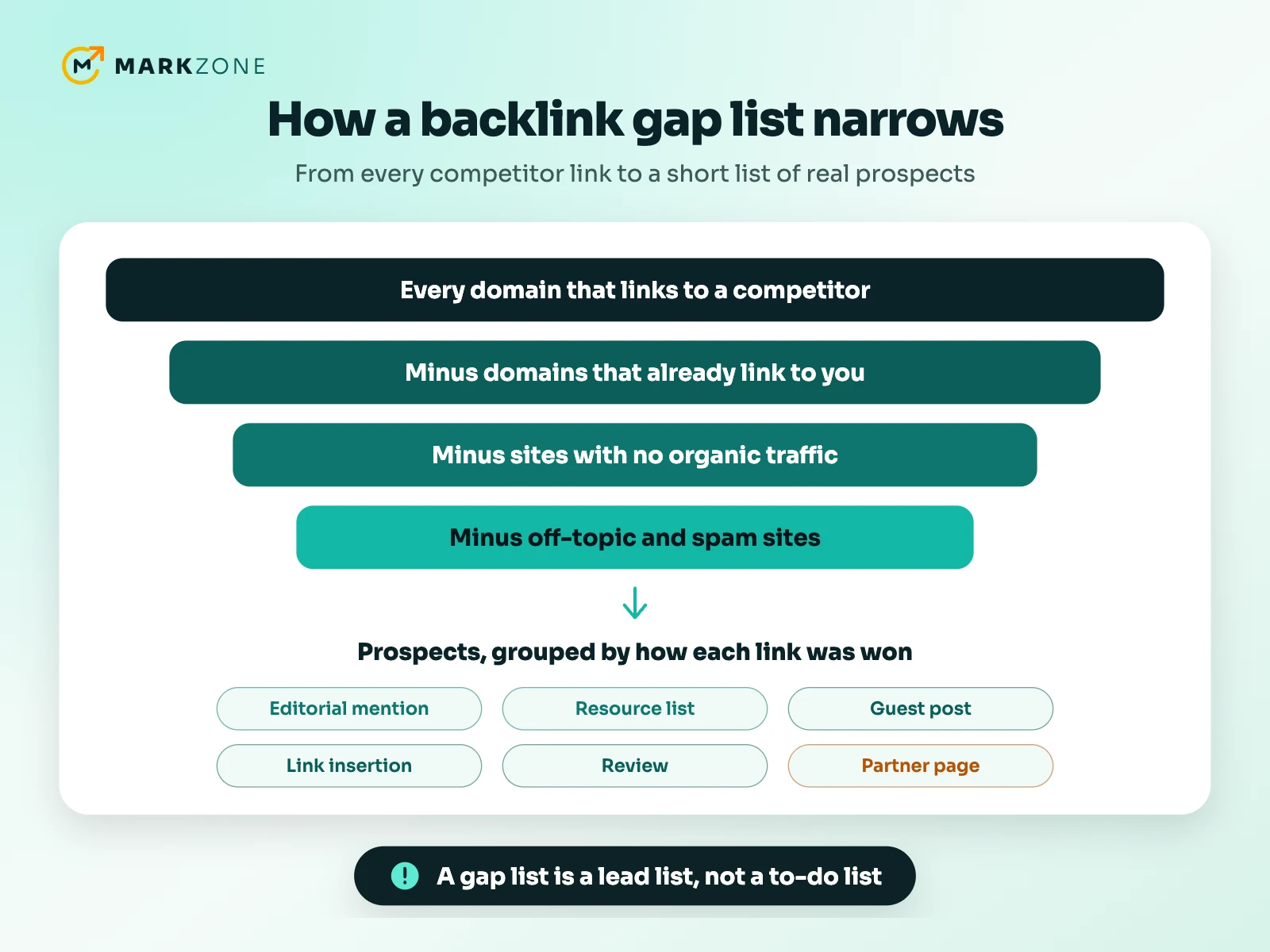
A gap list is a lead list. It shows who links to your competitors and not to you, not which of those links are worth having.
Filter on traffic before DR. In our catalog, 7,133 of the 18,977 priced sites (38%) show no Ahrefs traffic. Even at DR 50 and above, 722 of 3,856 sites (19%) have none.
Ask how each link was won. A news citation, a resource list, a paid post and a profile page each call for a different move, and some call for none.
A backlink gap analysis compares the websites that link to your competitors with the websites that link to you, and lists the ones you’re missing. You enter your site and two to four competitors in Ahrefs’ Link Intersect, Semrush’s Backlink Gap or a similar tool. Then you cut the list down to relevant sites with real readers and open the page that carries each competitor’s link. Then decide: pitch the site, earn the link with something better, pay for a placement or skip it. The filtering is where the work is.
Our business is selling guest posts and link insertions, and sites that sell them can turn up on your gap list, so weigh our advice with that in mind. Catalog figures come from our guest post price study (13 November 2026 snapshot) and two posts using the same catalog: High Authority Backlinks and What is Domain Rating.
What a backlink gap analysis shows
The tool compares referring domains: every website linking to a site, counted once however many links it sends. It drops every domain that already links to you. The rest shows where competitors get links, which sites link to several of them and, if you compare single URLs, which pages earn links in your niche. Google Search Console’s Links report covers only your own site (“See who links to you the most,” says its help page), so the competitor side needs a third-party tool.
“Gap” can also mean the number of extra linking sites a page needs to catch the pages above it, which how many backlinks you need calculates. This post is about the list of sites.
Backlink gap tools compared
Each vendor uses its own link index, so each tool returns a different list. Here are the limits the vendors state, checked on 16 November 2026:
| Tool | Where to find it | Sites it compares | Worth knowing |
|---|---|---|---|
| Ahrefs | Link Intersect, in the Competitive Analysis tool | Up to 10 domains or URLs | Filters for how many competitors a site links to, Do-follow, DR and traffic |
| Semrush | Backlink Gap | Up to five domains, your own included | “Best” groups the domains that link to all your competitors but not to you |
| SE Ranking | Backlink Gap Analyzer | Your site plus up to five competitors | Compares referring domains and backlinks |
| Majestic | Clique Hunter | 2 to 10 domains, your own included | Counts how often each linking domain links to the sites you entered |
How to do a backlink gap analysis in 6 steps
1. Pick three competitors
Choose two to four sites that keep outranking you for your main keywords and are close to your size or a little bigger. Household names earn links for reasons you can’t copy. To win one page, compare it with the pages that outrank it, not with whole domains.
2. Run the comparison on referring domains
In Ahrefs’ Competitive Analysis tool, choose referring domains, put your site in the top section and your competitors in the bottom section. In Semrush, enter your domain and up to four rivals. Switch to referring pages later, when you want the exact articles.
3. Filter out sites without readers
This step matters most. Start with organic traffic above zero, dofollow links if rankings are the goal, and the language or country of your market. If the list is still long, raise the traffic bar to 1,000 monthly visits. Don’t make DR your main cut: it measures links, not readers.
Ahrefs’ own gap guide (January 2025) suggests a minimum DR of 50, or a minimum domain traffic of 1,000. It adds: “You can adjust these values up or down depending on the results you get in the report.” Our catalog data below suggests leaning on the traffic filter.
4. Sort by overlap, then check the top rows by hand
A domain that links to all your competitors is a strong lead: Ahrefs’ guide calls these “high-priority link targets,” and Semrush files them under “Best.” But sites that link to almost every domain, such as auto-generated site-statistics pages and open profile platforms, match every competitor too. Open the first 20 rows before you trust the order. If no domain links to all your competitors, widen the filter to two, then to one.
5. Open the linking pages and group them
Read the page that carries each competitor’s link: a news story, tool roundup, guest post, review, partner page or user profile. Tag each prospect by how its link was won, and give each group one action from the table further down.
6. Track it, and rerun it every three months
Log the domain, linking page, traffic, group, action, price and outcome. On each rerun, look only at domains that are new since the last one; in Semrush, you can expand a competitor’s row to see its new, lost or follow links.
What the filters remove: data from 22,073 sites that sell links
Some domains on a gap list may sell guest posts or link insertions. Our catalog lists 22,073 such sites with their Ahrefs metrics, so it shows what each filter from step 3 does to them (13 November 2026):
| Filter | Effect in our catalog | What it means for link sellers on your list |
|---|---|---|
| Organic traffic above zero | Removes 7,133 of 18,977 priced sites (38%) | More than a third fail the first cut |
| 1,000+ monthly visits | Keeps 4,587 of those 18,977 sites (24%) | About one in four passes |
| DR 50+ | Keeps 3,856 of 22,073 sites (17.5%), including 722 with no traffic | A DR cut lets sites without readers through |
| DR 50+ and 1,000+ visits | Keeps 1,849 of 22,073 sites (8.4%) | Fewer than one site in ten passes both |
| DR 90+ | 74 priced sites, median price $30 | Several sit on shared domains, it.com and us.com among them; the high DR likely reflects the shared domain, not the site |
DR and traffic rise together, but a high DR is no guarantee of readers. Among priced sites, 41% of DR 50–59 sites reach 1,000 monthly visits, against 76% at DR 70–79 and about 6% at DR 0–9, as published in What is Domain Rating. Prices follow traffic more than DR too, with a rank correlation of 0.42 against 0.21. So rank your gap list by traffic, use DR only to break ties, and check the exact hostname of any domain rated 90 or more.
A worked example: six rows from a gap list
The rows below are made up to show the method. The benchmarks in the last column are real catalog figures. Say your store sells pet supplies and you compare it with three competing stores:
| Row | What the tool shows | The linking page | Decision | Catalog benchmark |
|---|---|---|---|---|
| A | DR 91, no traffic, links to all three | A page on a shared domain | Skip | The 74 sites at DR 90+ have a median price of $30 |
| B | DR 56, no traffic, links to two | Guest posts on any topic | Skip | 19% of DR 50+ catalog sites (722 of 3,856) have no traffic |
| C | DR 34, 2,600 visits, links to one | A guest post on a dog-care blog | Pitch a topic, or ask the price | Median $130 at 1,000 to 4,999 visits |
| D | DR 61, 14,000 visits, links to two | A “best dog harnesses” roundup | Ask to be added, or price an insertion | Median $200 at 10,000 to 49,999 visits |
| E | DR 78, 90,000 visits, links to all three | A news story citing a competitor’s survey | Offer newer data or an expert quote | Not for sale |
| F | DR 93, links to all three | A user profile on an open platform | Skip | Anyone can create one |
An overlap sort would put A, E and F on top, and only E is worth chasing.
If C and D sell placements at the median for their traffic tier, matching those two links costs about $130 + $200 = $330. Where a site prices both, a link insertion is cheaper than a new post at 70% of sites, typically by 20%, so two insertions would cost about $264. E costs time, and the rest cost nothing. Prices spread widely inside each tier: among sites with 1,000 to 4,999 visits, a quarter charge $40 or less and a quarter $340 or more. Use the medians to judge a quote, not to predict one.
How to turn each type of gap into a link
| How the competitor got the link | What you can do |
|---|---|
| Editorial mention | Give the writer something new: fresher data, an expert quote or a fuller resource |
| List or resource page | Show the owner what your page adds to the list |
| Guest post | Pitch your own topic, or ask whether the site sells posts and how it labels them |
| Link added to an older article | Ask for a link insertion in a relevant article on the same site |
| Review or comparison | Offer access to your product, and expect a qualified link if you give anything of value |
| Partner or integration page | Look for a real partnership |
| Directory or association | Join if people in your field use it |
| Profile or open platform | Skip it |
| Spam site or private blog network | Skip it: copying the link copies the risk |
Pitch what the page’s readers gain. “You linked to them, so link to me” gives an editor no reason to act. Our outreach guide has emails you can adapt.
If you pay for a placement, or send a product in return for a review with a link, Google’s rules apply. Its spam policies (last updated 28 August 2026) count “Exchanging goods or services for links” as link spam. They call buying and selling links “a normal part of the economy of the web,” but only “as long as they are qualified” with a rel="nofollow" or rel="sponsored" attribute. Links in our catalog are dofollow by default unless the publisher marks them otherwise, and you can ask for a sponsored label on any order. Just 240 catalog sites out of 22,073 say they label guest posts as sponsored, so settle the label in writing before you pay.
Check whether a prospect is in our catalog, with its traffic, DR and price shown before you decide.
Frequently asked questions
How many competitors should I compare?
Three is a sensible default. Semrush’s limit of five domains includes your own, while Ahrefs and Majestic take up to 10. Every extra competitor means more rows to check, so add a fourth only when the first three share most of their links.
Can I do a backlink gap analysis for free?
Partly, with a spreadsheet. On Sheet1, paste each competitor’s referring domains from a free backlink checker into columns A to C. Paste your own from the “Top linking sites” table in Search Console’s Links report into column D. Then, on a new sheet:
- Stack the competitor columns and remove duplicates, so each domain appears once in column A.
- In column B, count the competitor lists that contain it: =COUNTIF(Sheet1!A:A,A2)+COUNTIF(Sheet1!B:B,A2)+COUNTIF(Sheet1!C:C,A2)
- In column C, check whether it already links to you: =COUNTIF(Sheet1!D:D,A2)
- Filter column C to 0 and sort column B from high to low.
Free checkers show only part of a profile (Ahrefs calls its free version “a glimpse” of the paid tool). Search Console tables stop at 1,000 rows, so treat the result as a sample.
What if most of a competitor’s gap links are paid posts?
Then its rankings may rest on links you could buy too, with the same risk. Right-click a few, choose Inspect and look for rel="sponsored" or rel="nofollow". If the posts carry no label and the sites publish anything for anyone, don’t copy them. If the sites are real publications in your niche, a placement of your own can reach the same readers; label it the way Google asks. Is buying backlinks safe covers the risk.
Sources
- How to Do a Backlink Gap Analysis (With Template), Ahrefs (Despina Gavoyannis, 30 January 2025)
- How to use Link Intersect and export the referring domains and backlinks report, Ahrefs Help Center (updated 3 September 2026)
- Link Intersect, Ahrefs Academy (undated; accessed 16 November 2026)
- Free Backlink Checker, Ahrefs (accessed 16 November 2026)
- How Backlink Gap can help you, Semrush Knowledge Base (undated; accessed 16 November 2026)
- Backlink Gap Analysis Tool, SE Ranking (accessed 16 November 2026)
- Clique Hunter, Majestic (accessed 16 November 2026)
- Links report, Search Console Help (accessed 16 November 2026)
- Spam policies for Google web search, Google Search Central (last updated 28 August 2026)
- Guest Post Prices: What 18,977 Sites Charge, Markzone (catalog snapshot of 13 November 2026: traffic tiers, DR 90+ sites, rank correlations, niche edit comparison, sponsored labels)
- High Authority Backlinks, Markzone (12 November 2026: 3,856 DR 50+ sites, 1,849 of them with 1,000+ monthly visits)
- What Is Domain Rating (DR)?, Markzone (8 November 2026: share of priced sites with 1,000+ monthly visits by DR band)
Want a second pair of eyes on your gap list?
Send us your site and two competitors, and we’ll tell you which prospects look real and which to skip.

Muhammad Suleman is the founder of Markzone. He has done guest posting and link building since 2018 and has worked with hundreds of clients. Today his team handles 300–400 orders a month for brands and SEO agencies, with publisher sites in every major niche. He leads outreach, site checks and reporting, and writes about link building from his daily work with publishers and clients.