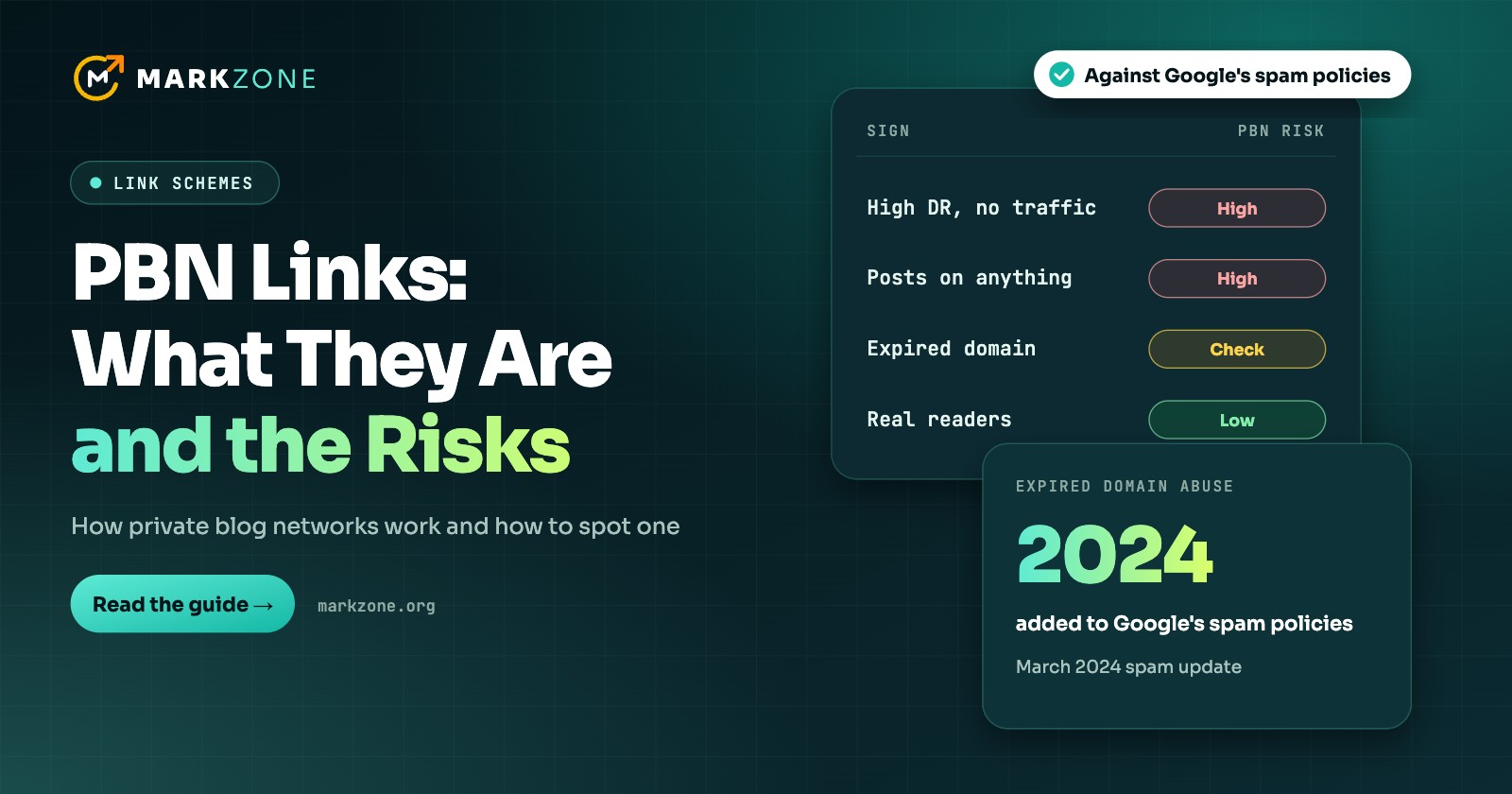
A PBN is a set of sites kept to pass links. One owner runs them, usually on expired domains that still carry old backlinks.
Google treats PBN links as link spam. Its spam policies cover links bought to pass ranking credit, and Google’s John Mueller called PBNs “just link schemes like others have been for many years.”
Traffic gives most networks away. Look for a strong rating with no readers. About one in five of our catalog’s DR 50+ sites (722 of 3,856) has no Ahrefs traffic.
PBN links are backlinks from a private blog network: a group of websites that one person or company controls and keeps mainly to link out. Most are built on expired domains that still have backlinks, so they score well in SEO tools without having an audience. Google counts these links as link spam, and its staff call PBNs link schemes. A network can lift rankings until Google’s systems connect its sites. After that, the links usually stop counting, and a site with a pattern of such links can get a manual action.
PBNs compete with our own products, guest posts and link insertions on independent publishers’ sites, so we’re not neutral. Google’s position below is quoted from Google or from dated reports. Markzone figures are from our 13 November 2026 catalog snapshot, except the DR and traffic shares of the $20 sites, which we published on 8 November 2026.
- What is a PBN?
- What Google’s rules say about PBN links
- Google and link networks: a dated timeline
- Do PBN links still work?
- What a high DR without readers looks like in our catalog
- How to spot a PBN: eight signs
- Should you buy PBN links?
- What to do if you already have PBN links
- Frequently asked questions
- Sources
What is a PBN?
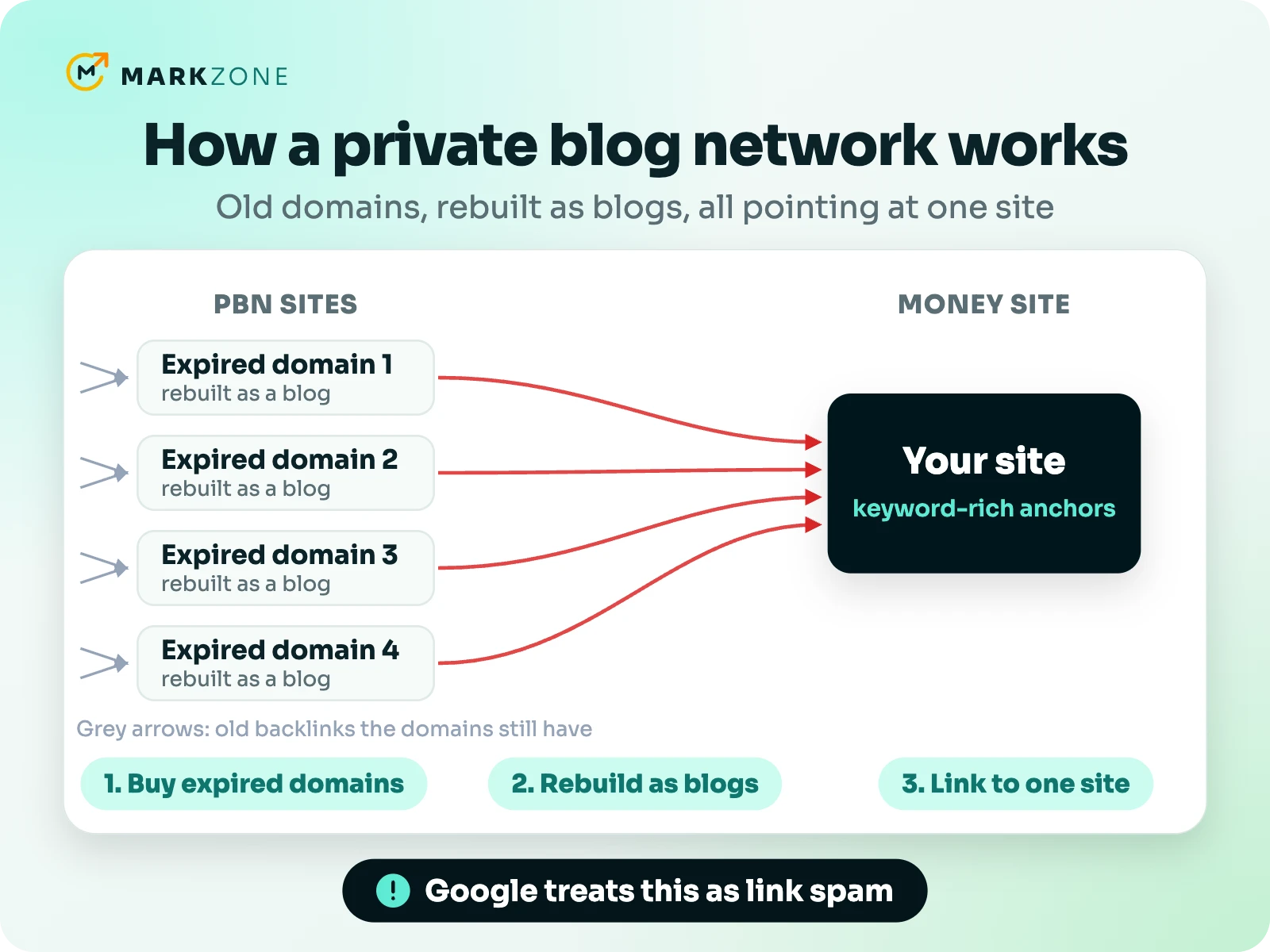
PBN stands for private blog network: private because one owner controls every site, and a network because the sites exist to pass links, to the owner’s projects or to paying customers. Most are put together in four steps:
- Buy expired domains that still have backlinks, often from closed businesses or projects.
- Rebuild each one as a blog with cheap articles on general topics.
- Hide the connection with different hosts, themes, registrars and author names.
- Link out to a “money site”, often with keyword-rich anchor text.
PBN links are sold as single posts, homepage links or monthly rentals, usually advertised by Domain Rating (DR) or Domain Authority. That score comes from the domain’s old backlinks, not from anyone reading the site today, as our guide to Domain Rating explains.
What Google’s rules say about PBN links
Google’s spam policies, updated on 28 August 2026, judge a link by its purpose: link spam means links made mainly to manipulate rankings. The first example listed, “Buying or selling links for ranking purposes”, is what a PBN sells. The list also names low-value content made to manipulate link signals, which describes the filler posts around the links.
Since 5 March 2024, Google’s spam policies have also covered expired domain abuse: an expired domain “purchased and repurposed primarily to manipulate Search rankings by hosting content that provides little to no value to users.” Google’s example is a former medical site turned into “low quality casino-related content.” It adds: “It’s fine to use an old domain name for a new, original site that’s designed to serve people first.” That policy concerns what a recycled domain hosts; the links it sells fall under link spam.
Paid links aren’t banned outright. Where links are bought and sold for advertising or sponsorship, Google’s spam policies see the trade as “a normal part of the economy of the web.” The links are fine “as long as they are qualified” with rel="nofollow" or rel="sponsored". A PBN link is sold to pass ranking credit, so it is unqualified by design. Asked on Twitter in May 2021 about leaked PBNs, Mueller wrote: “There’s nothing unique about PBNs, they’re just link schemes like others have been for many years.”
Google and link networks: a dated timeline
| Date | What happened (source) |
|---|---|
| March 2012 | Google hit paid blog networks. Participants were “penalized and some deindexed by Google completely,” and “BuildMyRank.com confirmed they were hit and is offering refunds to customers” (Search Engine Roundtable, 27 March 2012). |
| December 2013 | Matt Cutts, then Google’s head of search spam, announced action against another network with a mocking tweet: “‘There are absolutely NO footprints linking the websites together’ Oh, Anglo Rank.” Days later, some Anglo Rank customers said they had received penalty notices (Search Engine Roundtable, 9 and 11 December 2013). |
| September 2014 | SEOs reported “hundreds, if not thousands, of manual action notifications” to sites in private blog networks, many for thin content. Google “has not confirmed or denied these reports” (Search Engine Roundtable, 23 September 2014). |
| September 2016 | Penguin joined Google’s core algorithm, now “real-time” and adjusting rankings for spam signals instead of demoting whole sites (Google, 23 September 2016). |
| May 2021 | Mueller: “Usually nobody has to leak a PBN, they’re pretty obvious to the appropriate tools & basic scripts” (Search Engine Roundtable, 17 May 2021). |
| December 2022 | Google said its SpamBrain system now spots link buyers as well as sites that exist to pass links on, and that the credit those links pass is lost (Google, 14 December 2022). |
| March 2024 | Expired domain abuse became a named spam policy (Google, 5 March 2024). |
Two lessons for buyers:
- Buyers get hit too. In the Anglo Rank case, it was customers who reported the penalty notices.
- Enforcement got quieter. Manual actions come with a notice in Search Console, but we have found no Google page promising one when its systems simply stop counting links. That’s our reading: a buyer can pay for months for links that no longer count.
Do PBN links still work?
Sometimes, for a while, which is why networks still find buyers. A new network can pass ranking credit until Google’s systems connect its sites, and nobody outside Google knows how long that takes. Then the rankings it propped up fall back, and the money is gone.
What a high DR without readers looks like in our catalog
The PBN signal you can measure from outside is a rating with no audience behind it. Our guest post price study shows how common that is among sites that sell links, ours included:
- High DR, no traffic. Ahrefs records no organic traffic for 722 of our 3,856 DR 50+ sites, about 19%. Across all 18,977 sites with a listed price, 7,133 (38%) show none.
- DR costs little. Of the 4,492 sites listed at $20, our lowest price, half are rated DR 30 or higher and about one in five DR 50 or higher. Yet only 15% get 1,000 or more monthly visits.
- At DR 90 to 100, the 74 priced sites have a median of $30, the same as DR 0 to 9 and the lowest of any DR 50+ band. Several are subdomains of shared addresses like it.com and us.com, whose rating seems to belong to the parent domain.
| DR | Typical price, 1,000+ monthly visits | Typical price, under 1,000 visits | Under-1,000 price as a share |
|---|---|---|---|
| 50–59 | $160 | $40 | 25% |
| 60–69 | $240 | $80 | 33% |
| 70–79 | $400 | $100 | 25% |
| 80–89 | $500 | $120 | 24% |
| 90–100 | $540 | $20 | 4% |
Median price per guest post by DR band and Ahrefs organic traffic, Markzone catalog, 13 November 2026. We calculated the last column, for example $40 ÷ $160 = 25%.
From DR 50 to 89, a site with under 1,000 monthly visits typically costs a quarter to a third as much as one with the same rating and real traffic. Treat a high-DR quote in that range as a sign the readers are missing, then check. That doesn’t prove a network, since many low-traffic sites are small, honest blogs. But a strong score with no audience is common and cheap, and that is the gap PBNs fill.
How to spot a PBN: eight signs
No single sign proves a network; several together usually do.
| Sign | How to check | What we treat as a warning |
|---|---|---|
| A rating without readers | DR against organic traffic in Ahrefs or Semrush | DR 50+ with no traffic, or a price at a quarter or less of its DR band’s median with traffic |
| A different past | The Wayback Machine (web.archive.org) | Another business, cause or language before it became a blog |
| Every topic at once | Titles of the last 20 posts | Mortgages, gardening and esports in the same week |
| A sold link in every post | 5 to 10 recent posts | Most link to a business with a keyword anchor |
| Nobody behind it | Named authors, address, comments, social accounts | Stock bios and a contact form only |
| Filler content | Two posts, read in full | Text that would fit any site and exists to hold a link |
| Homepage links for sale | The seller’s offer | Any homepage or “permanent sidebar” link |
| A shared footprint | A sentence from the About page, searched in quotes | The same text or author names on several domains |
Our rule: one sign means look closer. Two or more, with the first among them, and we’d skip the site.
Example (hypothetical offer, real catalog medians). A seller offers a post on a “DR 76” site for $45. Our DR 70–79 medians are $400 with 1,000+ monthly visits and $100 with fewer. So $45 is about 11% of the first and under half of the second: expect few readers. If Ahrefs then shows almost no organic traffic and the Wayback Machine shows a different organization on the domain a few years ago, that’s two signs, and we’d stop.
Should you buy PBN links?
PBN links are sold as cheap, strong and fast. They’re cheap because the seller keeps the domains and you carry the risk. If a network is found, the seller loses some sites, and you lose the rankings and do the clean-up.
Before you pay, ask: can the seller show organic traffic in a tool you can check? Would you be comfortable if a Google reviewer or your client saw the link? Could your business cope if those rankings vanished next month? For a site you depend on, our answer is no.
| Guest post on a real site | PBN link | |
|---|---|---|
| Who the site is for | Readers who come for its topic | Link buyers |
| Under Google’s paid-link rule | Unlabeled, it’s link spam: Google can ignore it, and a pattern can lead to a manual action. Marked rel="sponsored" or rel="nofollow", it complies | Sold to pass ranking credit, so it can’t comply, and a whole network can lose its value at once |
Paying for a placement doesn’t make a link bad; the site and the label decide that. Links in our catalog are dofollow by default unless the publisher marks them otherwise, and you can ask for a sponsored label on any order. A sponsored or nofollow label is what Google asks for on paid links, not a warning sign. Run the checks above on any site, including those in our catalog. Google’s paid-link rules are covered in full in our guide to buying backlinks.
What to do if you already have PBN links
- Open Search Console’s Manual Actions report. A green check mark there means Google has taken no manual action against your site.
- Stop paying, and cancel any rentals.
- Map the network. Mark backlinks showing the signs above. Ahrefs’ Referring IPs report groups referring domains “by individual IPs and subnets,” which can expose network sites on shared hosting.
- Ask the seller to remove the links, and keep a record.
- Disavow only for a manual action or for many network links you can’t get removed. See how to disavow backlinks for the steps.
- Replace them with links from sites that have readers, or ask us for a shortlist.
Frequently asked questions
Is it a PBN if I own several sites that link to each other?
Not by itself. Linking related sites you run is normal when it helps a reader. Google’s test is purpose, not ownership: sites that exist mainly to point at one money site are a network, whoever owns them.
Is a PBN link safe if it’s marked nofollow or sponsored?
It’s within Google’s rules then, but it defeats the reason people buy one. Since 2019, Google has treated nofollow and sponsored as hints, so a marked link may pass nothing, and a site without readers sends no visitors either.
How can I tell whether a seller’s sites belong to one network?
Check where they link. Ahrefs’ Linked domains report lists “the unique domains that a target website links out to.” If several of the seller’s sites link to the same handful of businesses, they are probably run together.
Sources
- Google Search Central: Spam policies for Google web search (last updated 28 August 2026)
- Google Search Central Blog: What web creators should know about our March 2024 core update and new spam policies (5 March 2024)
- Google Search Central Blog: December 2022 link spam update releasing for Google Search (14 December 2022)
- Google Search Central Blog: Penguin is now part of our core algorithm (23 September 2016)
- Google Search Central Blog: Evolving “nofollow”, new ways to identify the nature of links (10 September 2019)
- Search Console Help: Manual Actions report (checked 16 November 2026)
- Search Engine Roundtable: Google Penalizes Blog Networks, Did SEOs Use It To Hurt Competitors? (27 March 2012)
- Search Engine Roundtable: Google’s Matt Cutts Calls Out Nailing Another Link Network (9 December 2013)
- Search Engine Roundtable: Google Penalty Notifications Sent To Anglo Rank Link Buyers (11 December 2013)
- Search Engine Roundtable: Report: Google Severely Hits PBNs (Private Blog Networks) (23 September 2014)
- Search Engine Roundtable: Google: PBNs Are Pretty Obvious (17 May 2021, quoting Mueller’s tweets of 14 May 2021)
- Ahrefs Help Center: What are linked domains? (3 September 2026)
- Ahrefs Help Center: How to check referring IPs to a website in Site Explorer (3 September 2026)
- Markzone guest post price study (catalog snapshot of 13 November 2026)
- Markzone: Cheap link building, what you get for $20 vs $200 (8 November 2026; DR and traffic shares of the 4,492 sites at $20)
Want links from sites people actually read?
Share your niche and target pages. We’ll send publishers with real organic traffic you can verify.

Muhammad Suleman is the founder of Markzone. He has done guest posting and link building since 2018 and has worked with hundreds of clients. Today his team handles 300–400 orders a month for brands and SEO agencies, with publisher sites in every major niche. He leads outreach, site checks and reporting, and writes about link building from his daily work with publishers and clients.