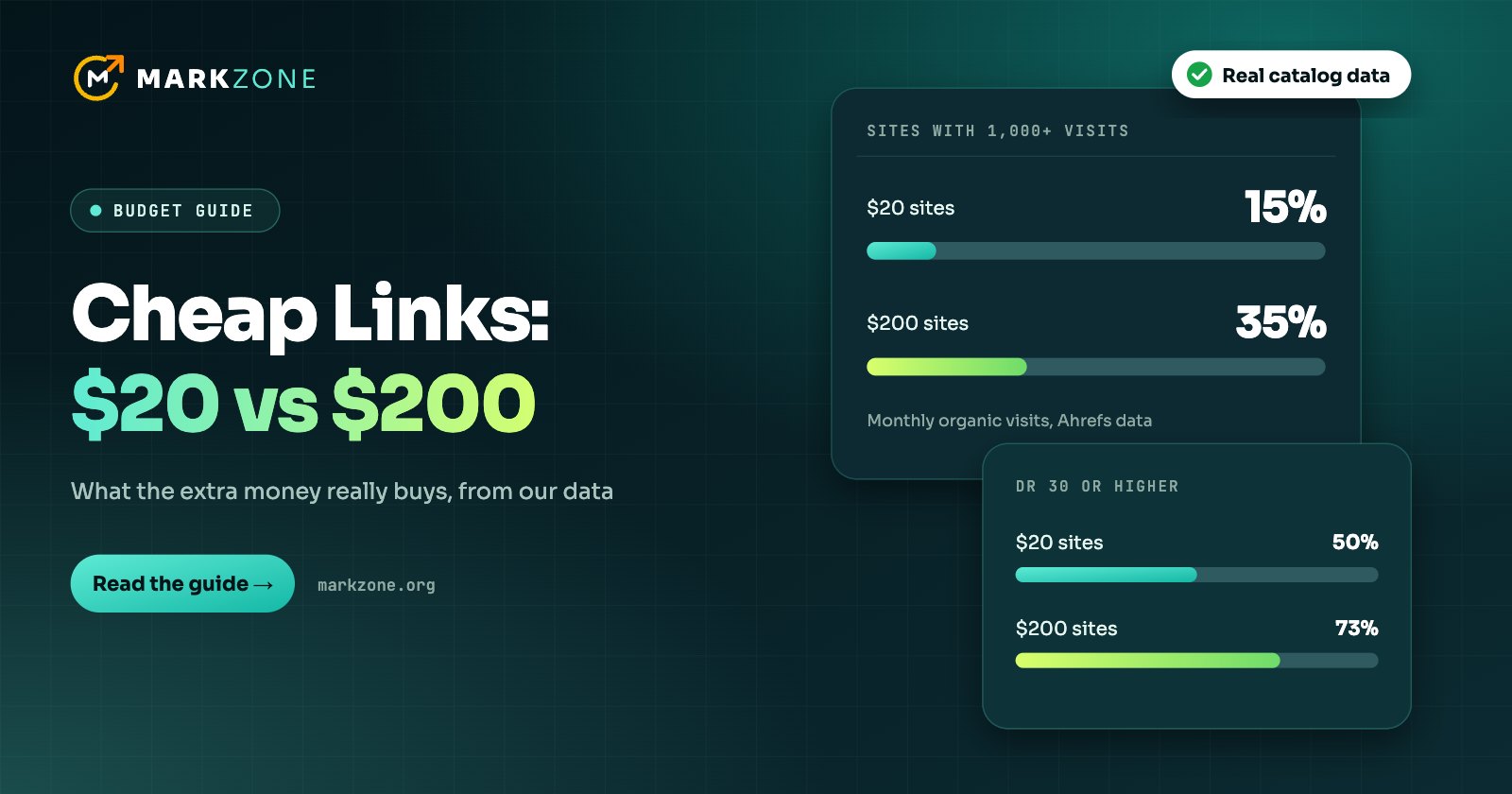
Cheap isn’t the problem, bad sites are. A $20 link from a relevant site with real traffic can be worth more than a $200 link from a site that sells to anyone.
$200 buys better odds, not a guarantee. In our catalog, 35% of $200 sites get 1,000+ monthly organic visits, against 15% of $20 sites.
Skip bulk link packages. Offers like “1,000 backlinks for $10” usually rely on automated or spammy links, which Google treats as link spam.
Cheap link building works when the cheap links come from real, relevant sites that people actually visit, and it fails when “cheap” means bulk packages from spam networks. In our own catalog, a $200 site is more than twice as likely as a $20 site to get 1,000 or more monthly organic visits. Still, most sites at both prices get fewer than that. So judge each site, not the price tag.
Our own prices start at $20, so cheap links are a question close to home. The numbers below come from our catalog of 22,000+ publisher sites, not from guesses.
What $20 and $200 links get you
In November 2026, our catalog listed 4,492 sites with a guest post price of $20, the lowest price we list, and 437 sites at $200. Here is how they compare on Ahrefs data:
| $20 sites | $200 sites | |
|---|---|---|
| Sites in our catalog | 4,492 | 437 |
| DR 30 or higher | 50% | 73% |
| DR 50 or higher | 19% | 30% |
| 1,000+ monthly organic visits | 15% | 35% |
| 10,000+ monthly organic visits | 4% | 15% |
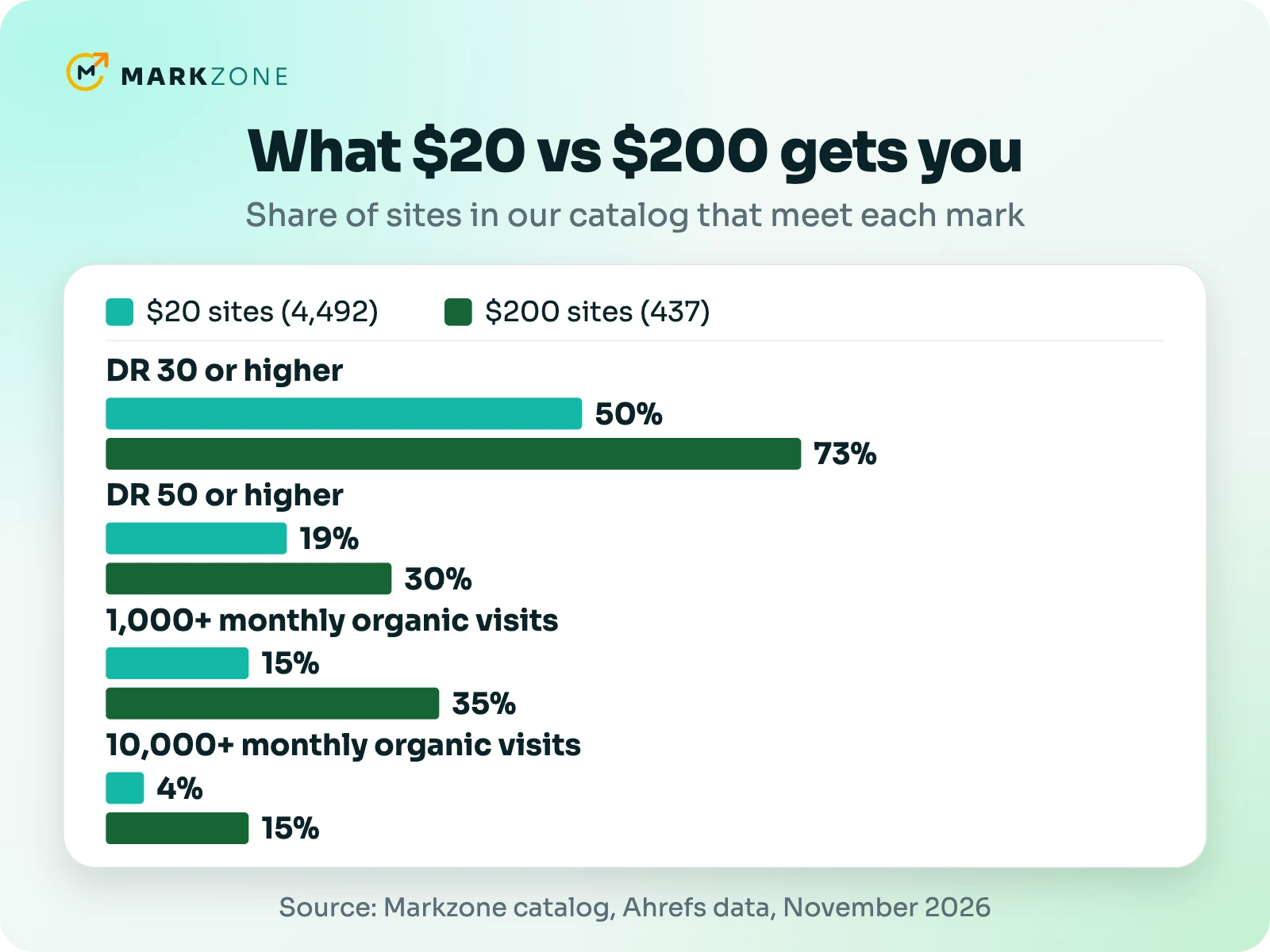
Three things stand out:
- DR is cheap. Half of the $20 sites have a DR of 30 or more, so a decent DR alone is not worth paying extra for.
- Traffic is what costs money. A $200 site is more than twice as likely to get 1,000+ monthly organic visits, and almost four times as likely to get 10,000+.
- Price is no guarantee. About two in three $200 sites still get fewer than 1,000 visits a month, while 675 of the $20 sites get 1,000 or more.
When cheap links make sense
A cheap link is worth buying when the site would be worth a link at any price. It covers your topic, its traffic is real and steady, and your link sits inside a useful article. Small niche sites often fit that description: they tend to charge less than big brands, but that doesn’t make their links worth less.
Cheap links also make sense when you are testing. A few well-chosen $20–50 links can show whether links move your page before you commit a bigger budget. The money you save can go into the content on the page you are linking to.
Cheap links to avoid
Some links are cheap because they are worthless or risky. Google’s spam policies give examples of link spam, including:
- “Using automated programs or services to create links to your site”
- “Low-quality directory or bookmark site links”
- “Widely distributed links in the footers or templates of various sites”
- “Forum comments with optimized links in the post or signature”
Google described its SpamBrain system in its December 2022 link spam update. It said SpamBrain “can now detect both sites buying links, and sites used for the purpose of passing outgoing links.” Any credit passed by unnatural links, it added, is lost. So a pile of spammy links is, at best, money wasted. Watch for these red flags:
- Hundreds of links for a few dollars.
- No organic traffic, or traffic that spiked and then crashed.
- Recent posts full of links to casinos, payday loans or pills.
- A seller who won’t show you the site before you pay.
How cheap sellers keep prices low
Low prices have to come from somewhere. When a seller is far cheaper than everyone else, find out which of these they cut:
- Editorial checks. Some sellers only use sites that publish anything for anyone who pays.
- The article. A thin or spun article adds little for the site’s readers, and a site that accepts it probably accepts anything.
- Placement. The link may go in an author bio, sidebar or footer instead of the body of the article.
- Protection. Many cheap offers don’t replace a link if it is removed, so ask before you pay. We replace any of ours that disappears within 8 months, or refund you.
- Transparency. Some sellers won’t name the site before you pay, so you can’t check it.
How to compare a $20 site with a $200 site
Look at what you get per visitor, not just per link. A $20 site with 2,000 monthly organic visits costs $10 per 1,000 visits, while a $200 site with 5,000 visits costs $40. The cheaper site isn’t automatically better, but the math shows you what the extra money buys.
Then check the rest: relevance, where your link will sit and who else the site links to. A DR score helps you compare sites, but it is easy to inflate, as we explain in what is Domain Rating. Our guide to good backlinks covers the full checklist.
Filter 22,000+ publisher sites by price, DR and Ahrefs traffic.
Cheap ways to get links without buying
If your budget is close to zero, spend time instead of money. Pitch guest posts to relevant sites; our guest posting outreach guide shows how. You can also answer journalists’ requests for expert quotes and suggest your page as a replacement for broken links. Finally, ask sites that mention your brand to link to you. These links take longer to get, but they cost nothing beyond your time.
Frequently asked questions
Are cheap backlinks bad?
Not always. A cheap link from a relevant site with real traffic can help. Cheap links are bad when they come from spam networks, automated tools or sites that sell links to anyone.
What do 1,000 backlinks for $10 get you?
Usually links from automated tools, low-quality directories, forum posts or spam networks. Google lists these as link spam and says credit from unnatural links is lost, so you pay for links that don’t count.
How much should a good backlink cost?
It depends on the site’s traffic, authority and niche. In our catalog, prices start at $20, and many of our clients choose sites in the $200–300 range. Our link building pricing guide shows outside averages by DR and traffic.
Can cheap backlinks get my site penalized?
They can. Google says sites that violate its spam policies “may rank lower in results or not appear in results at all,” and human reviewers can apply a manual action. Google also neutralizes spammy links, so the money spent on them is lost.
Is a $200 link always better than a $20 link?
No. In our catalog, about two in three $200 sites get fewer than 1,000 monthly organic visits, while hundreds of $20 sites get more. Check the site, not the price.
Want low-cost links that actually count?
Tell us your budget, and we’ll suggest low-cost sites that still have real traffic.

Muhammad Suleman is the founder of Markzone. He has done guest posting and link building since 2018 and has worked with hundreds of clients. Today his team handles 300–400 orders a month for brands and SEO agencies, with publisher sites in every major niche. He leads outreach, site checks and reporting, and writes about link building from his daily work with publishers and clients.