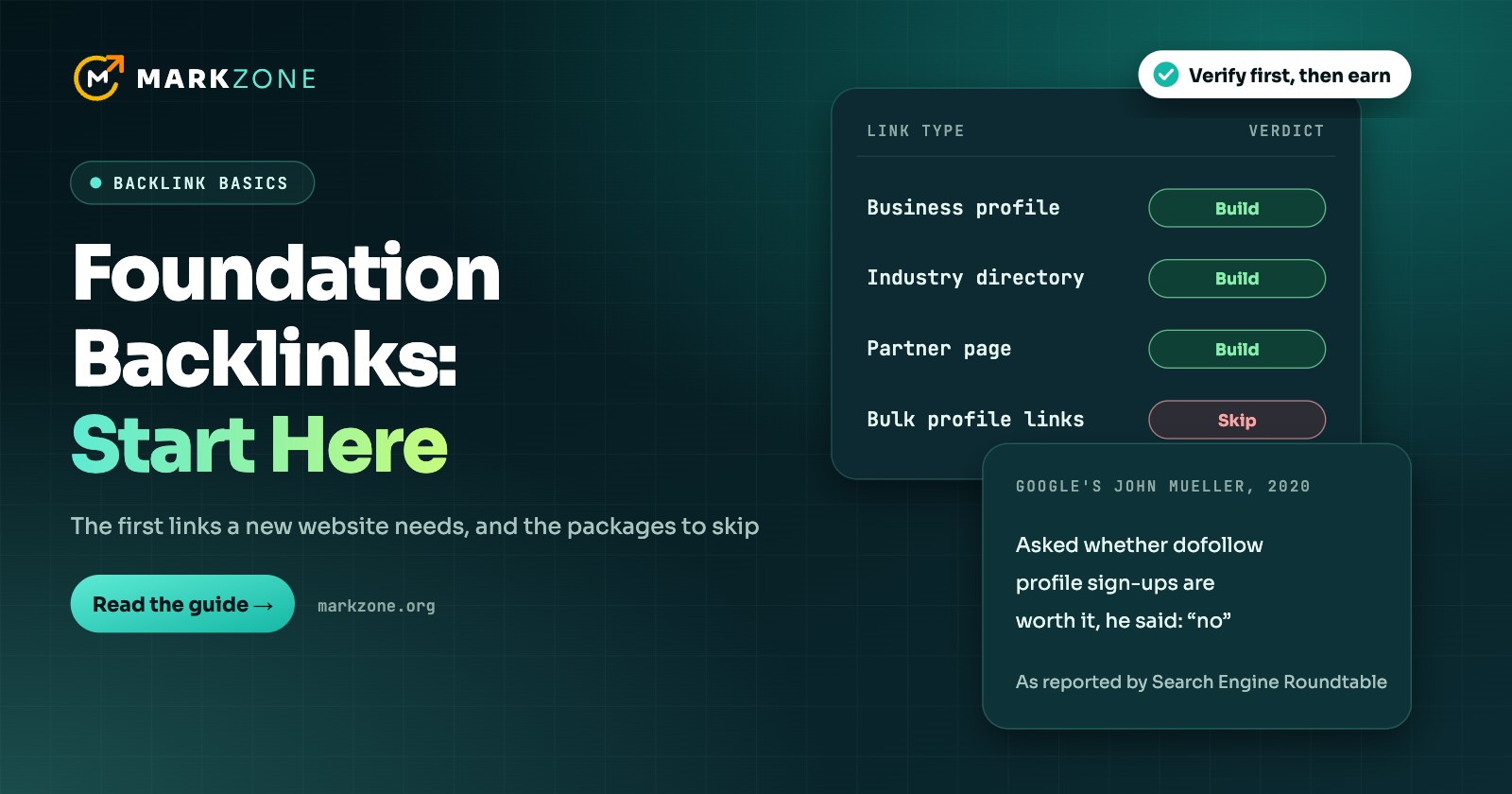
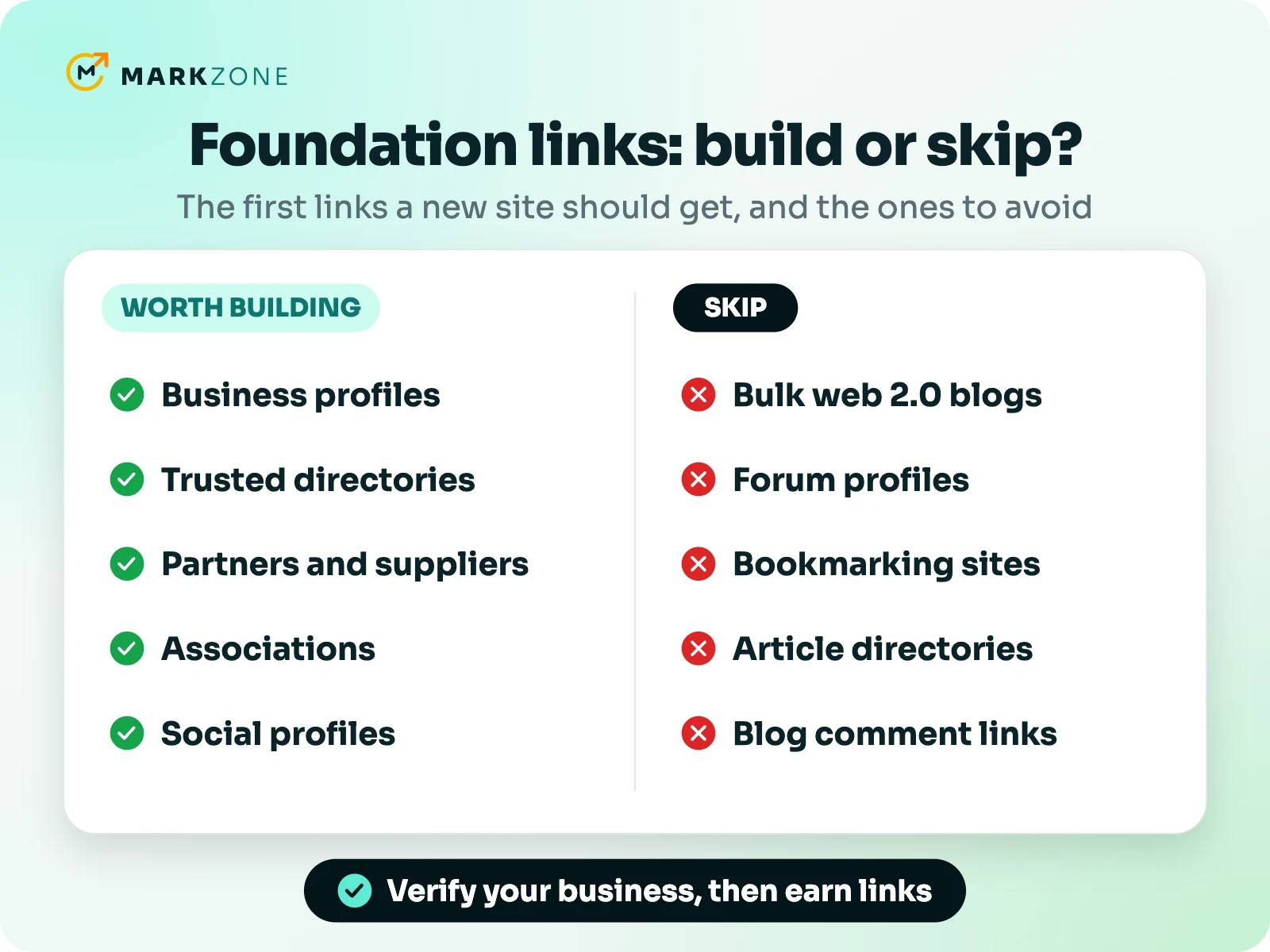
Foundation links come from being a real business. Business listings, a few directories your buyers use, and pages run by your suppliers, partners and associations. Most cost time or membership dues, not link fees.
Skip the packages sold under the same name. Bundles of bookmarks, forum posts and web 2.0 blogs match examples on Google’s link spam list. Google’s John Mueller answered “no” about profile links in 2020 and again in 2022.
A platform’s rating is not your page’s strength. In our catalog, sites rated DR 90 or more with under 1,000 monthly search visits have a median price of $20, our lowest price. A high rating with little search traffic sells at the bottom of the list.
Foundation backlinks are the first links a new website should get. They include its business listings, a handful of directories that customers really use, and the supplier, partner and association pages that mention it because the relationship is real. On their own they rarely move rankings. They confirm that the business exists, give customers more ways to reach the site and give its link profile a natural base before stronger links arrive. The packages sold as “foundation backlinks” are a different product, built from link types that Google’s spam policies and its staff have warned against by name.
Markzone makes its money from guest posts and link insertions, and both belong to the stage after this one. Almost nothing in this guide needs a vendor, us included.
- Two meanings of “foundation backlinks”
- The starter set for each kind of site
- Is a directory worth joining? Five checks
- What Google said about directories and profile links, and which directories closed
- Why high-authority profile packages are a poor buy
- Build them in this order
- Frequently asked questions
- Sources
Two meanings of “foundation backlinks”
For most businesses, the phrase means the starter set they end up with anyway. It includes a Google Business Profile, an entry in the trade association’s member directory, a supplier’s “where to buy” page. For link sellers, it means a product. A December 2025 article on these packages says a “comprehensive foundation package typically includes mini-blogs on established Web 2.0 platforms.” It adds forum and education-site profiles, document uploads and directory listings.
One question separates the two: would the link still exist if search engines ignored links? A supplier lists you because its customers need to find you. A web 2.0 blog set up by a package seller has no reader to serve.
The starter set for each kind of site
What a new site can get depends on how it meets customers. Google’s own rules split the field: a business “must make in-person contact with customers during its stated hours” to qualify for a Business Profile. The list of ineligible businesses includes “Brands, organizations, artists, and other online-only businesses.”
| Your site | Listings to claim | Relationship links to ask for | Leave out |
|---|---|---|---|
| Local business that meets customers in person | Google Business Profile, plus the business listings Bing and Apple run for their maps | Suppliers’ stockist pages, your chamber or trade body, local groups you belong to | Mass submissions to directories nobody in your town uses |
| Online-only store, app or service | No Business Profile. Brand profiles on the marketplaces, app stores, review sites and communities your buyers use | Brands you stock, partners that publish customer lists or case studies | A virtual office to qualify: Google says such a location “isn’t eligible for a Business Profile” |
| B2B services firm or agency | Clutch, which says it makes it easy “to find the right partners,” and your trade association’s member list | Clients’ case studies, vendors’ partner directories, conference speaker pages | General business directories that accept anything |
| Software or developer tool | Your GitHub organization and the review sites in your category | Integration partners’ app directories | Profile links on forums you will never post in |
Each type has its own guide with the next steps: local, ecommerce, B2B and SaaS.
Is a directory worth joining? Five checks
When Google removed directory submission from its guidelines in October 2008, Mueller explained the change in a Google Groups thread. If a directory will “bring them lots of visitors,” it’s “obviously fine to get listed there.” Visitors are still the right test. Run each candidate through these checks:
| Check | How to test it | Join if | Skip if |
|---|---|---|---|
| Buyers use it | Search as a customer would, for example “[service] [town]” or “best [category] software” | It shows up on page one for searches your buyers make | You only find it on lists of places to submit a URL |
| Someone reviews entries | Read the listing rules | It verifies businesses, edits entries or requires membership | Any submission goes live at once |
| It covers your field or area | Open a category page | The listings are your trade, industry or region | Unrelated businesses share one page |
| Listings are real pages | Open three listings | Each has details, photos, reviews or contact information | Pages hold little beyond outbound links |
| The fee buys exposure | Read what the paid plans include | It’s free, or membership in a body you would join anyway | The main thing for sale is a followed link, which makes it a paid link under Google’s policies |
A nofollow attribute is no reason to drop a directory that passes. Google stopped treating nofollow as a hard block in September 2019, when it called all three link attributes “hints about which links to consider or exclude within Search.” And the visitors arrive either way.
What Google said about directories and profile links, and which directories closed
| Date | Source | What it said |
|---|---|---|
| Until October 2008 | Google’s Webmaster Guidelines | “Submit your site to relevant directories such as the Open Directory Project and Yahoo!,” plus industry-specific expert sites |
| 3 October 2008 | Search Engine Roundtable, on that line’s removal | Mueller: “I just think it’s not one of the things we really need to recommend.” |
| 31 December 2014 | Yahoo | Closing date for the Yahoo Directory, announced in September 2014 |
| 14 March 2017 | DMOZ | Announced closing date for the Open Directory Project |
| 28 January 2020 | Search Engine Roundtable, on a Reddit thread | Asked “Are dofollow profile sign ups worth it?”, Mueller answered “no.” |
| 30 September 2021 | Search Engine Roundtable, on Mueller’s tweets | In its summary, directory submissions, article submissions and bookmarking links are generally against Google’s guidelines and seen as artificial links |
| 10 September 2022 | Mueller on Twitter, reported on 14 September 2022 | Asked “Does profile creation/profile links work?”, he replied “No.” |
| Last updated 28 August 2026 | Google’s spam policies | Link spam examples include “Low-quality directory or bookmark site links,” “Forum comments with optimized links in the post or signature” and “Using automated programs or services to create links to your site.” |
Both directories Google once told site owners to join are gone. What the current policies single out is the low end: low-quality directories and bookmark sites, forum signatures and automated link building. They also name “low-value content primarily for the purposes of manipulating linking and ranking signals,” which describes a web 2.0 blog made only to carry a link.
Why high-authority profile packages are a poor buy
Packages are judged on the platforms’ metrics, not on readers. The same December 2025 article advises picking sellers who “disclose average domain metrics and index rates.” Those metrics describe someone else’s whole domain. Ahrefs, which publishes Domain Rating, draws the line itself: “UR is a page-level metric, whereas DR is a domain-level metric.” The DR in the sales pitch belongs to the platform, not to the profile page that would link to you.
Our catalog puts a number on a high rating with little search traffic. On 13 November 2026, buyers saw these prices:
- Same rating, very different price. Sites rated DR 90 to 100 with under 1,000 monthly search visits have a median price of $20. Those with 1,000 or more visits have a median of $540, 27 times as much.
- Borrowed ratings. Our catalog lists 74 priced sites rated DR 90+, and several of them sit on shared domains, it.com and us.com among them. Their rating seems to come from the parent domain, not from the site itself, the same position a profile page is in on a big platform.
- Ratings without search traffic are common. Missing traffic shows up even at high ratings: 722 of the 3,856 DR 50+ sites in our catalog and 7,133 of the 18,977 priced sites (38%) show none in Ahrefs.
So judge a starter link by who will see it. A supplier’s “where to buy” page that your customers open does more for you than a profile on a DR 95 platform that nobody visits.
Build them in this order
- Claim the listings that confirm who you are. If you meet customers in person, set up your Google Business Profile, which Google says is free, and the listings Bing and Apple run for their maps. Use the same business name, address, phone number and website on each. For local results, Google says prominence draws on “how many websites link to your business” as well as reviews.
- Ask the businesses you already work with. Suppliers, distributors, partners, clients and associations often keep pages that list who they work with. Ask where a listing helps their visitors, and don’t make it a link-for-link deal: Google’s link spam examples include “partner pages exclusively for the sake of cross-linking.”
- Add the directories that pass the five checks. Stop when the list runs out, not when you reach a number.
- Set up the profiles people will look at. A LinkedIn company page, the social accounts you will actually post on and, if you ship code, a GitHub organization. They answer the questions buyers and journalists ask before they get in touch.
- Then earn and buy links on sites with readers. Content, digital PR and guest posts come next, and link building strategies compares seven tactics by cost and speed. If you pay for placements, our guest post price study shows what search traffic costs. A site with 1 to 999 monthly search visits typically charges $60. One with 1,000 to 4,999 charges $130, and one with 5,000 to 49,999 charges $200. Sites with no search traffic typically charge $25, which looks like a bargain and has the package problem: few searchers. Google’s spam policies accept paid links for advertising and sponsorship “as long as they are qualified” with
rel="nofollow"orrel="sponsored". Placements in our catalog are dofollow by default unless the publisher marks them otherwise, and you may request a sponsored label on any order. When you get there, filter the catalog by traffic and niche. Or tell us your niche and goals and we’ll suggest which links to build first, starting with the free ones.
Frequently asked questions
Are foundation backlinks dofollow?
Some are and some aren’t, and it matters less than it seems. On 20 November 2026, the two GitHub organization pages we checked, Vercel’s and Supabase’s, marked the website link rel="nofollow". A chamber of commerce member page checked for our local guide linked to the member twice, once followed and once nofollow. Value these links for the people who click them and for confirming who you are, not for ranking credit.
Can an online-only business get citations?
Not through Google. A business that never meets customers in person is outside Google’s Business Profile rules, and a rented mailing address doesn’t change that. An online-only business starts with brand profiles on the platforms its buyers use, partner and supplier pages, and the review or comparison sites in its category.
How many foundation links does a new site need?
No number fits every site. A practical stopping rule: one listing on each platform your customers search, one link for each real relationship, and nothing that fails the five directory checks. If competitors still outrank you, the difference lies in editorial links; count it with the referring-domain gap method in how many backlinks you need.
Is it worth paying for a directory listing?
Only for its visitors or the membership behind it. A listing you pay for is a paid link under Google’s spam policies, which want paid links marked with rel="sponsored" or rel="nofollow". So a paid directory that adds one of those is following the rules. If the main thing a directory sells is a followed link, the fee buys risk rather than customers.
Sources
- Google Search Central: Spam policies for Google web search (last updated 28 August 2026)
- Google Business Profile Help: Business eligibility and ownership guidelines (checked 20 November 2026)
- Google Business Profile Help: Guidelines for representing your business on Google (virtual office rule, checked 20 November 2026)
- Google Business Profile: Stand out on Google with a free Business Profile (checked 20 November 2026)
- Google Business Profile Help: Tips to improve your local ranking on Google (checked 20 November 2026)
- Google Search Central Blog: Evolving “nofollow”, new ways to identify the nature of links (10 September 2019)
- Search Engine Roundtable: Directory Links Next? Google Drops Yahoo & ODP Directory from Guidelines (3 October 2008; quotes Mueller in the Google Webmaster Help group)
- Engadget: Yahoo’s old web directory still exists, but not for long (27 September 2014)
- Search Engine Roundtable: After 18 Years, DMOZ, The Web Directory, Is Closing Down (1 March 2017)
- Search Engine Roundtable: Google: Not Worth Signing Up For Dofollow Profile Links (28 January 2020)
- Search Engine Roundtable: Google: Directory, Article Submission & Bookmarking Links Are Against The Webmaster Guidelines (30 September 2021)
- Search Engine Roundtable: Google: Profile Links Are Not Enough (14 September 2022; Mueller’s tweet of 10 September 2022)
- IT Supply Chain: How Foundation Link Building Shapes Early SEO Success (10 December 2025)
- Ahrefs Help Center: What is URL Rating (UR)? (checked 20 November 2026)
- Clutch: About us (checked 20 November 2026)
- GitHub: Vercel organization page and Supabase organization page (page HTML checked 20 November 2026)
- Markzone: Local link building (chamber listing check of 16 November 2026)
- Markzone guest post price study (catalog snapshot of 13 November 2026)
Just launched a site?
Tell us your niche and goals. We’ll suggest which links to build first, starting with the free ones.

Muhammad Suleman is the founder of Markzone. He has done guest posting and link building since 2018 and has worked with hundreds of clients. Today his team handles 300–400 orders a month for brands and SEO agencies, with publisher sites in every major niche. He leads outreach, site checks and reporting, and writes about link building from his daily work with publishers and clients.