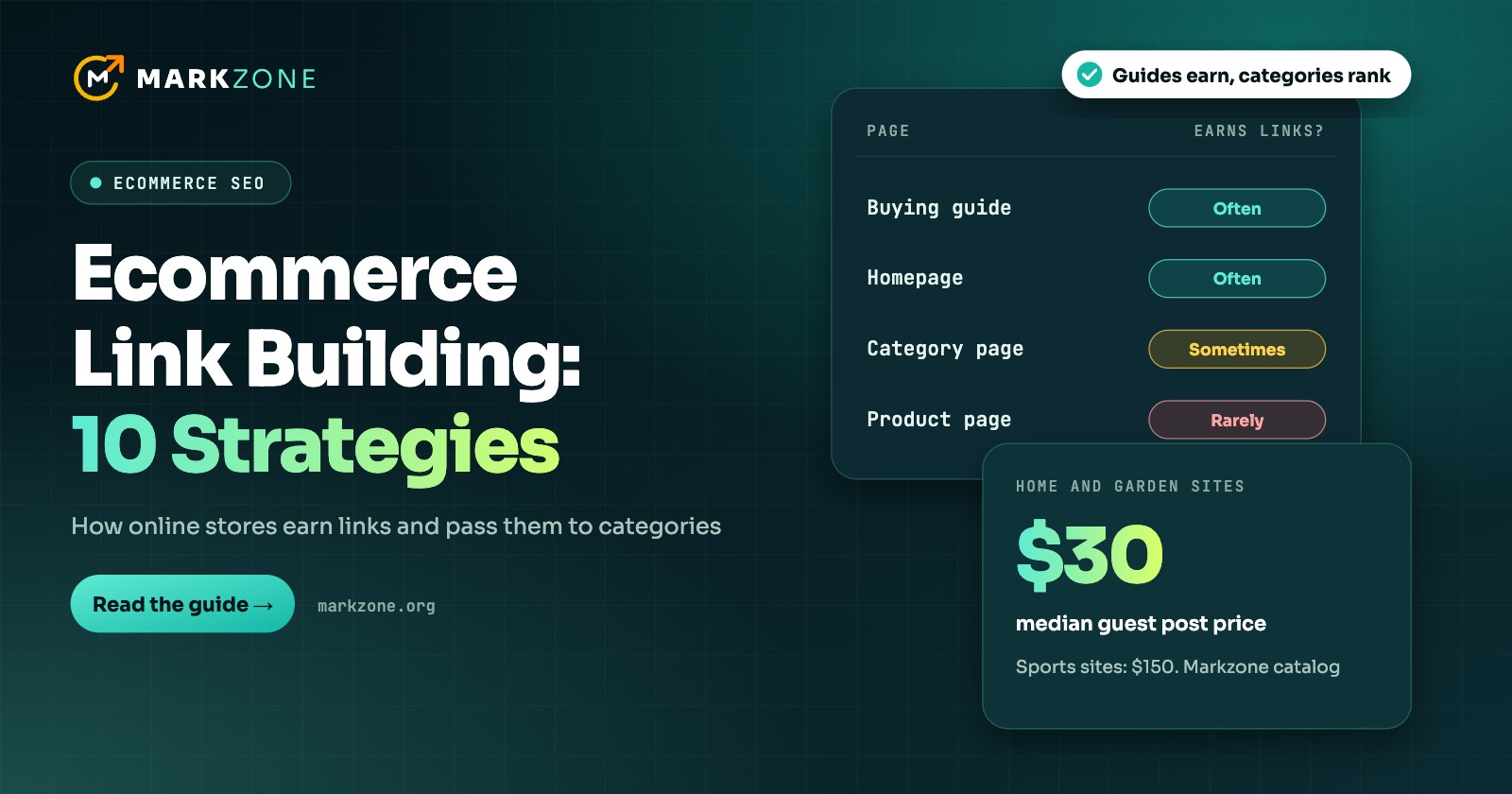
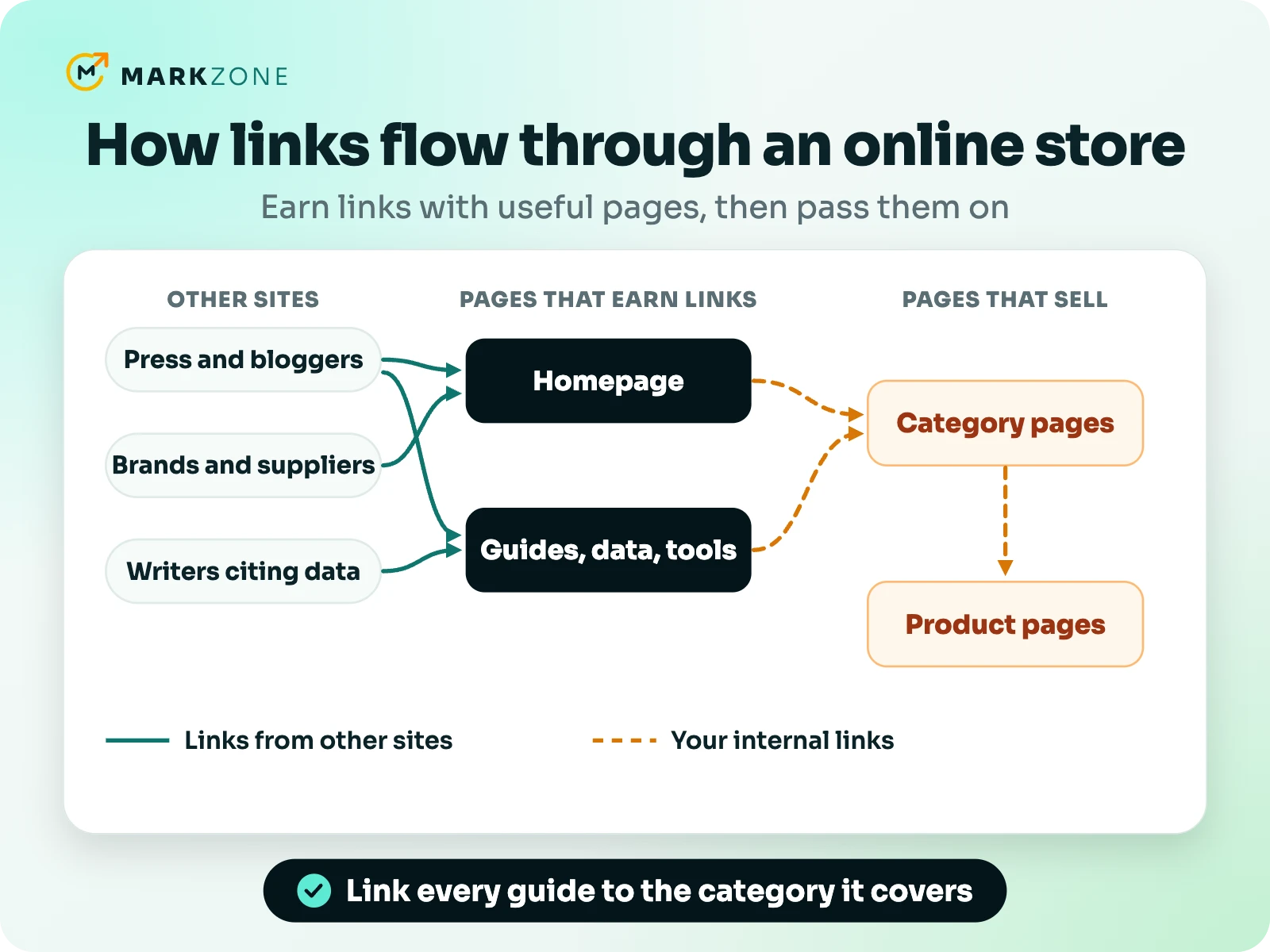
Earn links with pages people cite, then pass them on. Product pages rarely attract links. Guides, data and tools do, and internal links carry that value to categories and products.
Start with your supply chain. Brands you stock, suppliers and platform partners often list the stores they work with, and asking costs nothing.
If you pay, match the niche and the country. In our catalog, home-and-garden sites typically charge $30 a post and sports sites $150. Sites with mostly German traffic charge $390 against $50 for US traffic.
Ecommerce link building is getting other websites to link to an online store. Product and category pages rarely earn links on their own. Stores usually win them another way: listings from the brands and suppliers they work with, reviews and gift guides, original data, buying guides and tools, or paid placements on niche sites. Internal links then pass the value of those links to the categories and products that make money. If you give a product or pay for a link, Google expects the link to be qualified with rel="sponsored" or rel="nofollow".
Paid placements are our business: guest posts and link insertions are what Markzone sells. They are one of the ten strategies below, shown with our catalog’s prices so you can weigh them against the free ones.
Which pages should get the links?
Writers link to sources, explanations and tools, not to pages built to sell, and many shops carry the same products with the same manufacturer’s description. So decide which pages earn links and which receive them through internal links:
| Page | Links it tends to attract | Its job |
|---|---|---|
| Homepage | Brand mentions, press, supplier and partner listings | Usually your strongest page; passes value through the menu |
| Category pages | Gift guides, roundups, some resource lists | Target your most valuable keywords |
| Product pages | Reviews, gift guides, mentions of one item | Rarely earn links, so they lean on internal links |
| Guides, data and tools | Citations from writers, bloggers and journalists | Your link magnets; link from them to categories |
Google’s ecommerce guidance (last updated 10 December 2025) explains why the internal links matter: “As a general rule, the more links a page has to it within a site, the higher the relative importance of the page to other pages on your site.” For a best-selling product, it suggests “linking to it from the home page or in other content, such as blog posts or newsletters on your site.” It also says: “It’s strongly recommended to link to all products that you wish indexed.” So link each guide to the one or two categories it helps people shop, add breadcrumbs and related-product blocks, and make sure every product is reachable from a category.
Where to start, by type of store
| If your store… | Start with | Why |
|---|---|---|
| Stocks other brands | Their “where to buy” or stockist pages | The brand wants shoppers to find you |
| Makes its own products | Samples for reviewers and gift guide editors | The product itself is the story |
| Has a few years of sales data | One data piece on what sells, when and where | Data is what writers cite |
| Sells mainly outside the US | Sites whose readers live in your market | In our catalog, sites with mostly German traffic have a median price of $390, UK $105 and US $50 |
| Sells CBD | Sites that accept the topic, and a bigger budget | 7,753 catalog sites accept CBD, and where a site lists both prices, CBD typically costs 1.4 times the normal price |
| Also has a physical shop | Local links as well | Local media, events and suppliers know you already |
10 ecommerce link building strategies
1. Stockist and “where to buy” pages
Brands that sell through retailers often publish a list of the shops that carry them. Ask each brand you carry to add your store with a link, and mention that you’re an authorized seller. Search for the brand name with “stockists” or “where to buy” to find these lists.
2. Suppliers, platforms and partners
Your ecommerce platform, payment provider, courier and app vendors sometimes publish customer stories or partner directories. Offer a short case study with one real number, such as fewer failed deliveries. Keep partnerships real: Google’s spam policies name “partner pages exclusively for the sake of cross-linking” as link spam.
3. Product reviews from bloggers and creators
Offer samples to independent writers who already review products like yours. Two sets of rules apply. Google’s spam policies list “Sending someone a product in exchange for them writing about it and including a link” as link spam, so ask for rel="sponsored" or rel="nofollow" on the link. In the US, the FTC tells creators: “Disclose the relationship if you got anything of value to mention a product.” A labeled review still sends shoppers.
4. Gift guides and product roundups
Gift guides and “best of” lists run all year, and most of all before the holidays, so pitch early. Some charge for inclusion, so ask before you assume a spot is editorial. Search for “gift guide” plus your niche, and keep the pitch short. An example:
“Hi Sam, I saw your gift guide for new runners last year. Our reflective running vest, at $34, might suit this year’s list: it’s machine-washable and easy to see at night. Happy to send a sample and photos.”
5. Data and expert comment
Your orders show what sells by season, region or price point, and nobody else has that. An anonymized trend report or customer survey, with its method and a few reusable charts, can earn links from news sites and trade blogs. The same knowledge answers journalists who need a quick expert comment.
6. Buying guides and how-to content
Guides that help people choose, size, use or care for a product attract links from forums, blogs and resource pages. Write “what size road bike do I need,” not “our road bikes,” then link from the guide to the matching category.
7. Tools, calculators and size finders
A paint calculator, a ring-size chart or a coffee ratio tool answers a question people search for, and writers can’t easily recreate it inside their own article.
8. Brand mentions without links
Set up Google Alerts for your store and product names. If an article names your store but doesn’t link to it, email the writer and point to the page that would help their readers most.
9. Lost links from discontinued products
Redirect a discontinued product’s page to its closest replacement or its category, so links to it still lead shoppers somewhere useful. Then fix the URLs listed in a report such as Ahrefs’ Broken backlinks, which shows incoming links that point to “error 404” pages.
10. Guest posts and link insertions on niche sites
Writing for real sites in your product niche can bring relevant visitors as well as links. Here is how many sites in our catalog cover common store niches and what they typically charge, as of the 13 November 2026 snapshot in our price study:
| Store niche | Sites | Typical price | Middle half |
|---|---|---|---|
| Home and garden | 1,310 | $30 | $25 to $100 |
| Fashion and beauty | 689 | $30 | $20 to $110 |
| Technology | 3,752 | $30 | $20 to $100 |
| Food | 546 | $40 | $25 to $138 |
| Health | 809 | $50 | $25 to $130 |
| Automotive | 229 | $100 | $25 to $305 |
| Sports | 799 | $150 | $40 to $435 |
These medians mix sites with and without readers, and the study doesn’t split niches by traffic, so judge each site on its own traffic too. Across all niches, 7,133 of the 18,977 priced sites (38%) show no Ahrefs traffic, and sites with 1,000 to 4,999 monthly visits typically charge $130.
Match the audience too, because price tracks where a site’s readers are. Grouped by the main country in their search traffic, catalog sites have a median price of $50 for the US and $60 for Canada. Australia sits at $100, the UK at $105, France at $130 and Germany at $390. Sites with mostly Indian traffic charge $25, a saving that means little if you only ship within the US.
If you pay, the rule is in Google’s spam policies (last updated 28 August 2026): paid links are acceptable “as long as they are qualified” with rel="nofollow" or rel="sponsored". On that condition, Google calls buying and selling links “a normal part of the economy of the web.” Placements from our catalog come dofollow by default unless a publisher marks them otherwise, and a sponsored label can go on any order you place. Before you pay, is buying backlinks safe walks through the risks.
Browse publishers by niche, with organic traffic, DR and most prices shown up front.
What paid placements cost: a worked example
This is an example budget, not a client’s order. Say a store adds four guest posts a month, and every site charges the catalog median for its row:
| Sites you choose | Price per post | Four posts a month | Over three months |
|---|---|---|---|
| Home and garden, any traffic | $30 | $120 | $360 |
| 1,000 to 4,999 monthly visits | $130 | $520 | $1,560 |
| 10,000 to 49,999 monthly visits | $200 | $800 | $2,400 |
| Mostly German traffic, for a store selling in Germany | $390 | $1,560 | $4,680 |
On sites that list both prices, the typical discount for an insertion in an existing article, compared with a new post on the same site, is 20%. So two posts and two insertions on 1,000 to 4,999-visit sites cost about $468 a month instead of $520. A CBD store should expect about 40% more for the same sites. The first row is the cheapest, but only worth it if the sites have readers.
A 90-day plan for an online store
| When | What to do | Cash cost |
|---|---|---|
| Month 1 | Fix internal links from the homepage and guides to key categories. Ask for stockist and supplier listings. Set up mention alerts and redirect discontinued products. | None |
| Month 2 | Publish one guide, tool or data piece for your most important category. Pitch reviewers and gift guide editors with products from it. | Samples and shipping |
| Month 3 | Promote the new page to writers who cover the topic. Run a backlink gap analysis on two competing stores, and buy placements only where a gap calls for them. | None, up to the example above |
Then repeat for your next category. Each month, track new referring domains to your guides and categories, your main category rankings, the revenue your analytics credits to each referring site, and lost links to removed products.
Mistakes that cost stores the most
- Keyword anchors aimed at product pages. “Cheap leather boots” repeated across sites looks manipulative. Use your brand, the URL or a plain description, as keyword backlinks explains.
- Footer and template links from partners. Google lists “Widely distributed links in the footers or templates of various sites” among its link spam examples.
- Paying for DR without readers. A DR of 50 or more doesn’t prove an audience: 722 of the 3,856 such sites in our catalog show no Ahrefs traffic.
Mistakes that waste money on any site, not just stores, are covered in link building mistakes.
Frequently asked questions
Should links point to category pages or product pages?
Mostly to guides and categories. Category pages target bigger keywords, and Google says it can use “the number of links to a page to infer the relative importance of a page over the rest of your site.” So a well-linked guide that links on to a category helps both. Product pages pick up links on their own from reviews and gift guides that name a specific item.
Can I put two links in one guest post?
Often. In our catalog, 59% of sites let you link to your own site once per post, 37% twice and 4% three or more times. With two, point one at the guide that fits the article and one at the category it supports, using brand or descriptive anchors.
Do affiliate links count as backlinks?
They are links, but they shouldn’t pass ranking credit. Google introduced rel="sponsored" in 2019 for links “created as part of advertisements, sponsorships or other compensation agreements,” and a commission fits that description. An affiliate program pays off in sales and reach, not rankings.
Sources
- Help Google understand your ecommerce website structure, Google Search Central (last updated 10 December 2025)
- Spam policies for Google web search, Google Search Central (last updated 28 August 2026)
- Evolving “nofollow”: new ways to identify the nature of links, Google Search Central Blog (10 September 2019)
- Disclosures 101 for Social Media Influencers, Federal Trade Commission (November 2019)
- What are broken backlinks?, Ahrefs Help Center (3 September 2026)
- Google Alerts (accessed 16 November 2026)
- Guest Post Prices: What 18,977 Sites Charge, Markzone (catalog snapshot of 13 November 2026: niche, country and traffic-tier prices, niche edits, CBD surcharge, links per post)
- High Authority Backlinks, Markzone (12 November 2026: 722 of 3,856 DR 50+ sites with no Ahrefs traffic)
Want help finding the right sites for your store?
Tell us what you sell and where you ship, and we’ll suggest publishers in your niche with real traffic.

Muhammad Suleman is the founder of Markzone. He has done guest posting and link building since 2018 and has worked with hundreds of clients. Today his team handles 300–400 orders a month for brands and SEO agencies, with publisher sites in every major niche. He leads outreach, site checks and reporting, and writes about link building from his daily work with publishers and clients.