There is no official cut-off. Google doesn’t use DR or DA. We treat DR 50+ as high authority, and only about one in six sites in our catalog reaches it.
A high DR can be inflated. Check that the site has real traffic, a clear topic and real links behind its score before you count it as an authority link.
Earn them or pay for them carefully. Data, expert quotes and strong guest posts earn authority links. Bought links vary widely in price and quality.
High authority backlinks are links from strong, well-established websites, usually judged by a third-party score such as Ahrefs’ Domain Rating (DR) or Moz’s Domain Authority (DA). There is no official threshold. Some link builders reserve the label for DR 70 and above. We count DR 50+ as high authority, because only about one in six sites in our catalog reaches it. The links worth having also come from sites with real traffic and a topic close to yours, since a high score on its own can be inflated with spam.
Our catalog lists 3,856 sites with a DR of 50 or more, and we sell links on them, so weigh our view with that in mind. This guide also covers how to earn authority links without buying them, and how to spot a high DR that isn’t backed by a real site.
What counts as a high authority backlink?
Authority scores estimate how strong a site’s backlink profile is. Ahrefs says DR is “measured on a logarithmic scale from 0 to 100,” so each point is harder to gain than the last. Moz’s DA uses a similar scale of 1 to 100. Neither is a Google metric: John Mueller of Google has said “we don’t use domain authority at all in our algorithms,” as Search Engine Roundtable reported. We explain how the scores work in what is Domain Rating.
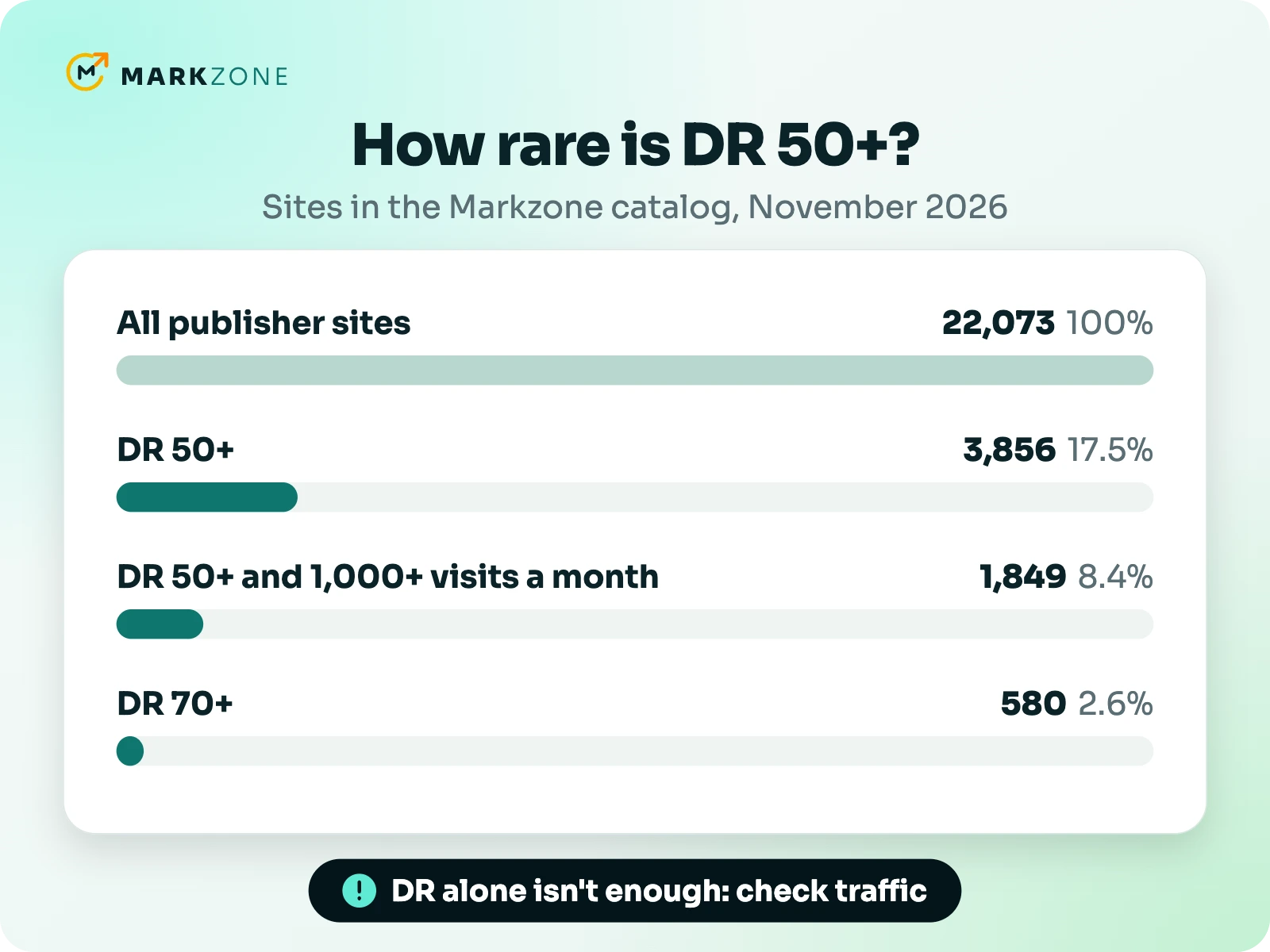
Where you draw the line is a choice. BlueTree describes high authority as typically DR or DA 70 or above, and Editorial.Link also points to sites with a DR over 70. We use DR 50 as the starting point because of how rare it already is. In our catalog of 22,073 publisher sites, the average DR is 31:
Authority also has to be relevant. Among the quality factors in Google’s guide to how Search ranks results is whether “other prominent websites link or refer to the content.” A respected site in your own field fits that description far better than a high-DR site that publishes anything for anyone.
How to check if a high DR is real
A high score is easy to sell, so check what is behind it. Ahrefs itself says in its guide to DR that “some black-hat SEOs found ways to inflate Ahrefs’ DR with link spam.” Joe Youngblood has documented how fake links were used to push up DA and, later, DR. Compare these signals:
| Signal | Real authority | Inflated authority |
|---|---|---|
| Organic traffic | Steady visits, in line with its DR | Little or no traffic despite a high DR |
| Who links to it | Known sites, many in its own field | Spammy, unrelated or strange redirect links |
| Content | Edited articles on a clear topic | Posts on anything, many of them sponsored |
| Outbound links | A few, relevant to each article | Casinos, loans or pills on recent posts |
| Traffic trend | Stable or growing over 12 months | A sharp drop after a Google update |
Traffic is the quickest check. Of the 3,856 DR 50+ sites in our catalog, 1,849 show at least 1,000 monthly visits in Ahrefs. Another 722 show no Ahrefs traffic at all. A site without traffic can still be legitimate, for example a strong brand that doesn’t rank for much, but it deserves a closer look before you pay. Check the page your link will sit on too. A new post linked from the homepage is worth more than a page buried in the archive. So is an existing article with its own links and traffic. Our guide to good backlinks covers the full list of checks.
Where to find high authority sites in your niche
- Your competitors’ links. In Ahrefs or Semrush, look at the sites that link to the pages that outrank you and filter them by authority, for example DR 50+ in Ahrefs. A site that links to several of your competitors already covers your topic.
- Gaps in your own profile. Ahrefs’ Link Intersect and Semrush’s Backlink Gap show sites that link to your competitors but not to you. Sites that link to several of them are often the easiest to approach.
- Big sites with outside writers. Look at bylines on the larger publications in your field. Many run contributor programs or publish expert columns.
- Your industry’s own bodies. Associations, trade publications, event organizers and suppliers tend to have strong, relevant sites.
- A filtered catalog. If you buy links, filter for DR 50+ and then sort by traffic, so the strongest real sites come first.
6 ways to get high authority backlinks
Strong sites get plenty of requests, so you need a better reason than most for them to link to you.
1. Publish data that others cite
Journalists and writers on big sites need numbers. An original survey, a study of your own anonymized data or a yearly report on your industry gives them a reason to link to you as the source. It is slow and takes real work, but one good dataset can earn links from sites you could never pitch directly.
2. Be an expert source for journalists
Many writers look for expert comments through journalist request platforms and on social media. A fast, specific answer from someone with real experience can earn a link from a news site or a large publication.
3. Guest post on strong sites in your niche
Some high-DR sites accept articles from outside writers. Pitch a topic their readers need, write it well and keep your link in the body with a natural anchor. The full process is in our guide to guest posting for SEO.
4. Get added to strong pages that already exist
A link insertion on a high-DR site puts your link on a page that may already rank and have its own links. Choose pages that are relevant and get traffic, not just a strong domain. Our guide to niche edits covers how to check one.
5. Replace broken links on authority sites
Large sites have old articles with links to pages that no longer exist. Find those dead links in your field, make sure you have a page that does the same job, and suggest it to the editor.
6. Use your real-world relationships
Suppliers, partners, industry associations, events and local organizations often link to the businesses they work with. These sites are often well established, and the links are among the easiest to get because the relationship already exists. If you pay for a sponsorship, the link should be marked sponsored or nofollow.
Whichever method you use, keep the link in context. We explain why that matters in contextual link building.
Set a minimum DR of 50 and see which of those sites have real Ahrefs traffic.
How much do high authority backlinks cost?
Prices vary more than the DR suggests. In BuzzStream’s 2026 data, a guest post bought directly from a DR 50–59 site averaged $470, against $832 for DR 60–69. In our catalog, prices for DR 50+ sites are often lower: of the 3,456 that list a price, about half charge $100 or less, and 84% charge $500 or less. The other 400 ask for a quote.
Price depends on traffic, niche and editorial standards as well as DR. A cheap DR 60 site isn’t a bad link by default, and an expensive one isn’t a good link by default, so run the checks above either way. See our link building pricing guide for current market prices.
Mistakes to avoid
- Buying on DR alone. A high score with no traffic, no topic and spammy links behind it is a weak link at any price.
- Ignoring relevance. A DR 45 site in your field with real readers can do more for you than a DR 80 site about everything.
- Forcing keyword anchors. Google’s spam policies list links with optimized anchor text in guest posts as link spam. Use your brand, URL or a natural phrase.
- Expecting one link to do everything. A single authority link rarely moves a page on its own. Plan a steady flow of relevant links instead.
Frequently asked questions
What DR counts as a high authority backlink?
There is no official number, because Google doesn’t use DR. Some link builders use DR 70+. We use DR 50+, which only about one in six sites in our catalog reaches, and we check traffic and relevance as well.
Is a DR 50 website good?
It is well above average: the average DR in our catalog is 31. Whether it is good for you depends on its traffic, its topic and the links behind its score.
Do high authority backlinks guarantee rankings?
No. They can help a lot, but rankings also depend on your page, your competitors and how relevant each link is. Nobody can honestly promise rankings.
How many high authority backlinks do I need?
It depends on how many sites link to the pages you want to outrank. To estimate your number, see how many backlinks you need.
Are .edu and .gov backlinks high authority?
Not automatically. Google has long said that a link from a .edu or .gov site carries no extra weight just because of its domain ending. Search Engine Journal and Labnol have both reported this. Judge the page and the site like any other link.
Can I buy high authority backlinks?
Yes, many sites sell guest posts and link insertions, including through us. Check traffic and relevance before you pay, and know Google’s rules on paid links. Before you order, read our guide to buying backlinks.
Want links from DR 50+ sites?
Tell us your niche and budget, and we’ll send DR 50+ sites whose traffic is real.

Muhammad Suleman is the founder of Markzone. He has done guest posting and link building since 2018 and has worked with hundreds of clients. Today his team handles 300–400 orders a month for brands and SEO agencies, with publisher sites in every major niche. He leads outreach, site checks and reporting, and writes about link building from his daily work with publishers and clients.