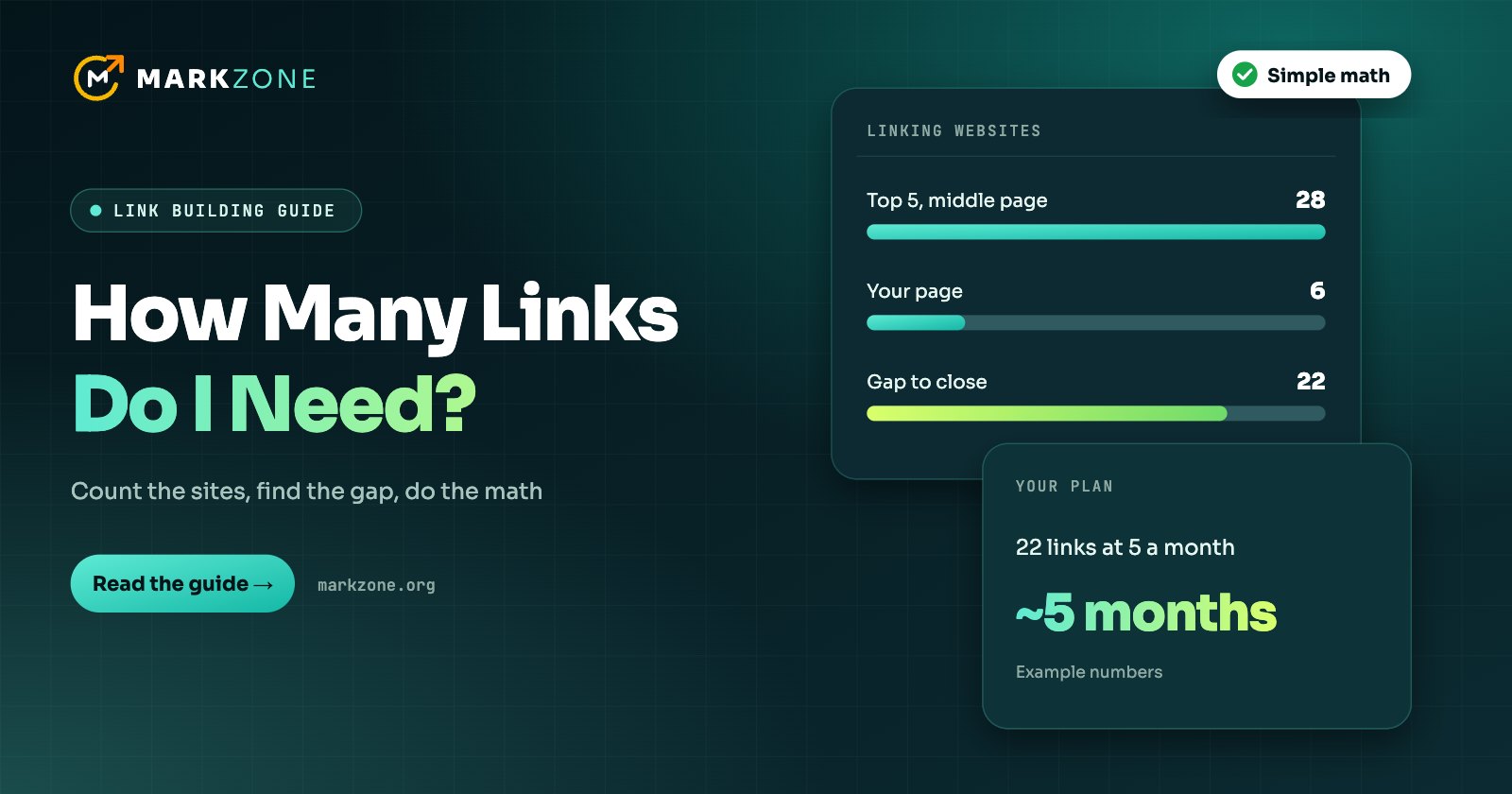
Count websites, not links. What matters most is how many different websites link to a page, not the total number of links.
Your target is set by the top results. Check how many websites link to the pages that rank for your keyword, and aim for the middle of that range.
Then do the math. The gap, divided by the links you can add each month, tells you roughly how long it will take.
There is no fixed number of backlinks you need to rank. The number depends on your keyword. Count how many websites link to the pages that already rank in the top results, and take the middle of that range. Then subtract the number of websites linking to your page. That gap is roughly how many relevant links you need, as long as your content is as good as theirs.
We sell links, but the honest answer is that some keywords need very few, and some need more than a small site can buy in a year. The math below shows which one you are dealing with.
Why there is no single number
Every keyword has its own competition. Ahrefs builds its Keyword Difficulty score this way, according to its guide to keyword difficulty. “We pull the top 10 ranking pages for your keyword and look up how many websites link to each of them.” On its scale, top-ranking pages for a KD 0–5 keyword “barely have any backlinks,” while a KD 90+ keyword has top pages with thousands.
That is why advice like “build 10 links a month” can’t answer the question on its own. Ten links might be plenty for one keyword and nowhere near enough for another.
Count referring domains, not backlinks
A referring domain is a website that links to you, however many links it sends. Studies point to the number of linking websites as the number that matters. A 2020 Backlinko study of 11.8 million search results found that “the number of domains linking to a page had a correlation with rankings.” Ahrefs found “a clear correlation between the number of websites linking to a page and its traffic.” Both are correlations, not proof, but they agree.
So a page with links from 20 different websites usually has a stronger profile than a page with 200 links from two sites. When you compare pages, use referring domains.
The simple math: how to find your number
- List the top results. Search your keyword and note the top five pages that are the same type as yours, such as blog posts or product pages.
- Count their referring domains. Check each exact URL, not the whole site, in Ahrefs, Semrush or Ahrefs’ free Backlink Checker.
- Take the middle number. Sort the five numbers and pick the one in the middle. It stops one unusual page, like a huge brand, from skewing your target.
- Subtract your own. Take away the referring domains your page already has. The result is your link gap.
- Adjust for your site. If your site’s Domain Rating is far below the sites that rank, aim above the middle. If your page is clearly better than theirs, you may need fewer.
- Turn it into a plan. Divide the gap by the number of relevant links you can add each month to see roughly how long it will take.
A worked example
Say the top five pages for your keyword have links from 64, 41, 28, 22 and 15 websites. The middle number is 28. Your page has links from 6 websites, so your gap is 22. If you add five relevant links a month, closing it takes four to five months. If you buy links in the $200–300 range, the gap costs roughly $4,400 to $6,600; our link building pricing guide shows what links cost by DR and traffic.
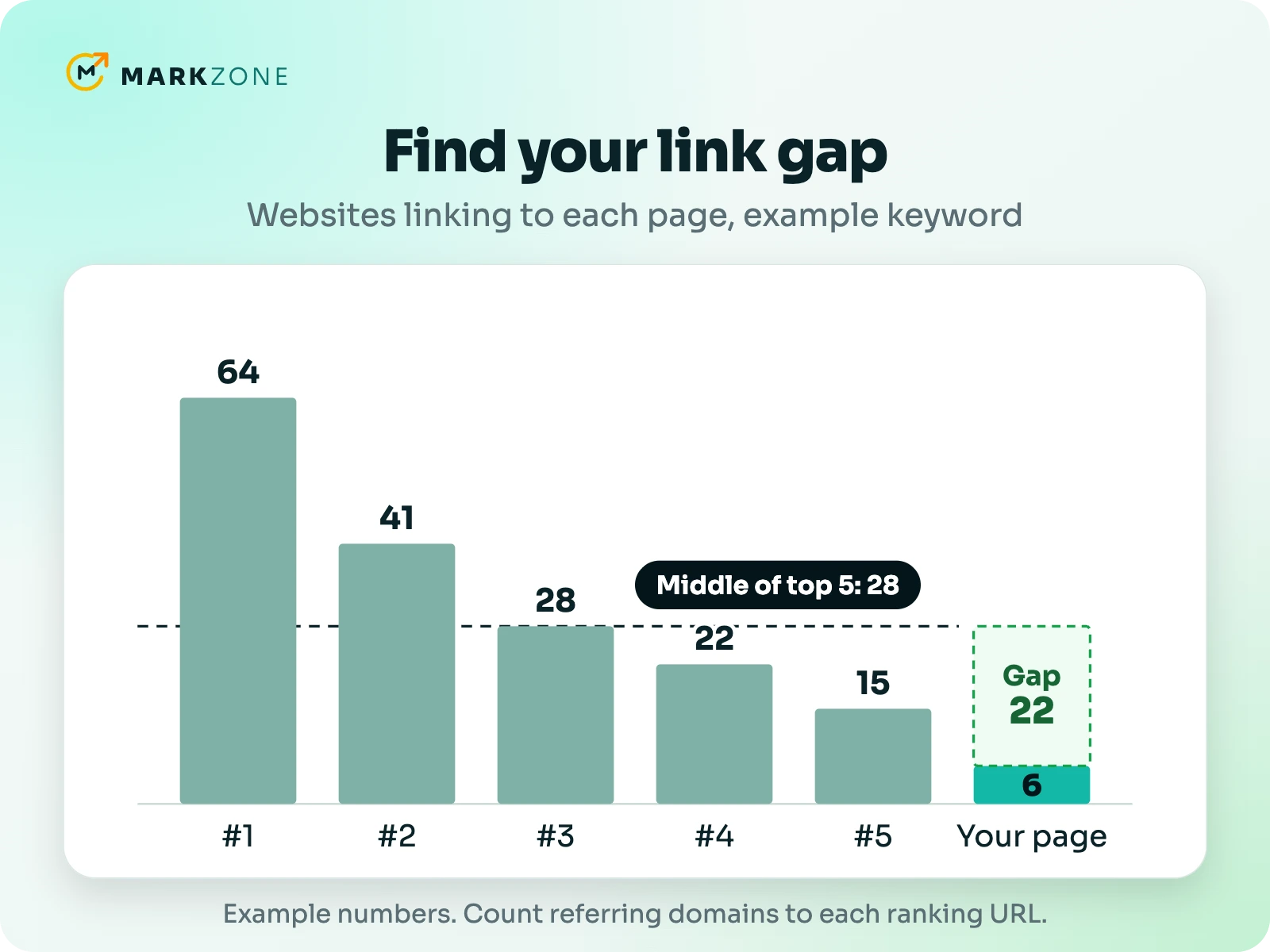
These numbers are an example. Your own will depend on your keyword, and the same method works for any of them.
Filter by DR, traffic and price to find sites that close the gap you just measured.
What changes the number
- Content and intent. Links help a page that already answers the search well. Google ranks results on relevance, quality and usability as well as links, so fix the page before you build links to it.
- Your site’s strength. A site with many good links can often rank a new page with fewer links of its own, because authority flows through internal links.
- Link quality. One link from a relevant site with real traffic is worth more than several from unrelated sites. Our guide to good backlinks shows what to check.
- Your competitors. The pages you are chasing keep earning links too, so check your target again every few months.
When you might need no links at all
For very easy keywords, the pages that rank may have almost no backlinks, as Ahrefs’ KD 0–5 range shows. If your page matches the search better than what is there now, it can rank on content and internal links alone. Start with those keywords while you build links for the harder ones.
Frequently asked questions
How many backlinks do I need to rank on Google?
There is no fixed number. Count the websites linking to the top five pages for your keyword, take the middle number and subtract the websites already linking to your page. That gap is your target.
Is it better to have more backlinks or better backlinks?
Better ones from more websites. Links from many different relevant sites count for more than many links from the same few sites.
How many backlinks should a new website have?
A new site usually starts with very few. Aim first for easy keywords where the top pages have few links, then build links to the pages that matter most.
Do internal links count as backlinks?
No. Backlinks come from other websites. Internal links still help, because they pass authority between your own pages and help Google find them.
How fast should I build links?
At a steady pace you can keep up, with relevant links each month rather than a big burst at once.
Want help working out your number?
Send us your target keyword, and we’ll suggest where to start closing the gap.

Muhammad Suleman is the founder of Markzone. He has done guest posting and link building since 2018 and has worked with hundreds of clients. Today his team handles 300–400 orders a month for brands and SEO agencies, with publisher sites in every major niche. He leads outreach, site checks and reporting, and writes about link building from his daily work with publishers and clients.