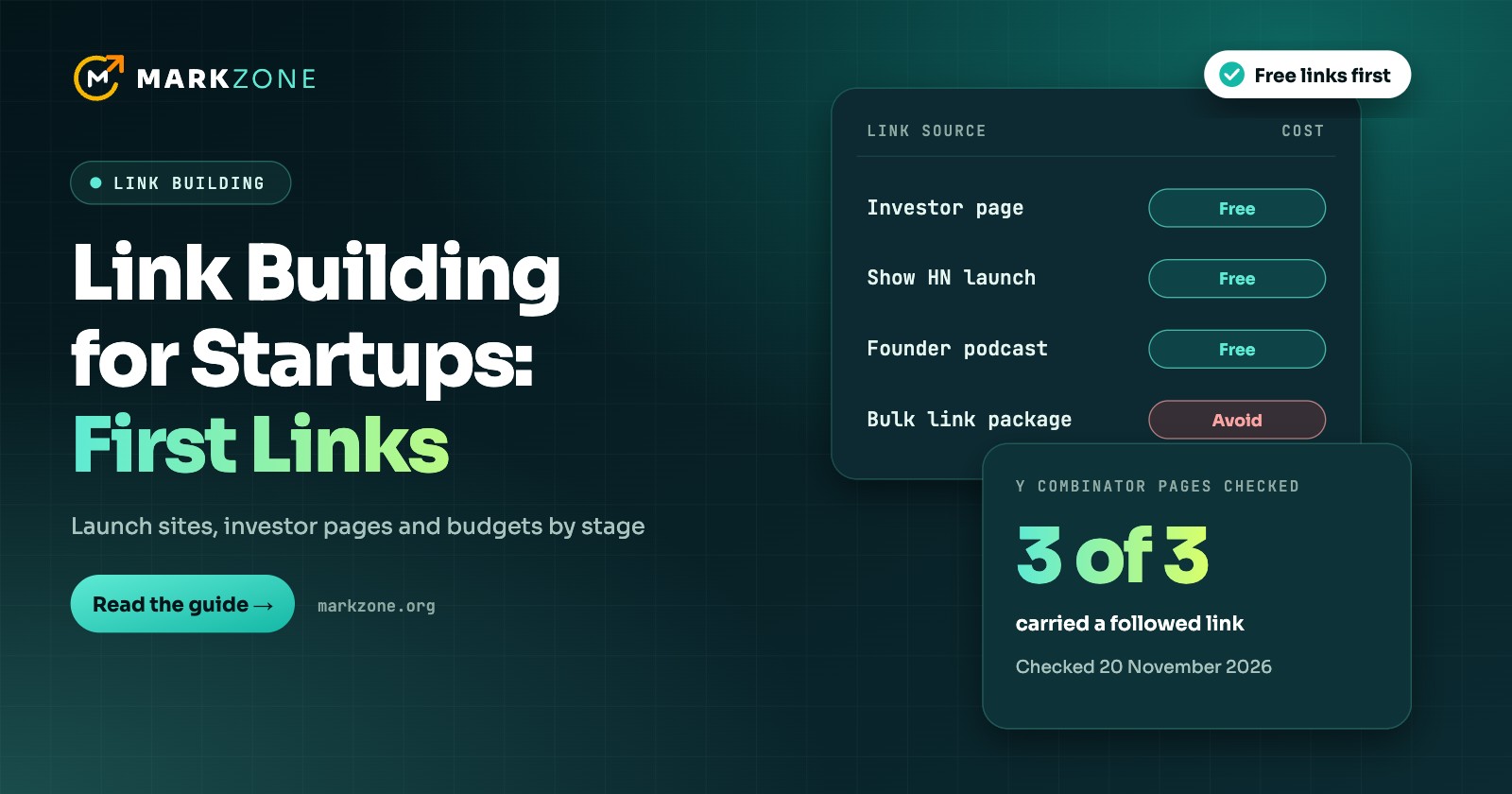
Start with the links that come with being new. Accelerator and investor pages, launch platforms, and articles and interviews under the founders’ names.
Check what each platform really links. On 20 November 2026, the three Y Combinator company pages we checked carried a followed link. Wellfound showed the website as a button rather than a link, and Show HN posts with 2 to 8 points linked out with nofollow.
Pay for links only once a page converts. At our catalog medians, a three-link test on sites with 1,000 to 4,999 monthly search visits costs 3 × $130 = $390, before writing.
Link building for startups begins with sources that come with being new. Think of your accelerator’s company directory, your investors’ announcement of the round, a launch on Product Hunt or Hacker News, and articles and interviews under the founders’ names. Most cost time rather than money, but they don’t all link the same way, so check each one before you count it. Leave paid placements until one page reliably turns visitors into signups, then test small and scale what works. The listings and partner pages every new site needs are covered in foundation backlinks.
Markzone’s products, guest posts and link insertions, fit only the last two stages in the budget table below. Everything before that is free or paid to the platforms themselves.
What startup platforms link to: our check
On 20 November 2026 we opened the pages a young startup is most likely to get and read the HTML each one served. The format matters: Google says it can generally crawl a link only if it’s an <a> element with an href attribute.
| Source | Who can get one | Cost | The link to your site on the day we checked |
|---|---|---|---|
| Y Combinator company directory | YC companies | Comes with acceptance | On all three pages checked (Stripe, PostHog, Supabase): a followed link showing the company URL, plus a nofollow “Company website” icon |
| An investor’s announcement post | Startups whose investors write one | None | Andreessen Horowitz’s 18 November 2026 post on its Linq investment: the link in the text was nofollow, the two logo links were not |
| Show HN on Hacker News | Something “other people can play with” | You post it yourself | On the Show page, all 10 posts with 2 to 8 points linked with nofollow; all 19 with 16 to 250 points linked without it |
| BetaList | Startups new to its audience, pre-launch or live | Every submission is paid; plans and prices appear at checkout, with a full refund if you aren’t selected | “Visit website” goes to a betalist.com address that 301-redirects to your site with ref=betalist and utm tags. The “Visit website” text links had no nofollow; the five gallery images linking to that address did |
| Wellfound company profile | Startups hiring through Wellfound | Free for job posts | Stripe’s and Supabase’s profiles showed the website as a button, with no link to it in the HTML |
| Product Hunt | Products “people can use,” live or coming with a clear date | “Launching costs nothing” | Not checked: Product Hunt refused our automated request, as did Crunchbase and LinkedIn |
Three lessons follow. Page templates decide the attribute, so ask for an accurate listing rather than a followed link. A platform is unlikely to change its template for one company. A button isn’t a link Google can generally crawl, so treat a profile like Wellfound’s as a recruiting page. And on Hacker News, the posts people engaged with carried the plain links. That’s one day’s snapshot, though, of a pattern HN doesn’t publish as a rule.
Launch platforms: what each one’s rules allow
Product Hunt. Its help center says it “reviews thousands of launches every day” and features only some on the homepage leaderboard. A launch that isn’t featured still goes live. The rules that trip startups up are about votes: “Never ask for upvotes,” and accounts get flagged for “asking for upvotes, using multiple accounts, or posting from a company account.” Launch when people can use the product, since “A closed beta that nobody can join usually isn’t a good fit.”
Show HN. Hacker News is stricter. Show HN “is for something you’ve made that other people can play with,” and its guidelines say “Don’t post landing pages or fundraisers.” A waitlist page can’t be a Show HN. The guidelines also ask makers not to recruit friends to upvote or comment.
BetaList. It takes both stages: it features “pre-launch waitlists and private betas” as well as live products, as long as they’re new to its audience. Products with “significant press coverage aren’t a fit.” A startup featured before launch can be featured again when it launches. For startups already featured, a Boost adds a rotating homepage spot and a newsletter slot to its 70,000+ subscribers. It cost $99 a week or $199 a month, introductory prices on 20 November 2026. Because every submission is paid, its followed listing link is a paid link under Google’s rule. So pay for the early adopters, not the link.
So the order is BetaList before launch and before press, then Product Hunt and Show HN once people can use the product. Google’s SEO Starter Guide supports the effort (“Effectively promoting your new content will lead to faster discovery”) and adds a warning that applies to launch week: “you can overdo promoting your site and actually harm it.”
Investor and accelerator pages
When you join a program or close a round, check three pages. They are the portfolio or company directory, the investor’s announcement and any page about your batch or cohort. Ask for:
- The right URL. Your homepage, not a deck, an app store page or a waitlist form that will move.
- Your words. Your brand name as the link text and a one-line description you would use yourself.
- Updates. A corrected listing when you rebrand or change domains.
Don’t expect a say over rel attributes. The Y Combinator and Andreessen Horowitz pages above each carried a followed link and a nofollow link to the same company. And keep portfolio friendships out of link swaps: Google’s spam policies list “partner pages exclusively for the sake of cross-linking” among their link spam examples.
Founder-led content and early PR
- Articles under a founder’s name. Google’s 2017 note on guest articles draws the line at intent. It doesn’t discourage articles that teach another site’s readers or make your company known. The problem is “when the main intent is to build links in a large-scale way.” A few pieces on sites your buyers read, each with a brand or URL link, stay on the right side of that line.
- Funding news. If you announce a round with a press release, keep its links plain. Google’s link spam list names “links with optimized anchor text in articles, guest posts, or press releases distributed on other sites.”
- Journalist requests. Answering reporters’ calls for expert sources suits founders who know their field and can reply the same day. Our guide to link building strategies compares the services and what agencies charge.
- Podcasts and talks. When you’re a guest or a speaker, ask the host to link your site from the episode or event page under your brand name.
Software startups have more to work with, from integration pages to free tools, and SaaS link building covers those.
Budgets by stage
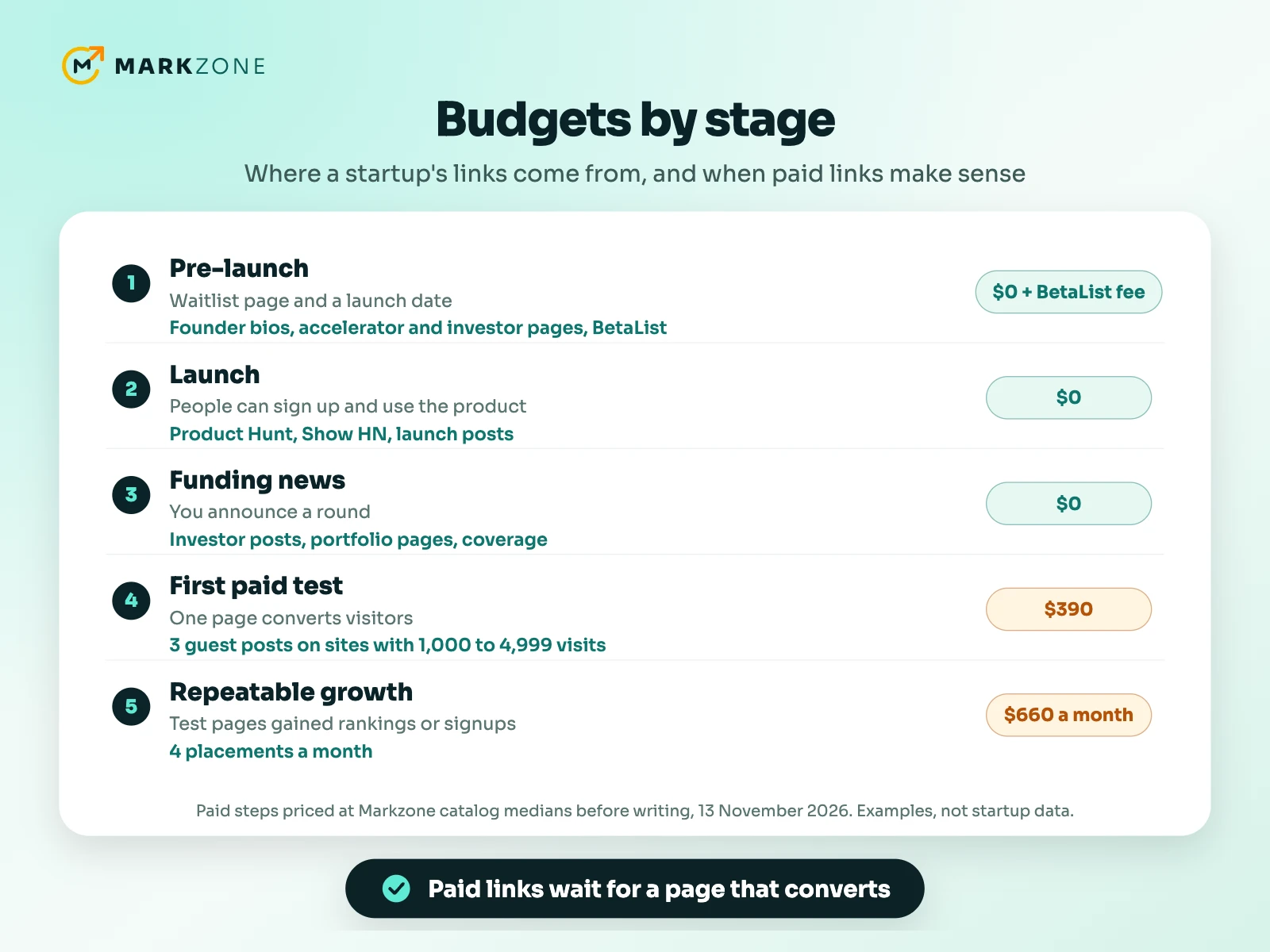
Spend should follow evidence. The first three stages cost little or nothing, and paid links start once a page converts and you can measure it. The cash column uses median prices from our catalog price study (13 November 2026). They are examples, not data on what startups spend.
| Stage | You’re here when | Where links come from | Cash for links |
|---|---|---|---|
| Pre-launch | You have a waitlist page and a launch date | Founder bios, accelerator and investor pages, BetaList | Nothing, plus BetaList’s fee if you use it |
| Launch | People can sign up and use the product | Product Hunt, Show HN, the founders’ launch posts | Nothing |
| Funding news | You announce a round | Investor posts, portfolio pages, coverage of the round | Nothing |
| First paid test | One page converts visitors and you can trace signups to it | 3 guest posts on sites in your niche with 1,000 to 4,999 monthly search visits | 3 × $130 = $390 |
| Repeatable growth | The test pages gained rankings or signups | 4 placements a month: 2 on sites with 5,000 to 49,999 visits, 2 at 1,000 to 4,999 | 2 × $200 + 2 × $130 = $660 a month |
Pre-launch, launch and funding news often come in a different order. What doesn’t change is that paid links wait for a page that works. Five adjustments:
- Writing. Our catalog prices are for the placement only; the article is extra. We charge $20 per 800 words, as listed in link building pricing, so the test costs 3 × $150 = $450 if we write all three posts.
- Link insertions. If two of the three sites already have an article that fits, an insertion there typically costs 20% less, about $104, and the test drops to 2 × $104 + $130 = $338.
- Niche. Typical prices are $30 for technology, marketing and education sites, $40 for finance, $50 for health and $60 for business and crypto. Across all 18,977 priced sites, it is $50. These medians aren’t split by traffic, so use them to judge whether a quote runs high or low, and budget by traffic as the table does.
- Crypto topics. On the 7,805 sites that list both prices, a crypto article costs a median 1.4 times the normal price.
- Country. If your first market isn’t the US, budget by audience. Sites whose search traffic comes mainly from Germany have a median price of $390, the UK $105 and the US $50.
Google accepts paid links for advertising and sponsorship, calling the trade “a normal part of the economy of the web.” But that holds only “as long as they are qualified” with rel="nofollow" or rel="sponsored". Our catalog’s placements start as dofollow unless a publisher marks them otherwise, and founders can ask for a sponsored label on any order. To shortlist sites by niche and traffic, browse the catalog. Or tell us about your product and we’ll suggest where your first links should come from, free ones included.
Frequently asked questions
Do launch platform links help SEO?
Some carry a plain link, some carry none, and the main value lies elsewhere. In our check, Show HN posts with more points had plain links, and BetaList’s link runs through a 301 redirect. Wellfound showed a button and Product Hunt couldn’t be checked. What a launch reliably brings is early users and feedback. Count any press or link that follows as a bonus.
Should a startup pay for a launch listing that promises a followed link?
Pay for the audience if it fits your buyers, not for the link. Money for a listing makes its link a paid one. Google wants paid links qualified with a sponsored or nofollow attribute, whether they sit in a launch directory or a guest post, ours included.
When should a startup start paying for links?
When a page converts and you can measure it, meaning signups you can trace to that page in your analytics. Before that, paid links point at pages that don’t yet work. Run the three-link test from the stage table, check whether those pages gain rankings or signups, and only then commit to a monthly plan.
Sources
- Y Combinator company pages: Stripe, PostHog and Supabase (page HTML checked 20 November 2026)
- Andreessen Horowitz: Investing in Linq (posted 18 November 2026; page HTML checked 20 November 2026)
- Hacker News: Show page (page HTML checked 20 November 2026, about 18:30 UTC)
- Hacker News: Show HN guidelines (checked 20 November 2026)
- BetaList: Help and FAQ (checked 20 November 2026)
- BetaList: Boost (prices checked 20 November 2026)
- BetaList: example startup listing (page HTML and redirect checked 20 November 2026)
- Wellfound: Stripe and Supabase company pages (page HTML checked 20 November 2026)
- Wellfound: Hiring plans and pricing (checked 20 November 2026)
- Product Hunt Help: How Product Hunt works (checked 20 November 2026)
- Product Hunt Help: Launch FAQ and myths (checked 20 November 2026)
- Product Hunt Help: What kind of products get featured (checked 20 November 2026)
- Google Search Central: Link best practices for Google (last updated 10 December 2025)
- Google Search Central: SEO Starter Guide (last updated 10 December 2025)
- Google Search Central: Spam policies for Google web search (last updated 28 August 2026)
- Google Search Central Blog: A reminder about links in large-scale article campaigns (25 May 2017)
- Markzone guest post price study (catalog snapshot of 13 November 2026)
- Markzone: Link building pricing (writing price of $20 per 800 words)
Launching soon?
Tell us your product and target customers. We’ll suggest where your first links should come from, free ones included.

Muhammad Suleman is the founder of Markzone. He has done guest posting and link building since 2018 and has worked with hundreds of clients. Today his team handles 300–400 orders a month for brands and SEO agencies, with publisher sites in every major niche. He leads outreach, site checks and reporting, and writes about link building from his daily work with publishers and clients.