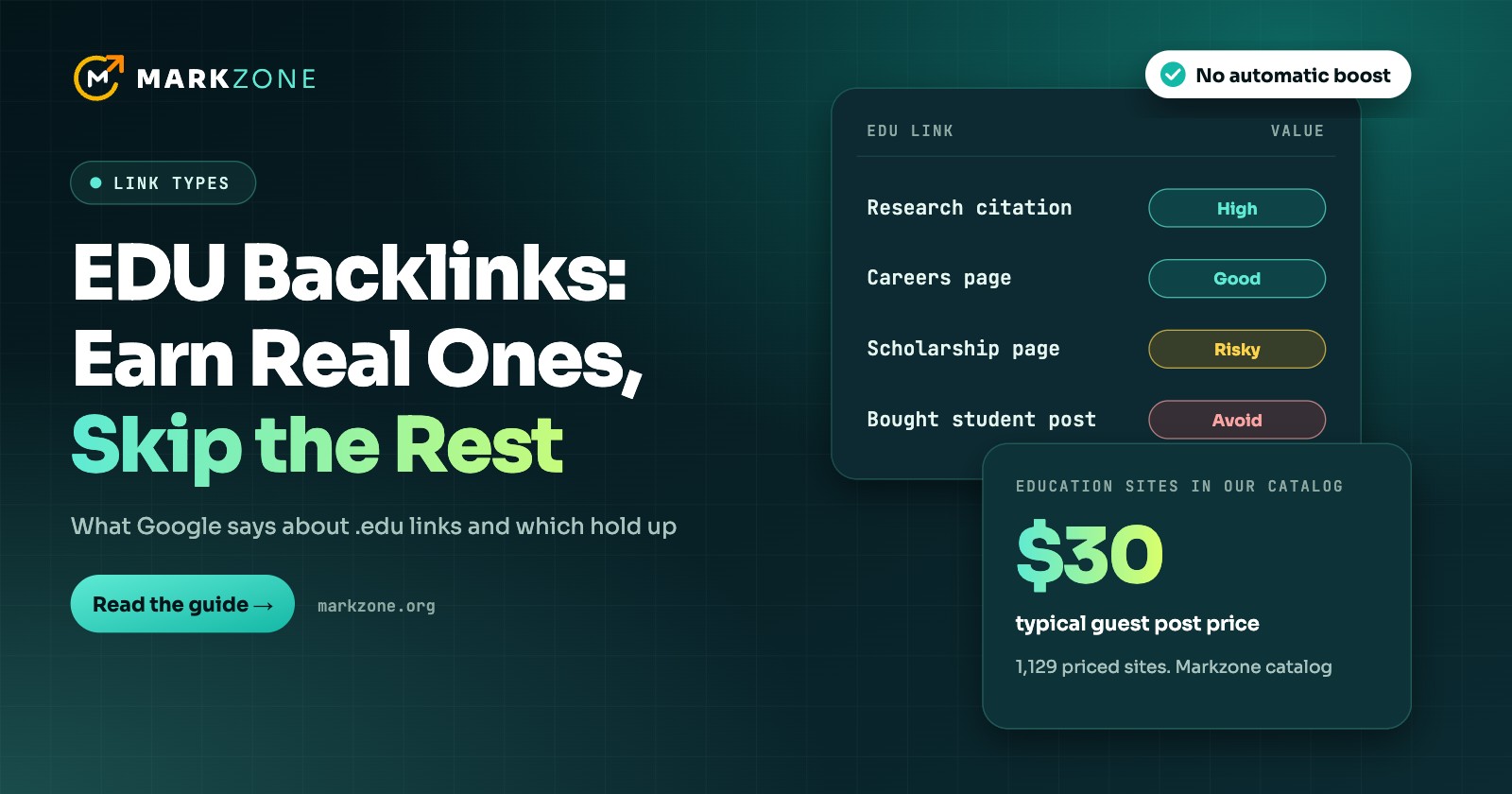
The .edu ending adds nothing on its own. Google said in 2008 that .edu and .gov links get no automatic boost, and that a .edu page nobody links to passes no PageRank.
Real .edu links come from pages that already link out. In one search run on 20 November 2026, four of ten .edu results were live resource lists that link to companies, and three of those had dead links.
Skip packages, paid student pages and scholarship schemes. Google ignores much of the spam on .edu sites and uses an educational site as an example in its site reputation policy.
EDU backlinks are links to your site from pages on .edu domains, which in the US are reserved for accredited colleges and universities. They are worth having when a maintained university page links to you because your resource helps its readers. Think of a library guide, a small business center’s tool list, a careers page or a research citation. Google’s Matt Cutts called the idea of an automatic .edu boost “a common misconception” in 2008. In 2018, John Mueller said Google ignores “a ton of the links” on .edu sites because spammers target them.
Markzone sells guest posts and link insertions, which means we profit when you buy links. The evidence here is Google’s own words, dated cases, a sample check of .edu pages made on 20 November 2026 and our price study of 13 November 2026.
- What counts as an .edu backlink?
- What Google has said about .edu links: a timeline
- Which .edu links are worth it?
- How to earn .edu backlinks
- How to check a .edu page before you pitch or pay
- .edu links to avoid
- If you’d rather pay for an education audience
- What about .gov backlinks?
- Frequently asked questions
- Sources
What counts as an .edu backlink?
Any link to your site from a page on a .edu domain. EDUCAUSE, which runs .edu registrations, limits new names to US-based postsecondary institutions with institutional accreditation from an accreditor recognized by the US Department of Education. Some university system offices and education associations also qualify. Names registered before 29 October 2001 could be kept. Other countries have their own endings, such as .ac.uk, managed by Jisc, and .edu.au, whose registrar is Education Services Australia.
A university website is many sites in one, from departments and libraries to blogs, wikis or profile pages that students or the public can create. That is why .edu links range from excellent to worthless.
What Google has said about .edu links: a timeline
| Date | What Google said or did | Source |
|---|---|---|
| 22 October 2008 | In a live webmaster chat, Matt Cutts said the belief that .edu and .gov links carry extra weight is “a common misconception”: “If you get an .edu link and no one is linking to that .edu page, you’re not going to get any PageRank at all.” John Mueller added: “We generally treat all links the same – be it from .gov or .edu or .info sites.” | Google Webmaster Help chat transcript |
| February 2011 | Overstock offered students and faculty a 10% discount in return for keyword links on college and university sites. After Google penalized it, the Wall Street Journal reported the pages had fallen to positions 40 to 70 for those terms. | Search Engine Roundtable, 24 February 2011 |
| 3 September 2018 | Mueller: “Because of the misconception that .edu links are more valuable, these sites get link-spammed quite a bit, and because of that, we ignore a ton of the links on those sites.” | Search Engine Roundtable |
| Reported May 2021 | A law firm that offered a $1,000 scholarship and collected about 100 school links had an “Unnatural inbound links” manual action. One of Google’s three example links was a .edu scholarship page. | Internet Marketing Ninjas; Search Engine Journal |
| 14 July 2021 | Told that Google ignores a big chunk of .edu links, Mueller replied: “People who focus on .edu links usually have bigger problems to worry about, but I’ve certainly never said what you’re suggesting.” | Search Engine Roundtable, 29 July 2021 |
| 5 March 2024 | Google added site reputation abuse to its spam policies, enforced from 5 May. Its first example (page archived June 2024): “An educational site hosting a page about reviews of payday loans written by a third-party that distributes the same page to other sites across the web, with the main purpose of manipulating search rankings.” | Google Search Central |
| 19 November 2024 | Google said its systems can treat sections that are “independent or starkly different from the main content” of a site “as if they are standalone sites.” | Google Search Central Blog |
| 28 August 2026 | Google changed enforcement in the European Economic Area and clarified its criteria; the policy now says a human review looks at whether third-party content is “fully integrated with the main site.” The current text still lists an educational site hosting “sponsored reviews of payday loans.” | Google Search Central |
In short, no ending earns a bonus. Google discounts the spam .edu sites attract rather than .edu links as a class, and renting a university’s reputation is a named spam pattern. The Overstock case is told in full in good vs bad backlink examples.
Which .edu links are worth it?
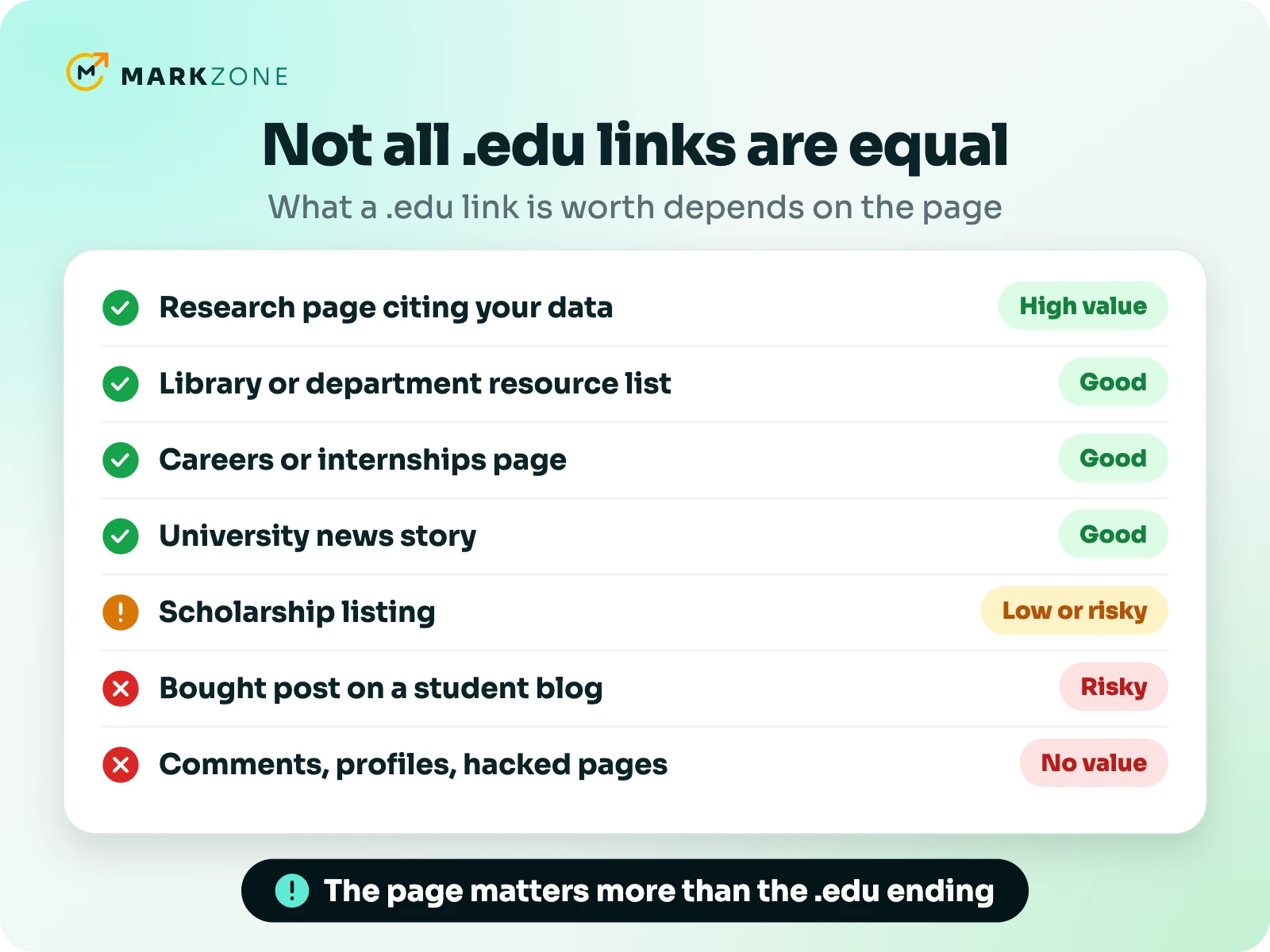
| .edu page | Likely value | Why |
|---|---|---|
| Research or course page citing your data | High | An editorial citation on a page students and staff use |
| Library guide or center resource list | Good | Chosen because the resource helps its readers |
| Careers or internship page | Good | Reflects a real hiring relationship |
| University news story about you | Good | Coverage of something you actually did |
| Scholarship listing | Low or risky | Built for links at scale; one was cited in a manual action reported in 2021 |
| Paid post on a student or staff blog | Risky | Paid, usually off-topic and rarely labeled |
| Profile, comment or hacked page | None | User-generated or hacked spam that Google ignores |
How to earn .edu backlinks
1. Get listed on resource pages
Libraries, small business development centers and departments keep lists of tools, guides and data. Find them with site:.edu “resources” plus your topic, and pitch a free resource that fits the list.
What a sample search turned up
A run of site:.edu “resources” small business tools on 20 November 2026, in a web search engine (Google’s results may differ), returned ten .edu pages. Each was opened and its links checked:
| What the ten results turned out to be | Pages |
|---|---|
| Gone (page not found, or domain no longer resolves) | 4 |
| Live, but not a resource list | 2 |
| Live resource lists that link to companies | 4 |
| Of those four, with a dead outbound link | 3 |
| Of those four, with a contact email | 4 |
| Of those four, with a visible update date | 0 |
The four lists were St. Edward’s University’s entrepreneurship research guide, SUNY Suffolk’s Small Business Resources & Tools page, and the small business development center pages of UW–Madison and UW–La Crosse. Their main content held 153 links to other domains, none marked nofollow, sponsored or ugc, and at least 10 were dead. They link to companies that help their readers: SUNY Suffolk’s “collection of free and low-cost tools” includes Wave, Canva and Mailchimp, and UW–Madison’s page links to articles from Bench, CoSchedule and Sprout Social. In this sample, under half the results were usable, so open each page before outreach.
2. Replace dead links
Three of the four lists had dead links, from government pages that no longer exist to a bank’s missing PDF. If your page does the same job as a dead one, tell the owner which link is broken and offer yours as one option.
3. Publish data researchers can cite
A survey or dataset that states its sample, method and date can earn citations from course and research pages.
4. Work with careers offices
Post internships and join employer events; employer directories and event pages often name the companies taking part, with a link.
5. Offer your expertise
Guest lectures, competition judging and startup mentoring get written up by departments, often with a link.
6. Support student groups and events
If you pay a hackathon, conference or society, the link is a paid link: ask the organizer to mark it rel="sponsored".
7. Start with people you know
Alumni on your team and clients in education are the warmest leads for alumni spotlights and directories.
How to check a .edu page before you pitch or pay
- Where does it sit? A page in a department, library or center menu is maintained by staff. A personal, student or open blog subdomain is a small site using the university’s address.
- Who can publish there? If anyone can register and post, Google’s spam policies treat abuse there as user-generated spam. Their examples include “Spammy accounts on hosting services that anyone can register for” and “Comment spam on blogs.”
- Does it fit? A marketing course page linking to a survey tool makes sense; a chemistry page linking to a casino doesn’t.
- Is it maintained? No page in the sample showed an update date, so check that its links work and it names a current contact.
- Does it get found? Judge the page’s own search traffic, not the university’s.
- Don’t trust DR on a subdomain. Before DR4, Ahrefs gave subdomains their root domain’s rating, except on shared hosts such as wordpress.com: its 2022 explainer shows codex.wordpress.org and wordpress.org both at DR 98. Ahrefs says DR4, which gives subdomains “their own rating,” will reach its standard interface on 1 December 2026, so ask which DR a seller is quoting.
Our catalog shows the same trap. The 74 priced sites rated DR 90 or above sell posts at a median of $30. Some of them are addresses on it.com or us.com that seem to borrow the parent domain’s rating.
.edu links to avoid
- Profile and comment packages. A PeoplePerHour listing, “50 EDU Profile Backlinks from Universities,” cost £50 on 20 November 2026, displayed as $60 or about $1.20 a link. It says the links are “not guest posts or article links.” A profile made only to hold a link is what Google’s user-generated spam examples describe.
- Paid pages that don’t belong on a university site. A payday-loan review placed there to rank is Google’s own example.
- Hacked pages. In Google’s words, hacked content is “any content placed on a site without permission, due to vulnerabilities in a site’s security.” Links planted that way vanish in the clean-up.
- Discounts or scholarships offered for links. “Exchanging goods or services for links” is on Google’s link spam list, as the Overstock and scholarship cases show. Fund a scholarship for the students, not the link.
- Lapsed school domains. Google’s expired domain abuse examples include “Casino-related content on a former elementary school site.” The risks of buying old domains are in 301 redirect backlinks.
If you’d rather pay for an education audience
Sites about education are a different product from .edu domains, and among the cheapest in our catalog. Our guest post price study of 13 November 2026 counts 1,129 priced sites tagged Education. They typically charge $30 per post, with a middle half of $20 to $70, against $50 and $25 to $170 across all 18,977 priced sites. Prices exclude writing, and niches aren’t split by traffic, so check each site: 7,133 of the 18,977 priced sites (38%) show no Ahrefs traffic.
| Option | Cost | What you get |
|---|---|---|
| 50 EDU profile backlinks (marketplace listing, 20 November 2026) | £50, displayed as $60, about $1.20 a link | Profile pages, by the listing’s own description |
| A scholarship built for links (case reported in 2021) | $1,000 for about 100 links, about $10 a link | School listings, one of which Google cited in a manual action |
| Two posts on education-topic sites at the catalog median | 2 × $30 = $60, plus writing | Articles on sites about education, as paid links |
| Resource-page outreach | Your time | An editorial listing, if the page owner agrees |
Paid links are fine when labeled. In its spam policies, Google describes the advertising trade in links as “a normal part of the economy of the web”. It accepts them “as long as they are qualified” with rel="nofollow" or rel="sponsored". Every catalog link is dofollow by default unless its publisher marks it otherwise; if you want a sponsored label, ask for one on any order.
Sort our catalog by niche, then compare organic traffic before you choose.
What about .gov backlinks?
The same logic holds. .gov names are “only available to U.S.-based government organizations,” CISA manages them, and Cutts’s 2008 answer covered .gov too. Government sites link to programs, partners, approved suppliers and data sources, so join a public program, publish open data an agency can cite, or get listed where you genuinely qualify.
Frequently asked questions
Should I disavow spammy .edu links pointing to my site?
Usually not. Google’s disavow help reserves the tool for “a considerable number of spammy, artificial, or low-quality links” that have caused a manual action or likely will. How to disavow backlinks has the steps.
Are .ac.uk and .edu.au links treated differently from .edu?
No. Mueller’s 2008 answer was that Google generally treats links from all endings alike, and its spam policies name no education ending. Judge the page: who maintains it, who reads it and why it links to you.
Can I offer students a discount in return for a link?
Offer the discount without asking for a link. “Exchanging goods or services for links” is on Google’s link spam list, and Overstock’s 2011 discount is a well-known case. If a university lists your discount on its own, that link wasn’t traded for.
Sources
- Google Webmaster Help: Q&A from the 3rd live chat, October 2008 (chat held 22 October 2008; Wayback Machine capture of 23 March 2010)
- Google Webmaster Central Blog: Join us for our third live online chat (20 October 2008; gives the chat date)
- Search Engine Roundtable: Overstock.com’s Great Rankings Got Them Penalized In Google (24 February 2011; quotes the Wall Street Journal)
- Search Engine Roundtable: Google Ignores A Lot Of Edu Links (3 September 2018; Mueller’s tweet of the same day)
- Internet Marketing Ninjas: Scholarship Link Building – Penalized! (25 May 2021)
- Search Engine Journal: Google Cites Scholarship Links in a Manual Action Penalty (Roger Montti, 26 May 2021)
- Search Engine Roundtable: Google Says It Does Not Ignore All Edu Links (29 July 2021; Mueller’s tweets of 14 July 2021)
- Google Search Central Blog: What web creators should know about our March 2024 core update and new spam policies (5 March 2024)
- Google spam policies as archived on 2 June 2024 (page last updated 18 March 2024; original site reputation abuse examples)
- Google Search Central Blog: Updating our site reputation abuse policy (19 November 2024)
- Google Search Central Blog: Update to the Site Reputation Policy (28 August 2026)
- Google Search Central: Spam policies for Google web search (last updated 28 August 2026)
- Google Search Console Help: Disavow links to your site (checked 20 November 2026)
- EDUCAUSE: .edu eligibility (read in the Wayback Machine capture of 13 November 2025, because the live page blocks automated access)
- Jisc: Domain registry (read in the Wayback Machine capture of 26 March 2026)
- Education Services Australia: Show you are a recognised education provider with an edu.au domain (18 February 2026)
- get.gov: Eligibility for a .gov domain (checked 20 November 2026)
- Ahrefs Blog: Domain Rating, what it is and what it’s good for (Tim Soulo, 4 May 2022)
- Ahrefs Blog: Introducing a preview of DR4 (Glen Allsopp, 5 November 2026, updated 18 November 2026)
- PeoplePerHour: 50 EDU Profile Backlinks from Universities (listing checked 20 November 2026)
- St. Edward’s University Library: Entrepreneurship Research (page and links checked 20 November 2026)
- SUNY Suffolk: Small Business Resources & Tools (page and links checked 20 November 2026)
- UW–Madison Small Business Development Center: Free Business Resources (page and links checked 20 November 2026)
- UW–La Crosse SBDC: Business development and management (page and links checked 20 November 2026)
- Markzone guest post price study (catalog snapshot of 13 November 2026: Education row, no-traffic count, DR 90+ sites)
Looking for links that hold up?
Tell us your niche. We’ll suggest relevant sites with real readers, and tell you honestly where .edu links fit.

Muhammad Suleman is the founder of Markzone. He has done guest posting and link building since 2018 and has worked with hundreds of clients. Today his team handles 300–400 orders a month for brands and SEO agencies, with publisher sites in every major niche. He leads outreach, site checks and reporting, and writes about link building from his daily work with publishers and clients.