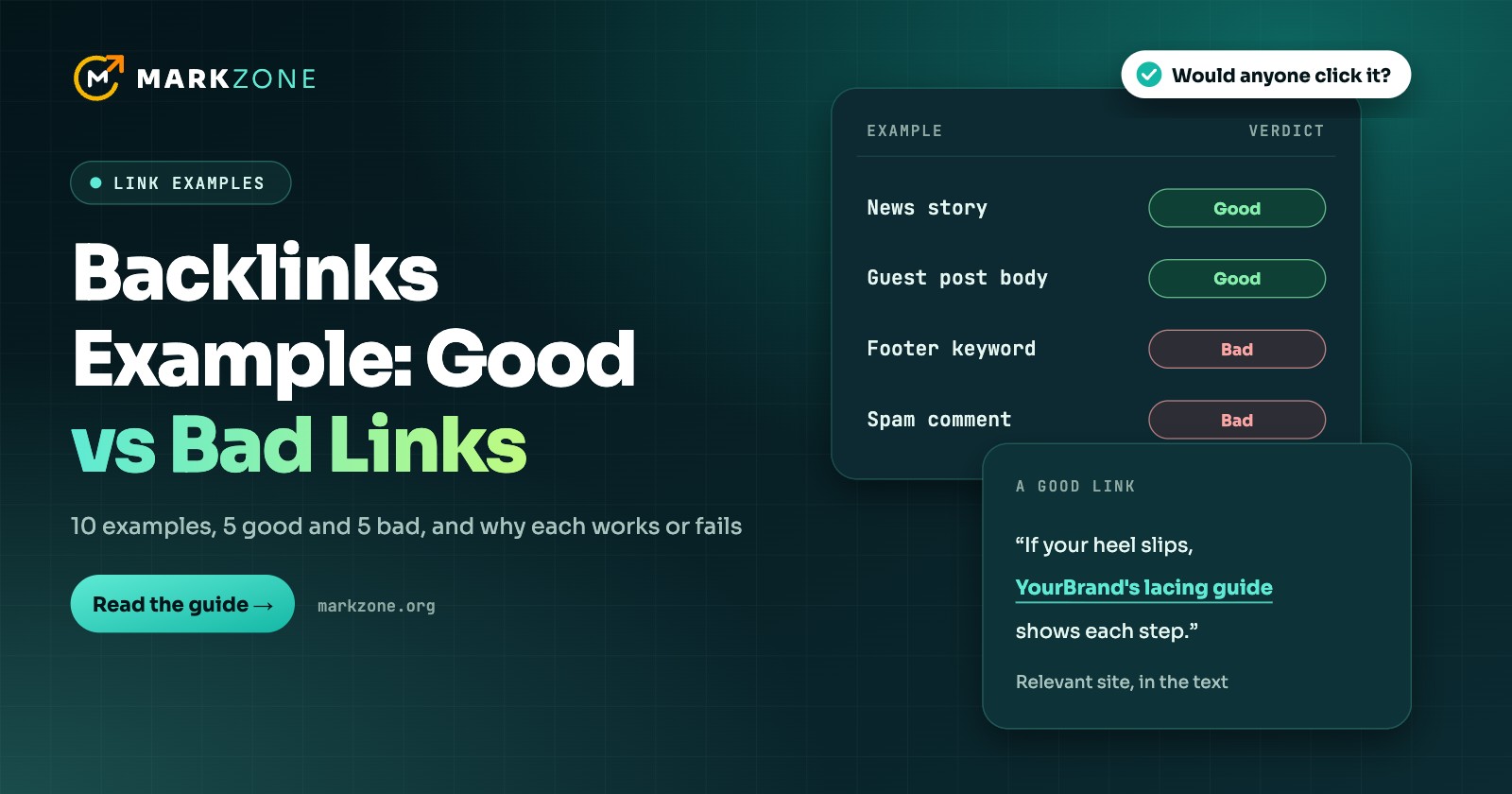
A good backlink is a citation that helps a reader. A site on your topic, with readers of its own, links to you where your page is useful.
A bad backlink exists only for rankings. Footer keyword links, stuffed signatures, unlabeled paid articles and links traded for discounts are all on Google’s link spam list. Overstock, Interflora and Rap Genius were penalized over links like these.
Traffic separates good host sites from bad ones. In our catalog, a DR 70–79 site with 1,000 or more monthly visits typically charges $400 for a guest post. One with fewer visits charges $100.
The best backlinks look like a recommendation: a site on your subject, read by real people, links to you in the sentence where your page helps. The clickable words describe what the reader will find. A bad backlink exists only to move rankings. Examples: a keyword in the footers of unrelated sites, a signature full of keywords, an unlabeled paid article that passes ranking credit, or a link swapped for a discount. Below are five of each, with three real penalty cases and our catalog figures.
Two of the good examples, guest posts and link insertions, are what we sell, so read our take with that in mind. The bad examples quote Google’s spam policies (page updated August 28, 2026) and reports from the time. Catalog numbers come from our November 2026 catalog data (sources below).
What a good and a bad backlink look like in the code
A backlink is an <a> tag on another site that points to yours. In every example below, you sell garden tools online and want links to your pruning guide. The scenario is invented; the rules and figures are real. Here is the same link in a good and a bad setting, with example.com standing in for your site:
<!-- Good: in an article about fruit trees, with words that describe the page -->
<p>Make each cut just above an outward-facing bud, as this
<a href="https://example.com/pruning-guide/">step-by-step pruning guide</a> shows.</p>
<!-- Bad: in the footer of an unrelated site, with a bare keyword -->
<footer><a href="https://example.com/">cheap garden tools</a></footer>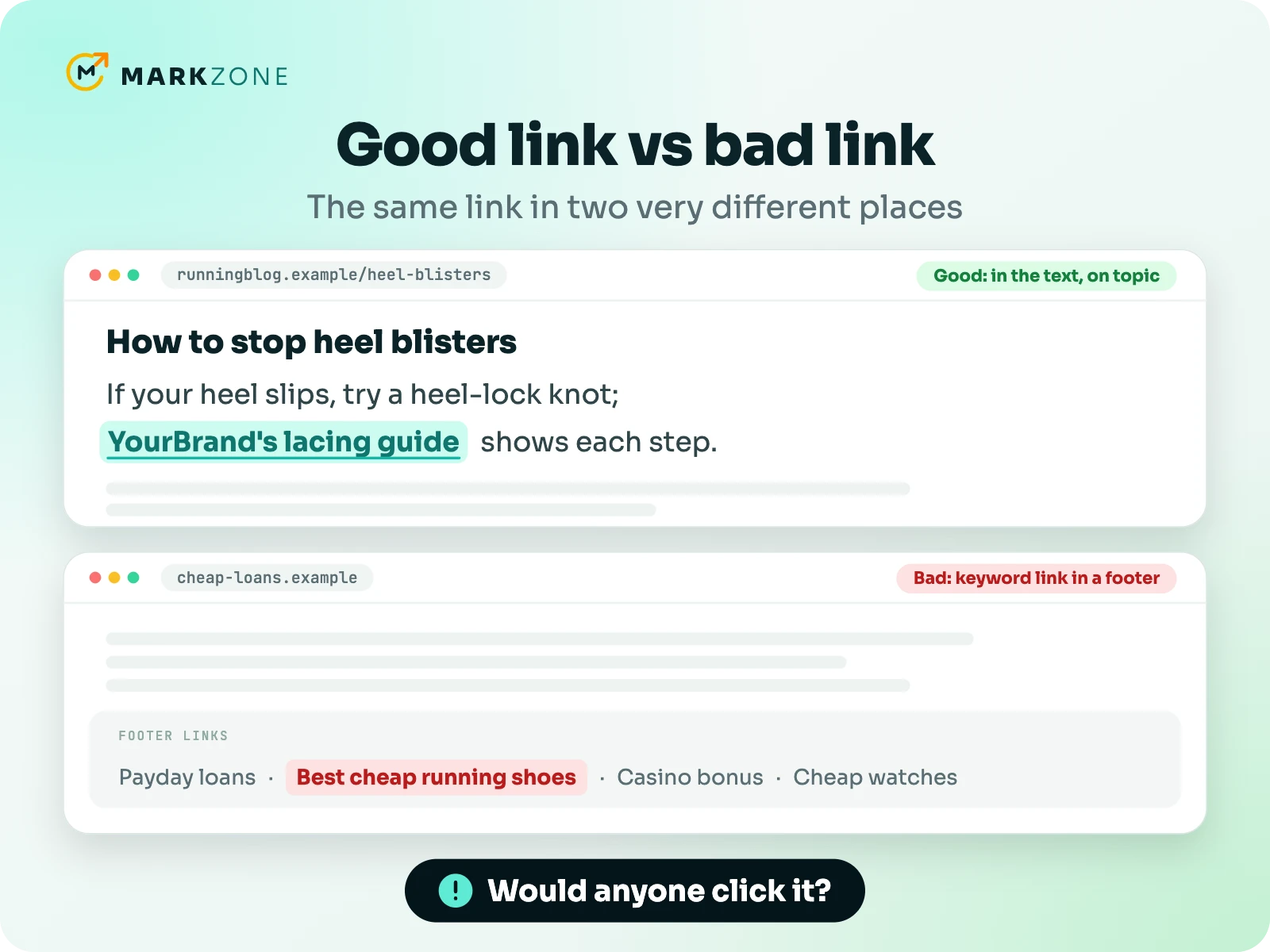
Both are plain <a> tags; the site, the sentence and the anchor decide.
5 good backlink examples
1. A writer cites your page as a source
What it looks like: a gardening magazine’s article on fruit tree care gives pruning dates and links “this pruning calendar” to your guide.
A real one: on February 25, 2013, Search Engine Roundtable reported on Google’s advertorial penalties. Its report linked the words “Google Webmaster Blog” to the Google post it covered, inside the sentence that needed it.
Why it works: nobody paid or traded for it, and it backs up a claim in the text. Google’s link best practices encourage it, saying external links “can help establish trustworthiness (for example, citing your sources).”
2. A guest post that links from the main text
What it looks like: you write an article for a home and garden site on getting an orchard through winter. One paragraph links “pruning guide with diagrams” to your page where a reader needs it.
Why it works: the site covers your topic, and the link is in the main text, not the author bio. Look at its traffic first. Home and garden sites in our catalog have a median guest post price of $30. Across all niches, the median is $130 for a site with 1,000 to 4,999 monthly visits and $25 for one with no search traffic. We place guest posts like this one.
If you pay for it: under Google’s spam policies, “Exchanging money for links, or posts that contain links” is link spam. The same page says Google “does understand that buying and selling links is a normal part of the economy of the web for advertising and sponsorship purposes.” It allows such links “as long as they are qualified” with rel="nofollow" or rel="sponsored". Links in our catalog are dofollow by default unless the publisher marks them otherwise, and you can ask for a sponsored label on any order. The trade-offs of each choice are in is buying backlinks safe.
3. A new sentence in an article that already ranks
What it looks like: a garden blog’s existing post on fruit trees for small gardens already gets search visits. It gains one sentence: “Once the tree is planted, this pruning guide shows where to make the first cuts.”
Why it works: the page already has readers and links of its own, so people see your link from the day it goes live. Sellers call this a link insertion or niche edit. Of our 22,073 publisher sites, 13,262 (60%) offer one. Where a site lists a fixed price for both (8,387 sites), the edit is the cheaper option at 70% of them. The paid-link rule above applies here too.
4. A resource page someone maintains
What it looks like: a garden club’s “Guides for new members” page lists eight resources with a line on each, including “Pruning guide: where to cut, with diagrams.”
Why it works: the page exists to send members to useful guides, so your guide fits its purpose. Check that it was updated recently and that its other links still work.
5. An image that is itself the link
What it looks like: a blog embeds your diagram of three pruning cuts. The image links to your guide, and its alt text reads “diagram of three pruning cuts.”
Why it works: if the image itself carries the link, Google treats its alt text as the anchor text. Google’s own good example of an image link uses alt="add enchiladas to your cart". Its bad example leaves the alt text empty, so the link carries no words at all.
Our catalog shows DR, Ahrefs traffic and price for most sites, so you can rule out sites without readers first.
5 bad backlink examples
1. A keyword link in the footers of unrelated sites
What it looks like: “cheap garden tools” in the footer of dozens of sites about loans, recipes and software, all pointing to your homepage.
Why it fails: no editor chose it, and the repeated keyword shows the links were arranged. It matches an item on Google’s link spam list word for word: “Widely distributed links in the footers or templates of various sites.” A single footer credit on a site you built or genuinely partner with is a different case.
2. A signature stuffed with keywords
What it looks like: Google’s spam policies supply this one. A forum comment reads “Thanks, that’s great info! – Paul”, followed by three links: “paul’s pizza”, “san diego pizza” and “best pizza san diego”.
Why it fails: the comment adds nothing, and the links are there for their keywords. Google also tells forum owners to label user-added links ugc or nofollow, so on a well-run forum they are labeled from the start.
3. A paid article whose link passes credit without a label
A real case, February 2013: Google penalized Interflora, a UK flower seller, over advertorials it used to lift its rankings before Valentine’s Day. It also cut the PageRank of the news sites that ran them to zero, as Search Engine Roundtable summed up on February 25, 2013. Google’s blog post of February 22 warned: “Selling links (or entire advertorial pages with embedded links) that pass PageRank violates our quality guidelines, and Google does take action on such violations.”
Why it fails: money bought a link that passed ranking credit. Google’s current list still names “Advertorials or native advertising where payment is received for articles that include links that pass ranking credit.” With its links marked rel="sponsored" or rel="nofollow", the same paid article would not break Google’s link spam policy.
4. Links traded for discounts or favors
- Overstock, February 2011. The retailer offered students and faculty 10% off some merchandise and asked college and university websites to embed links for certain keywords. Its pages had ranked in the top three for those words. After Google acted, they “dropped to between No. 40 and No. 70 in the rankings,” according to the Wall Street Journal report that Search Engine Roundtable quoted on February 24, 2011.
- Rap Genius, December 2013. The lyrics site offered to tweet bloggers’ posts in exchange for “keyword rich anchor text links.” On December 26, 2013, Search Engine Roundtable reported that Google had penalized it and that it “no longer ranks top for their own name.”
Why they fail: no money changed hands, but Google’s list of link spam still includes “Exchanging goods or services for links.” A discount or a free product counts, and Google treated Rap Genius’s tweets the same way.
5. A thin post on a site nobody reads
What it looks like: a 500-word “10 garden tips” post on a site that also covers casinos, crypto and recipes, gets no search traffic and links to three different stores.
Why it fails: the post exists to hold links, and Google’s list includes “Creating low-value content primarily for the purposes of manipulating linking and ranking signals.” Our own catalog has plenty of sites without search traffic. Ahrefs shows none for 7,133 of the 18,977 priced sites (38%) and for 722 of the 3,856 sites at DR 50 and above (19%). No traffic doesn’t prove a site exists to sell links, but few searchers will ever find your link there.
Same DR, different backlink: two offers side by side
This worked example uses our catalog medians. You have two guest post offers for your pruning guide, both from sites rated DR 70–79:
| Offer A | Offer B | |
|---|---|---|
| Domain Rating | 70–79 | 70–79 |
| Monthly search visits (Ahrefs) | 1,000 or more | Fewer than 1,000 |
| Typical guest post price in our catalog | $400 | $100 |
| For reference: all DR 50+ sites | 48% (1,849 sites) | 52% (2,007 sites), 722 of them with none |
Offer B looks like the bargain: the same DR for a quarter of the price. But the discount follows the traffic, not the DR. In all ten DR bands of our study, sites with 1,000 or more monthly visits typically cost more than sites with fewer. The gap runs from $40 against $30 at DR 0–9 to $500 against $120 at DR 80–89. So when a high-DR offer is cheap, low traffic is the first thing to suspect.
Before you choose B, check its traffic over the last 12 months and whether its recent posts rank. If nobody reads it, A is the better backlink even at four times the price. If B’s few readers are exactly your customers, it can still be worth $100.
Good vs bad backlinks at a glance
| Signal | Good backlink | Bad backlink |
|---|---|---|
| The site | Covers your topic and has its own readers | Unrelated, or built to hold links |
| Search traffic | Real visits. In our catalog, sites with 10,000 to 49,999 monthly visits typically charge $200 | None. 7,133 of 18,977 priced sites (38%) show no Ahrefs traffic, as do 722 of 3,856 DR 50+ sites |
| Placement | In a sentence in the main text | Footer, sidebar, signature or hidden text |
| Anchor text | Brand, URL or words that describe the page | The same keyword, link after link |
| How it came about | Earned, or paid and labeled the way Google asks | Paid or traded for, and passing ranking credit with no label |
| Clicks | Some readers click it | Nobody would |
A link that fails one row may still be worth having; a link that fails three rarely is. For every check with a table, see what makes a good backlink.
Frequently asked questions
What is an example of a backlink?
Any link from another site to a page on yours. When a garden club’s resource page links “pruning guide” to your site, that link counts as a backlink to you; to the club, it is an outbound link.
Is a nofollow or sponsored link a bad backlink?
No. A label says what kind of link it is, not whether it is bad. All Wikimedia wikis tag external links with rel="nofollow", and English Wikipedia’s articles have done so since January 2007, yet a citation there can still send you readers. Google has called all three attributes hints since September 10, 2019, and a sponsored label on a paid link is what it asks for. Do nofollow links help SEO compares what each label passes.
Can one bad backlink hurt my site?
Rarely. Google’s position is that it can usually tell, unaided, which links to trust. Its disavow guide suggests acting only when a large number of spammy links has led, or is likely to lead, to a manual action. Overstock, Interflora and Rap Genius ran deliberate schemes. When you review your backlink profile, look for patterns like the five bad examples, not single odd links.
Is a link from a high-DR site with no traffic a bad backlink?
Not always, but it is rarely worth paying for its DR. DR measures a site’s links, not its visitors, and catalog prices reflect the gap. At DR 70–79, the typical guest post costs $100 on a site with fewer than 1,000 monthly visits and $400 on one with 1,000 or more. A well-known brand that gets its visitors from elsewhere can be an exception, so ask the seller why search traffic is missing before you buy.
Sources
- Spam policies for Google web search (Google Search Central, last updated August 28, 2026)
- Link best practices for Google (Google Search Central, last updated December 10, 2025)
- A reminder about selling links that pass PageRank (Google Search Central Blog, Matt Cutts, February 22, 2013)
- Evolving “nofollow”: new ways to identify the nature of links (Google Search Central Blog, Danny Sullivan and Gary Illyes, September 10, 2019)
- Disavow links to your site (Google Search Console Help, undated)
- Google Dishes Out Widespread Penalties For Advertorials (Search Engine Roundtable, Barry Schwartz, February 25, 2013)
- Overstock.com’s Great Rankings Got Them Penalized In Google (Search Engine Roundtable, Barry Schwartz, February 24, 2011; quotes the Wall Street Journal)
- Rap Genius’ Link Scheme Goes Public Leading To Google Penalty (Search Engine Roundtable, Barry Schwartz, December 26, 2013)
- Nofollow (Meta-Wiki, Wikimedia; checked November 16, 2026)
- Guest Post Prices: What 18,977 Sites Charge (Markzone price study, November 13, 2026: DR × traffic prices, traffic tiers, niches, niche edits, no-traffic counts)
- High Authority Backlinks: How to Get Links From DR 50+ (Markzone, published November 12, 2026: 1,849 of 3,856 DR 50+ sites with 1,000+ monthly visits)
Want backlinks like the good examples?
Send us your niche, and we’ll shortlist sites with real readers where your link fits the text.

Muhammad Suleman is the founder of Markzone. He has done guest posting and link building since 2018 and has worked with hundreds of clients. Today his team handles 300–400 orders a month for brands and SEO agencies, with publisher sites in every major niche. He leads outreach, site checks and reporting, and writes about link building from his daily work with publishers and clients.