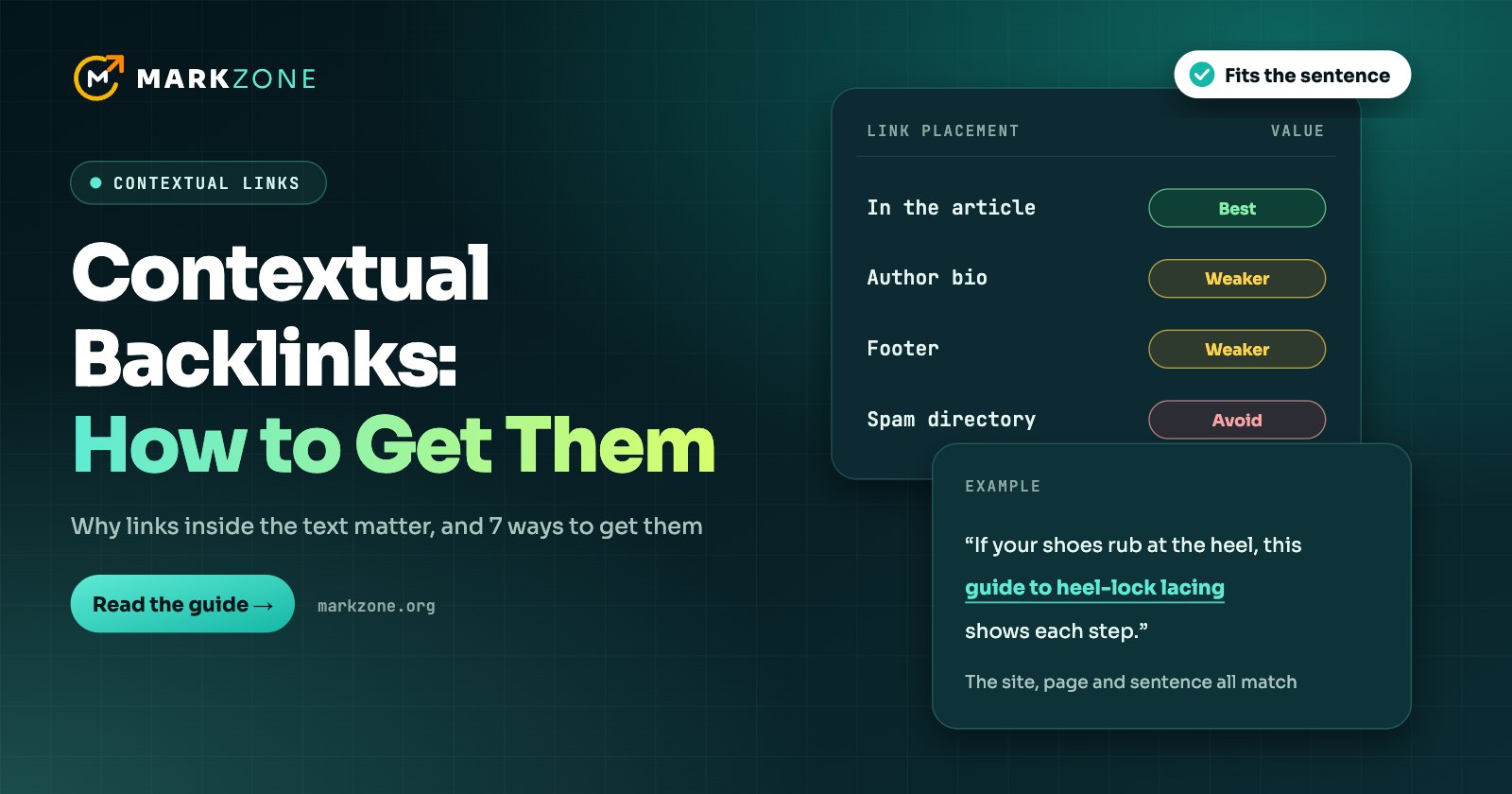
A link inside the text of a related page. A contextual backlink sits in the body of an article about your topic, where the words around it explain why it is there.
Context helps readers and Google. Google’s own guidance says the words before and after a link matter, and a link that fits the sentence is one readers are likely to click.
Most other placements are weaker. Footer, sidebar, directory and forum links carry little context, and Google lists the spammy versions of several of them as link spam.
Contextual link building means getting your links placed inside the main text of relevant articles on other websites, where the words around each link explain what it points to. A contextual backlink might come from a guest post, a link added to an existing article or a quote in a news story. These are the links most sites should focus on, because they carry relevance and can send real readers. Links in footers, sidebars, author bios and directories tell readers and search engines far less about why they are there.
Contextual links are what we sell: every guest post and link insertion we place puts the link in the body of an article. So this guide sticks to what Google has published, and it also covers ways to earn contextual links without paying anyone, us included.
What is a contextual backlink?
A contextual backlink is a link from another website that sits inside the main content of a page. It appears in a sentence about the same topic as the page it links to. The context is everything around the link: the site, the article, the sentence and the anchor text all tell readers and search engines what to expect when they click.
For example, a running blog’s article on heel blisters might say: “If your shoes rub at the heel, this guide to heel-lock lacing shows each step.” The site, the article and the sentence are all about the same problem, and the anchor text says exactly what the reader will get. Put the same link in the blog’s footer under “Partners”, with the anchor “cheap running shoes”, and it tells readers and Google almost nothing.
| Where the link sits | Contextual? | What to know |
|---|---|---|
| In the body of a relevant article | Yes | The words around it explain what it points to |
| Added to an existing article | Yes, if it fits the sentence | Often called a link insertion or niche edit |
| Author bio | No | Sits outside the article, next to the writer’s name |
| Footer, sidebar or blogroll | No | Footer links spread across many sites are on Google’s link spam list |
| Directory or bookmark site | No | Low-quality ones are on Google’s link spam list |
| Forum post or comment | Sometimes | Google asks sites to mark links that users add as ugc or nofollow |
Why contextual links matter
Google hasn’t said exactly how much more a link in the body text is worth than one in a sidebar. But its own guidance puts a lot of weight on context. Its link best practices say good anchor text is “descriptive, reasonably concise, and relevant to the page that it’s on and to the page it links to.” They add that “the words before and after links matter.” The same page advises against chaining links next to each other, because each one loses its surrounding text.
Google also focuses on a page’s main content. John Mueller of Google said in 2022 that, to understand a page, Google looks mainly at its primary content rather than the header, sidebar or footer. Search Engine Roundtable and Search Engine Journal both reported it. Speaking about internal links, though, he said a link in the footer isn’t treated as less useful, so placement on its own is not the whole story.
A Google patent points the same way. The “reasonable surfer” patent, filed in 2004 and granted in 2010, describes weighting each link by how likely a reader is to click it, as Search Engine Land explains. Its signals include where the link sits on the page and whether it is in a footer or sidebar. It names “Terms of Service” links, banner ads and links unrelated to the page as less likely to be followed. A patent shows what Google has explored; it isn’t proof of what Google uses today.
Non-contextual placements are also where a lot of link spam lives. Google’s spam policies give “widely distributed links in the footers or templates of various sites” as one example of link spam. Others include “low-quality directory or bookmark site links” and forum comments with optimized links.
Finally, readers click links that help them. A link in a paragraph about the reader’s problem can send visitors who care about your topic. A link in a footer or author bio is far less likely to do that.
What makes a contextual link strong
Context works at four levels. The more of them match the page you are linking to, the stronger the link:
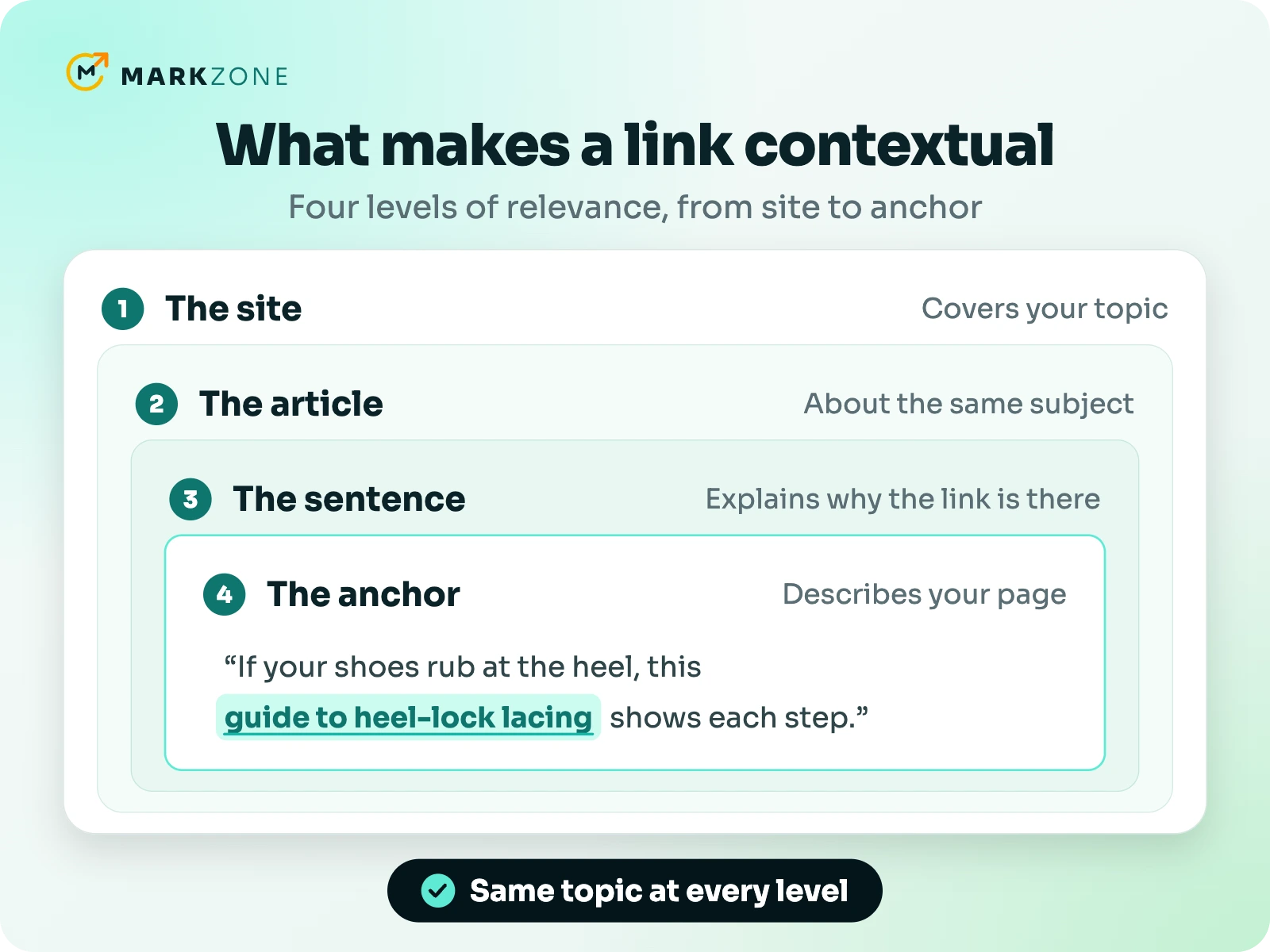
- The site covers your topic. A running blog linking to a guide on running shoes makes sense. A site that writes about anything for anyone adds little.
- The article is about the same subject. The page itself should cover what your page covers, not just mention your industry in passing.
- The sentence explains the link. The link should sit where a reader would want more detail, not be bolted onto an unrelated paragraph.
- The anchor describes your page. Use words a writer would naturally choose, such as your brand, the page title or a short description, rather than the same exact-match keyword every time.
The page also has to be worth a link: indexed by Google, with real traffic and not crowded with outbound links. Our guide to good backlinks covers those checks in detail.
7 ways to build contextual links
Each of these puts your link inside the text of a relevant page. The first two are the most direct and are often paid; the rest are earned.
1. Guest posts on relevant sites
Write a useful article for a site in your niche and link to your page where it genuinely helps the reader, inside the article rather than in the author bio. You choose the topic and the anchor, so keep anchors natural. Google’s spam policies flag “links with optimized anchor text in articles, guest posts, or press releases distributed on other sites.” Our guide to guest posting for SEO walks through the process.
2. Link insertions (niche edits)
Ask a site to add your link to an article it has already published, ideally one that already ranks and gets traffic. The link has to fit a sentence someone else wrote, so pick articles where your page adds real detail. We cover the pros, cons and checks in our guide to niche edits.
3. Broken link building
Find articles in your niche that link to pages that no longer exist, and suggest your page as a replacement. The old link already sits in a relevant sentence, so the context is built in.
4. Unlinked brand mentions
Look for articles that mention your brand, product or research without linking to you, and ask the author to add a link. The mention is already in context, so it is a small request.
5. Expert quotes for journalists
Reporters and bloggers often look for expert comments. A useful quote can earn a link in the body of a news story or guide, usually next to your name or company.
6. Content that others cite
Original data, free tools and clear guides give writers a reason to link to you in the middle of their own articles, often without being asked. It is the slowest method, but a good resource can keep earning links for years.
7. Contextual links between your own pages
Internal links count too. When you publish a new page, link to it from related articles on your own site, in sentences where readers would want it. It is the one kind of contextual link you fully control.
For more tactics, see our guide to link building strategies.
Pick a site in your niche, and we place your link inside a relevant article on it.
Mistakes that weaken contextual links
- Forcing the link. A link squeezed into an unrelated paragraph doesn’t fit the sentence, and readers are unlikely to click it.
- The same keyword anchor everywhere. Repeating one exact-match anchor across many posts is what the guest post rule above warns against. Mix brand, URL and descriptive anchors.
- Chained or crowded links. Several links side by side, or a page with dozens of outbound links, leaves each link with less context.
- Hiding paid links. If you pay for a link, Google asks for it to be marked
rel="sponsored"or nofollow. A paid link that passes ranking credit without that label counts as link spam under its policies. - Ignoring the site. A perfect sentence on a site that sells links to anyone, or has no real readers, is still a weak link.
Frequently asked questions
What is a contextual link in SEO?
A link placed inside the main text of a page, in a sentence about the same topic as the page it points to. The words around it tell readers and search engines where the link goes and why.
Are contextual backlinks better than other backlinks?
For most sites, yes. A link in the body of a relevant article carries more context and is more likely to be clicked than one in a footer, sidebar or author bio. A natural link profile still has some other links too, and that is fine.
Do contextual links have to be dofollow?
No. A nofollow link in a relevant article can still send visitors, and Google treats nofollow as a hint rather than a strict rule. For rankings, followed links usually matter more. We explain the difference in do nofollow links help SEO.
How many contextual backlinks do I need?
There is no fixed number. Look at how many websites link to the pages that rank for your keyword, and close the gap steadily. Our guide to how many backlinks you need has a simple way to estimate it.
How long do contextual links take to work?
Usually one to three months. In our experience, the first change in rankings often shows within 4 to 12 weeks after a link goes live. See how long backlinks take to work.
Can I buy contextual backlinks?
Yes. Guest posts and link insertions are usually sold as in-content links, including by us. Check the site and the page before you pay, and know Google’s rules on paid links first. Our guide to buying backlinks covers the risks.
Want links inside relevant articles?
Send us the page you want to promote, and we’ll suggest sites that write about the same topic.

Muhammad Suleman is the founder of Markzone. He has done guest posting and link building since 2018 and has worked with hundreds of clients. Today his team handles 300–400 orders a month for brands and SEO agencies, with publisher sites in every major niche. He leads outreach, site checks and reporting, and writes about link building from his daily work with publishers and clients.