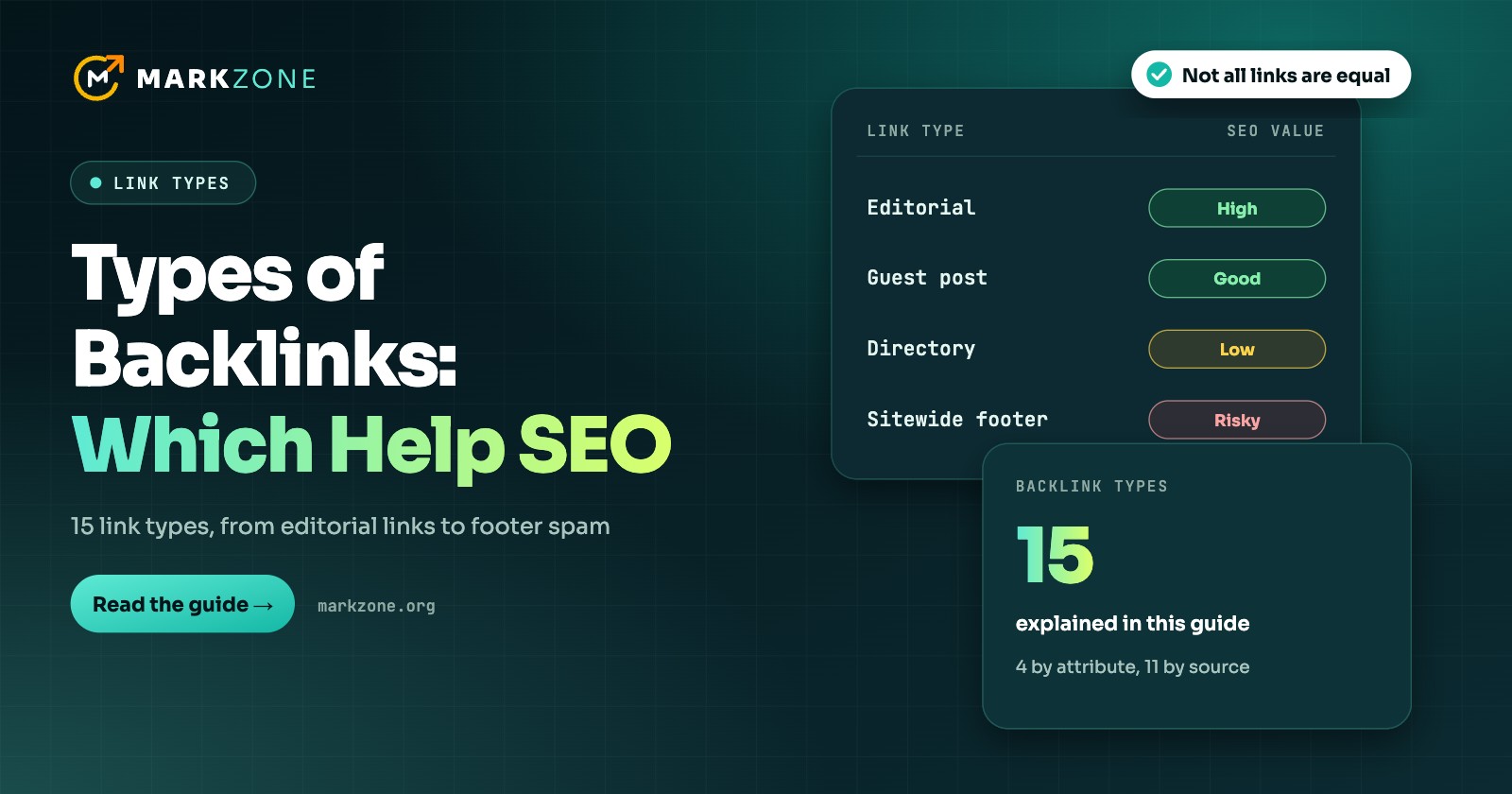
Two ways to sort backlinks. By how they are marked (dofollow, nofollow, sponsored, ugc) and by where they come from (articles, directories, forums and more).
Links inside relevant articles help most. Editorial links, guest posts and link insertions on real sites carry the most value.
Some types are mostly for traffic or risk. Social, comment and directory links rarely move rankings, and spammy versions are on Google’s list of link spam.
The main types of backlinks are dofollow, nofollow, sponsored and ugc links, which differ in how the linking site marks them. Others differ in where they come from: editorial, guest post, link insertion, resource page, image, directory, press release, social, forum, sitewide and private blog network links. The ones that help SEO most are followed links inside relevant articles on real websites. Directory, social, comment and press release links mostly bring visitors or visibility, and the spammy versions of several of them count as link spam under Google’s policies.
Guest posts and link insertions, two of the types below, are what we sell, so we have rated every type on what it does for rankings, ours included. Our catalog data further down shows how publishers actually offer the two types we sell.
Backlink types by link attribute
Every link either has no special attribute or carries one that tells Google how the site wants it treated. Google’s guide to qualifying outbound links describes three:
| Type | What it means | SEO value |
|---|---|---|
| Dofollow (no attribute) | A normal link the site is happy to vouch for | Can pass ranking value |
| Nofollow | The site doesn’t want to vouch for the page | Treated as a hint; can still send visitors |
| Sponsored | A paid link, such as an ad or sponsored post | Treated as a hint; marks the link as paid |
| UGC | A link added by users, such as in comments or forums | Treated as a hint |
These attributes are hints, not strict rules. When Google added sponsored and ugc in 2019, its announcement said all three “are treated as hints about which links to consider or exclude within Search.” So Google may still use such a link in some cases. For rankings, followed links are the ones that usually matter, as do nofollow links help SEO explains.
Backlink types by where they come from
This is where most of the difference lies. Here are the common types, from the most useful for rankings to the riskiest:
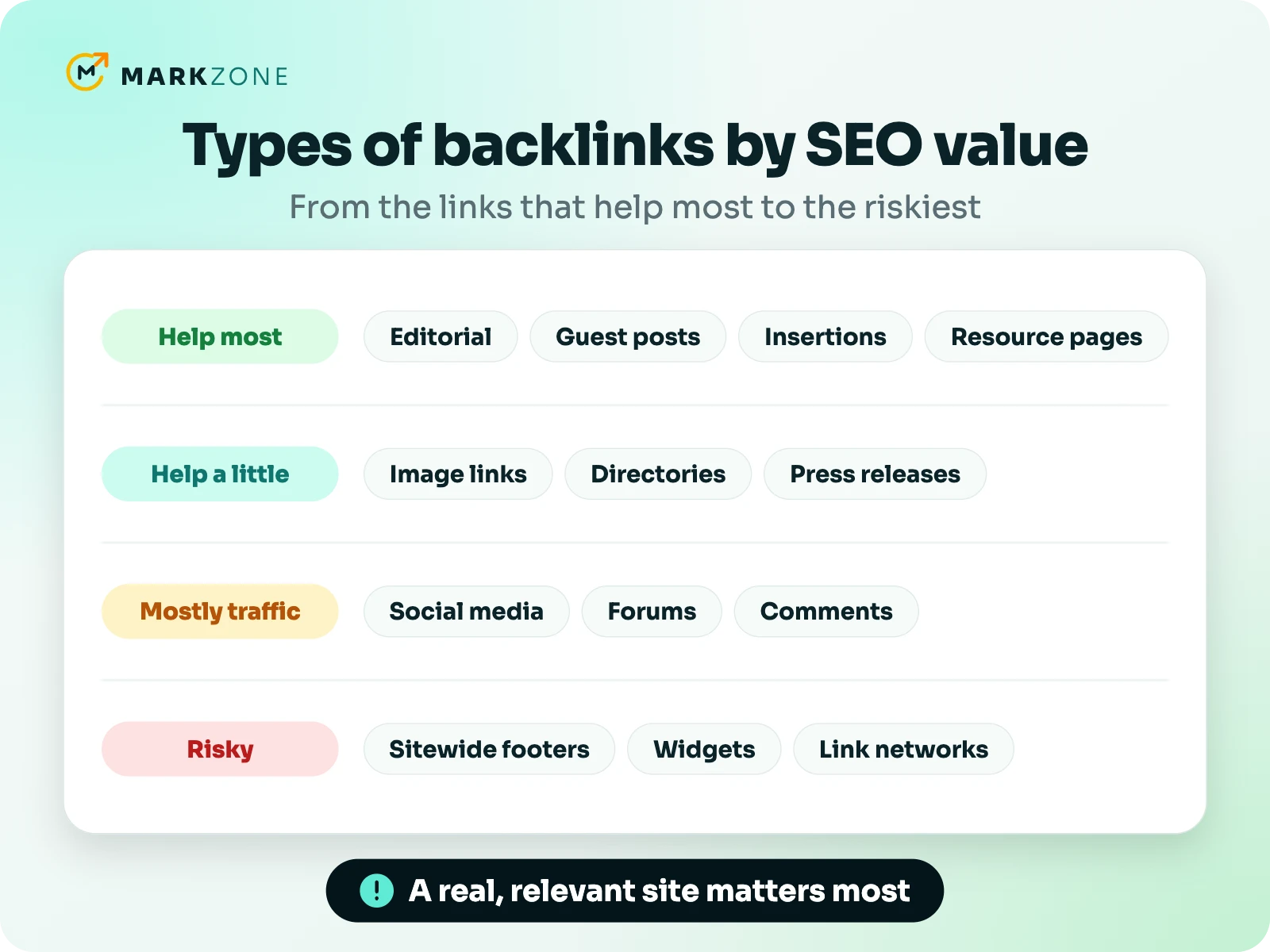
1. Editorial links
A writer links to your page because it helps their readers, without being asked or paid. They are the most natural kind of backlink, and they usually sit inside the text of a relevant article. You earn them with original data, useful tools and clear guides. They are also the hardest links to get: a 2019 Backlinko and BuzzSumo study of 912 million blog posts found that 94% had no links from other websites.
2. Guest post links
You write an article for another site in your niche and include a link back to your own site in the body. They help when the site is relevant and has real readers, and when the anchor reads naturally. Google’s spam policies treat “links with optimized anchor text in articles, guest posts, or press releases distributed on other sites” as link spam. A paid guest post link that passes ranking credit also counts as link spam unless it is marked sponsored or nofollow. Our guide to guest posting for SEO covers how to do it well.
3. Link insertions (niche edits)
A site adds your link to an article it has already published. The page may already rank and have links of its own, so a relevant insertion can be strong. The same rules on paid links apply. See our guide to niche edits.
4. Resource page links
Many sites keep pages that list useful tools or guides on a topic. A link there is relevant by design. Look for pages that are maintained and get traffic, not lists of hundreds of unrelated sites.
5. Image links
When an image links to your page, for example an infographic or chart someone embeds with credit, its alt text works as the anchor. Google’s link best practices say “for images as links, Google uses the alt attribute of the img element as anchor text.”
6. Business directory and citation links
Listings in business directories, industry associations and local chambers help people find you and support local SEO. They rarely move rankings on their own. Avoid paying for lists of directories: Google’s spam policies name “low-quality directory or bookmark site links” as link spam.
7. Press release links
Links in press releases spread across news wire sites are often nofollow and seldom help rankings. Their value is coverage: if a journalist writes about your news, the article’s link is an editorial link. Keyword anchors in distributed press releases are on Google’s link spam list.
8. Social media links
Links in profiles and posts on social networks are usually nofollow. They don’t do much for rankings, but they can send real visitors and help people find your content, which can lead to editorial links.
9. Forum and comment links
Links you add in forum posts and blog comments are usually marked ugc or nofollow, as Google asks sites to do for user-added links. A helpful answer with a relevant link can bring visitors. Dropping links for SEO is spam: Google’s policies name forum comments with optimized links in the post or signature.
10. Sitewide and widget links
Links in a site’s footer, sidebar or blogroll appear on every page. A genuine partner link is fine. But Google’s spam policies count “widely distributed links in the footers or templates of various sites” as link spam. Links embedded in widgets that are spread across sites are on the same list.
11. Private blog network links
A private blog network is a group of sites built mainly to link to other sites. Links from them exist to manipulate rankings, which is exactly what Google’s spam policies forbid, and they can be devalued or lead to a manual action. Google’s manual actions guide describes that penalty as “a pattern of unnatural, artificial, deceptive, or manipulative links pointing to your site.” Avoid them.
What our catalog shows about these backlink types
Here is how the 22,073 publisher sites in our catalog offered the types we sell on 13 November 2026. Every site takes guest posts, 60% also do link insertions, and almost all give followed links:
| Publisher sites that | Sites | Share |
|---|---|---|
| Take guest posts | 22,073 | 100% |
| Also do link insertions | 13,262 | 60% |
| Give dofollow links | 21,754 | 98.6% |
| Are listed as mixed (dofollow or nofollow) | 195 | 0.9% |
| Give nofollow links only | 124 | 0.6% |
| Allow 1 link per post | 12,975 | 58.8% |
| Allow 2 links per post | 8,213 | 37.2% |
| Allow 3 or more links per post | 885 | 4.0% |
The sponsored label is where practice and Google’s rules part ways. Only 240 sites, about 1%, are listed as adding a sponsored tag to paid posts. Another 7,190 are listed as not adding one, and the other 14,643 don’t say. So unless you ask, a paid link usually arrives as a plain followed link, without the sponsored or nofollow mark Google expects on paid links. We ask the publisher for the label when a client wants it.
Price depends more on the site than on the type. In our catalog, the median guest post and the median link insertion both cost $50, yet 508 sites charge more than $1,000 for a guest post. Our guest post and link insertion pages break prices down by DR.
Which types of backlinks help SEO most?
The type is only part of the story. A guest post on a relevant site with real readers beats a resource page link on an abandoned site, and an editorial link from a spammy site is still weak. Judge every link by the same few questions. Is the site real and relevant? Is the link inside the main content? Does the anchor read naturally, and is it marked honestly? Our guide to good backlinks turns those questions into a checklist.
A healthy link profile also includes a mix of types. Real websites get nofollow links from social media, a few directory listings and links with all kinds of anchors. A profile made only of followed keyword links from guest posts looks like what it is: links someone arranged.
Backlink types to avoid
- Bought links that pass ranking credit, without a sponsored or nofollow label. These count as link spam under Google’s policies.
- Private blog networks and other sites built only to link out.
- Automated links from tools that post comments, profiles or forum posts in bulk.
- Excessive link exchanges and partner pages made only to swap links.
- Widget and sitewide footer links spread across many sites.
Frequently asked questions
How many types of backlinks are there?
It depends on how you count. By attribute there are four: dofollow, nofollow, sponsored and ugc. By source, we count 11 common types, from editorial links to private blog networks.
Which backlinks are best for SEO?
Followed links inside the main content of relevant articles on real websites, especially editorial links you earn. Guest posts and link insertions can be strong too when the site is relevant and the anchor is natural.
Are nofollow backlinks useless?
No. They can send visitors, and Google treats nofollow as a hint, so it may still use them. They usually do less for rankings than followed links.
Are guest post backlinks against Google’s rules?
Not by themselves. Google’s spam policies target guest posts with optimized keyword anchors and paid links that pass ranking credit without being marked sponsored or nofollow.
Want the backlink types that help most?
We place guest posts and link insertions inside relevant articles. Tell us your niche to see which sites fit.

Muhammad Suleman is the founder of Markzone. He has done guest posting and link building since 2018 and has worked with hundreds of clients. Today his team handles 300–400 orders a month for brands and SEO agencies, with publisher sites in every major niche. He leads outreach, site checks and reporting, and writes about link building from his daily work with publishers and clients.