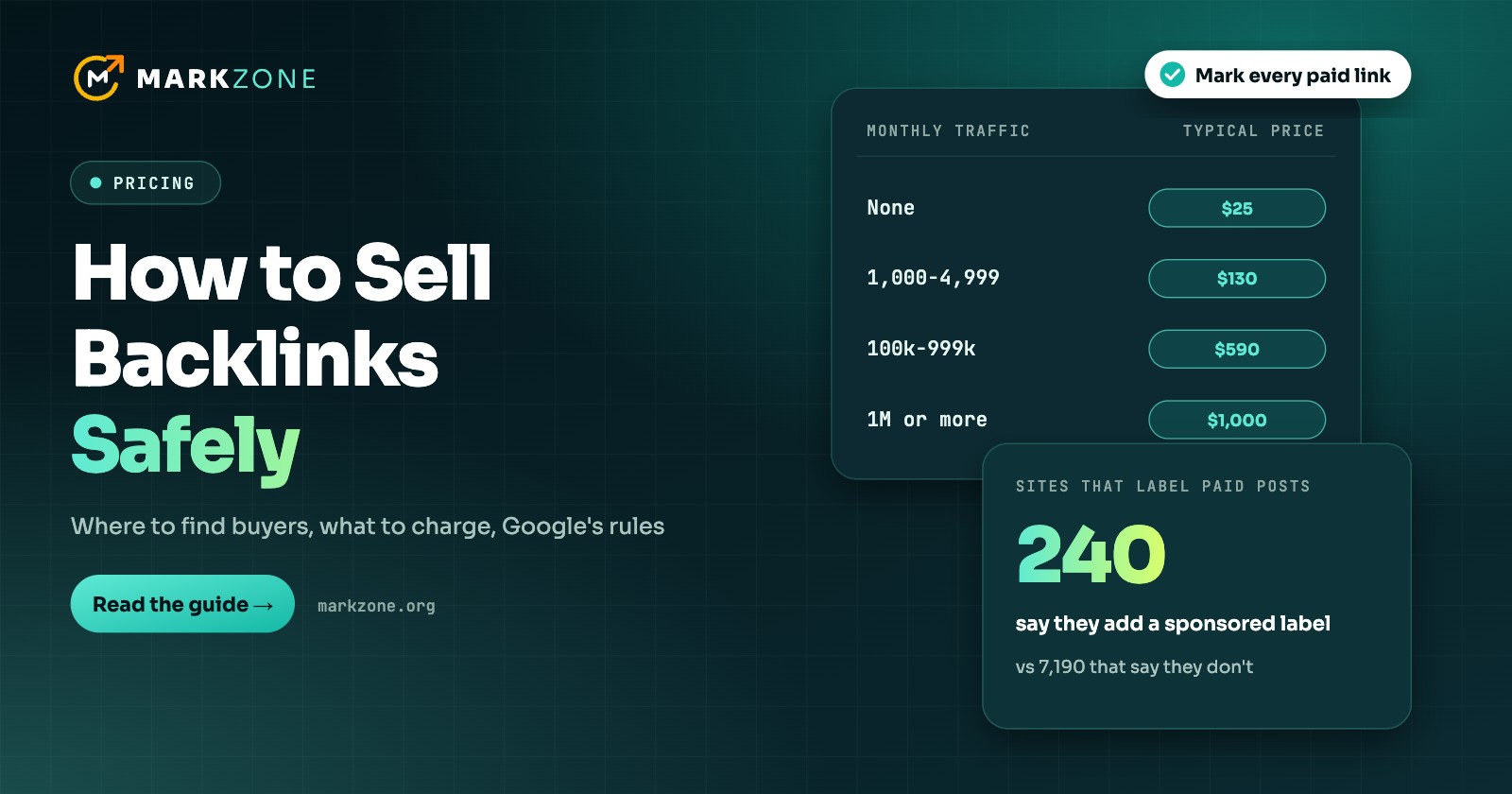
Sell the placement, label the link. Google’s spam policies class a sold link that passes ranking credit as link spam. Tag each paid link rel="sponsored" or rel="nofollow" and the sale is allowed.
Price from search traffic first. In our catalog, the typical guest post price climbs from $25 for a site without search traffic to $200 at 5,000 to 49,999 monthly visits. At a million or more, it is $1,000.
Set your terms before you list. Marketplaces can lock them in: Collaborator forbids adding a sponsored tag to a placed article unless the customer asks.
To sell backlinks, offer sponsored posts or paid links in existing articles, either directly through an “advertise” page or through a marketplace that brings buyers to you. Set the price mainly by your search traffic, then by niche and audience country. Before you take payment, mark every paid link rel="sponsored" (or rel="nofollow"), label the post for readers and publish it the way you publish your own work. A link sold to pass ranking credit breaks Google’s spam policies, and the consequences land on your site, not only the buyer’s.
Markzone sits on the other side of these deals. Our catalog lists 22,073 publisher sites, gathered from the price lists of publishers and resellers, and we sell placements on them to link buyers as guest posts and link insertions. We profit when publishers sell, and more when buyers order through us than direct from you. So this guide sticks to Google’s, the FTC’s and the marketplaces’ own words, plus our published price data.
Can you sell backlinks without breaking Google’s rules?
Yes, if every paid link is qualified. Google’s spam policies treat any link made “to or from a site” chiefly to manipulate rankings as link spam. Their first example of selling is “Exchanging money for links, or posts that contain links”. Paid placements as such are allowed: Google accepts that buying and selling links for ads and sponsorships is “a normal part of the economy of the web”. It says such links don’t violate its policies “as long as they are qualified”. That means a rel="sponsored" or rel="nofollow" value on each paid link. Its guide to qualifying links prefers sponsored for paid placements and still accepts nofollow.
What changes when you’re the seller:
- The manual action lands on your site. Google’s “Unnatural links from your site” action tells owners to “Identify any links on your site that were paid for”. Then they should remove them or add
rel="nofollow"“or a more specific attribute”. - Google addresses publishers directly. In July 2021 it called sponsored and guest posts “Another common way sites can monetize” and wrote: “we still strongly recommend that site owners apply the appropriate rel values to these links.” Since its December 2022 link spam update, it has said SpamBrain hunts for sites that pass outgoing links, not only for the sites that buy them.
- Weak guest posts are a content problem too. Google’s thin content manual action counts “low-quality guest blog posts” as content from other sources.
The buyer’s side of the rule, with a dated history, is in is buying backlinks safe.
What other sellers offer
In our price study, the publisher sites in our catalog (22,073 of them on 13 November 2026) stated the terms below. These are publishers’ own statements, not our tests, but they show what buyers are used to:
| Term | What sellers in our catalog state |
|---|---|
| Price | 18,977 list a fixed price per post; 3,096 quote on request |
| Links per post | 59% allow one link to the buyer’s site, 37% two and 4% three or more |
| Turnaround | Over 96% of the 16,127 that state a turnaround promise 48 hours or less |
| Link attribute | 21,754 list followed links; 319 list nofollow or a mix |
| Sponsored label | 240 mark guest posts as sponsored by their own account; 7,190 say they don’t; 14,643 are silent |
| Links in old articles | 13,262 also sell them; of the 8,387 that price both, 70% charge less for the insertion, and the typical insertion costs 20% less |
| Crypto and CBD | 8,384 accept crypto and 7,753 CBD; where a separate price is listed, the median is 1.4 times the normal one |
Two things follow. Speed is the norm, so if you need a week, say so up front. A seller who marks paid posts sponsored joins a small group: 240 of 22,073 catalog sites say they do.
How much to charge for a backlink
Buyers pay for search traffic first. The table gives the median guest post price for each band of monthly Ahrefs traffic across our catalog’s 18,977 priced sites (13 November 2026). The last two columns are derived from catalog-wide medians. They show a link added to an existing article at the typical 20% discount, and a crypto or CBD post at the typical 1.4 times surcharge. Treat these two columns as estimates: the study doesn’t split those prices by traffic.
| Monthly search traffic | Priced sites | Typical guest post | Middle half | Link in an old article (× 0.8) | Crypto or CBD post (× 1.4) |
|---|---|---|---|---|---|
| None | 7,133 | $25 | $20 to $60 | $20 | $35 |
| 1 to 999 | 7,257 | $60 | $25 to $180 | $48 | $84 |
| 1,000 to 4,999 | 2,377 | $130 | $40 to $340 | $104 | $182 |
| 5,000 to 9,999 | 798 | $200 | $40 to $500 | $160 | $280 |
| 10,000 to 49,999 | 1,016 | $200 | $40 to $540 | $160 | $280 |
| 50,000 to 99,999 | 199 | $325 | $60 to $785 | $260 | $455 |
| 100,000 to 999,999 | 172 | $590 | $215 to $1,000 | $472 | $826 |
| 1 million or more | 25 | $1,000 | $360 to $1,400 | $800 | $1,400 |
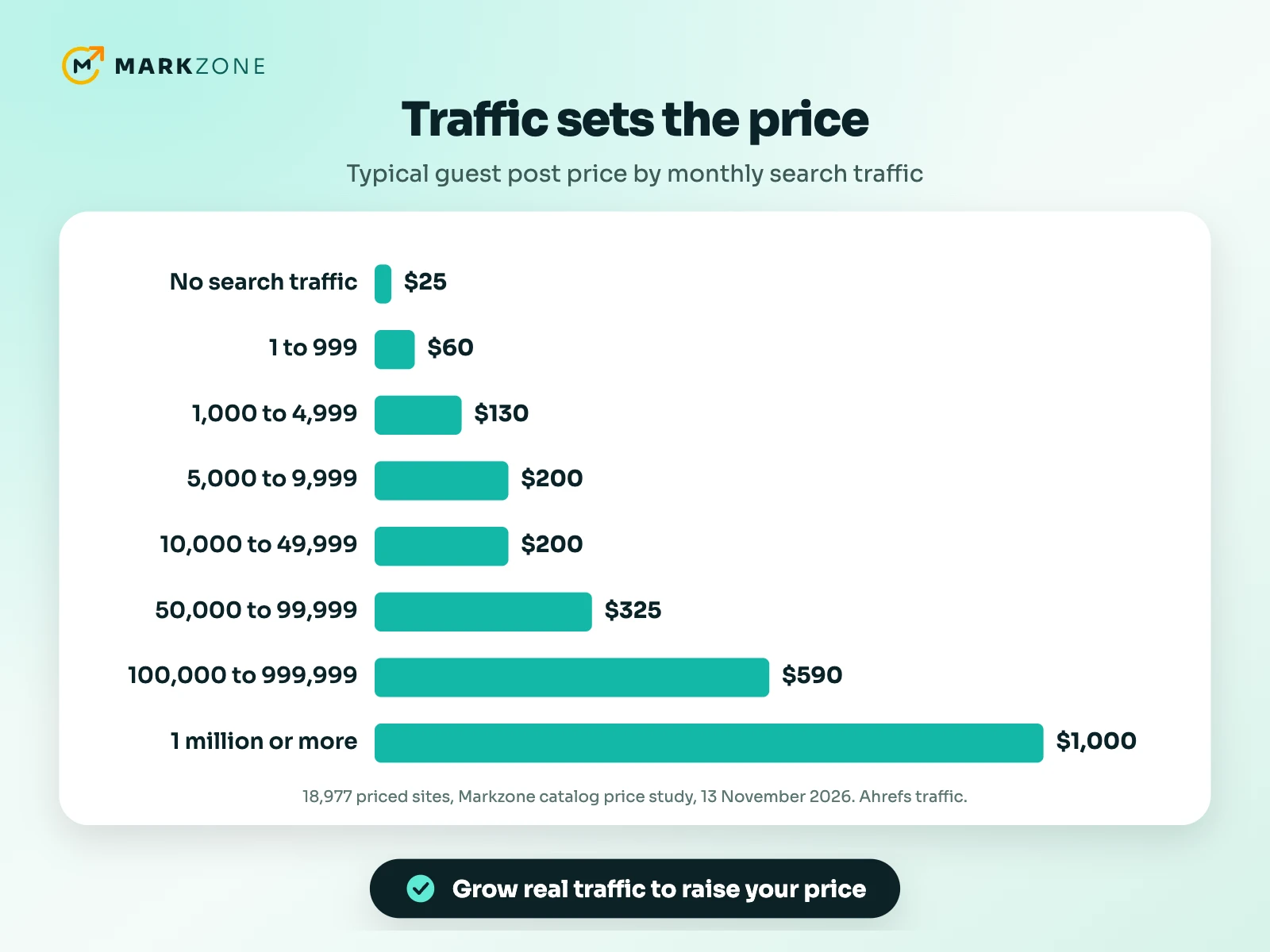
Read these as market prices, not as what a publisher keeps. Buyers pay them through our catalog, so they cover our outreach, our vetting of the site and an 8-month guarantee, but not article writing. A direct sale can come in lower and still match the market.
Then adjust for:
- Niche. Sports sites typically charge $150, travel $120 and automotive $100, the most of any niche. Technology, education, home and garden, fashion and beauty, gaming, marketing and real estate sites charge $30, the least.
- Audience country. Where a site’s search visitors mostly come from matters: the typical price is $390 for Germany, $105 for the UK, $50 for the US and $25 for India.
Example, not a real site: a travel blog with about 3,000 monthly search visits, most of them from the UK. Its traffic band typically charges $130, travel sites $120 and UK-audience sites $105. Those medians sit within $25 of one another, so a guest post at $105 to $130 is in line with similar sites. At the typical gaps, a link in an old article comes to $84 to $104 and a crypto or CBD post to $147 to $182. Medians don’t stack, so don’t multiply niche, country and traffic together.
Where to find buyers
- Your own “advertise” page. You keep the whole price and handle vetting, invoicing and disputes. State your traffic, topics, prices and link policy on it.
- Marketplaces. Buyers come to you and the platform holds the money, for a fee (compared below).
- Resellers and catalogs. Agencies and catalogs, ours included, list sites from publishers’ price lists and resell them at their own prices. If you’d like us to look at your site, contact us.
- Brands in your niche. Many already advertise to your readers.
What three marketplaces state for publishers, checked on 20 November 2026:
| Platform | Who sets your price | Fee stated for publishers | When you’re paid | Rules to know before you list |
|---|---|---|---|---|
| Adsy | “You are the one to set prices” | 7.9% at withdrawal: 4% PayPal and 3.9% Adsy | When the client approves the post, or automatically after 14 days; withdrawals by PayPal | “You can reject an article placement” |
| Collaborator | You; its FAQ advises “competitive rates” | 15% on withdrawals | When the advertiser approves (72 hours, then automatic); withdrawals processed in 1 to 3 business days | You pick dofollow, nofollow or sponsored in your settings; adding sponsored to a placed article is “forbidden” unless the customer asks; posts stay up “for the entire lifespan of the website” |
| WhitePress | “Only you set the prices” | Not stated on its publisher page | “within one business day from receiving the invoice” | “you don’t have to accept offers that don’t suit you” |
Plan around Collaborator’s rule: the link type set when an article is placed is the one it keeps, so pick sponsored there if you mean to follow Google’s rule. Fees change your price too. At Collaborator’s 15%, a $200 sale pays out $170; at Adsy’s 7.9%, $184.20.
Before you publish a paid post
Google’s site reputation policy covers third-party content placed on a site mainly to borrow its ranking signals. A sponsored post written by the buyer or its agency is third-party content. When Google reviews a site under this policy, it looks for “sufficient input, editorial oversight, or contribution from the host site”. The spam policies page lists four factors, added in its 28 August 2026 update. Each maps to a check you can make before publishing:
| Google’s factor | Check before you publish |
|---|---|
| Presentation: are the “graphic design, formatting, typography and UX features” consistent with your site? | Use your normal template, and file the post in a section readers can reach from your homepage |
| Quality: are there issues that “suggest a departure from the standard of quality of the main domain”? | Edit it like your own articles, or send it back |
| Authorship: is there “an explicit acknowledgement of ownership or responsibility for the content”? | Name the author and the sponsor, and say who edited it |
| Duplication: does the content appear “on multiple other sites in identical or near-identical form”? | Search a sentence from the draft in quotes, and refuse copy that runs elsewhere |
Google’s own example under “Likely to take action” is an article linking to a CBD marketplace. In it, “Neither the author of the article nor the responsible editor is identified, nor are there disclaimers about the commercial character of the content”. No menu or section links to it either. Outside the European Economic Area, pages like that can get a manual action. Inside it, Google said on 28 August 2026 that “the impact of the manual action won’t apply”, though such pages may be ranked separately from the rest of the site.
Then, for every paid placement:
- Qualify the link. Add
rel="sponsored"to each paid link, including links you add to old articles. If you also sell through catalogs, check how they describe your links. Ours says: Links in our catalog are dofollow by default unless the publisher marks them otherwise, and you can ask for a sponsored label on any order. - Label the post for readers. The FTC’s native advertising guide says “Everyone who participates directly or indirectly in creating or presenting native ads should make sure that ads don’t mislead consumers about their commercial nature”. The publisher is the one presenting the ad. What a sponsored post is lists the label wording the FTC accepts and where it goes.
- Keep anchors plain and links in the body. Ask for a brand name, URL or plain description as the anchor, and don’t sell footer or sidebar links: Google’s link spam list includes “Widely distributed links in the footers or templates of various sites”.
- Keep a log. Record the buyer, URL, anchor, attribute, price and date of every paid link. If a manual action ever arrives, Google asks you to “Provide examples of bad content that you removed and good content that you added”.
Frequently asked questions
Can I add a sponsored tag after a buyer paid for a followed link?
Not on Collaborator, unless the buyer asks: it forbids changing a link’s type after placement “unless directly requested by the customer”. Elsewhere, the buyer paid for the terms you offered, so settle the attribute before you accept an order and state it in your offer. Then the label is part of the deal, not a change to it.
How much can I earn selling links?
It depends on your traffic and how many paid posts you accept. As an example only: four posts a month at $200, the typical catalog price for sites with 10,000 to 49,999 monthly visits, come to $800 before fees. Through Collaborator that pays out $680 after its 15% withdrawal fee, and through Adsy $736.80 after 7.9%. Our catalog prices include our margin, so treat them as a guide to the market, not to your payout.
Should I sell links in old articles?
You can if you treat them like any paid link: rel="sponsored" on the link and a disclosure readers can see. Some marketplaces restrict them: Collaborator prohibits “Placing links in previously published articles” unless the client asks.
Sources
- Google Search Central: Spam policies for Google web search (last updated 28 August 2026; link spam and site reputation sections)
- Google Search Central: Qualify your outbound links to Google (last updated 10 December 2025)
- Google Search Console Help: Manual Actions report (“Unnatural links from your site” and thin content sections; checked 20 November 2026)
- Google Search Central Blog: A reminder on qualifying links and our link spam update (26 July 2021)
- Google Search Central Blog: December 2022 link spam update (14 December 2022)
- Google Search Central Blog: Update to the site reputation policy (28 August 2026)
- Wayback Machine: Google spam policies, capture of 26 August 2026 (page last updated 15 May 2026; no review factors) and capture of 2 September 2026 (last updated 28 August 2026; factors present)
- FTC: Native Advertising: A Guide for Businesses (December 2015; checked 20 November 2026)
- Adsy: How to Earn Money from Your Blog (publisher terms; checked 20 November 2026)
- Collaborator: for publishers and Collaborator FAQ (fees, payouts, link and placement rules; checked 20 November 2026)
- WhitePress: for publishers (checked 20 November 2026)
- Markzone guest post price study (catalog snapshot of 13 November 2026)
Want to sell placements on your site?
Send us your domain and niche. We’ll tell you honestly whether our buyers would be interested and what similar sites charge.

Muhammad Suleman is the founder of Markzone. He has done guest posting and link building since 2018 and has worked with hundreds of clients. Today his team handles 300–400 orders a month for brands and SEO agencies, with publisher sites in every major niche. He leads outreach, site checks and reporting, and writes about link building from his daily work with publishers and clients.