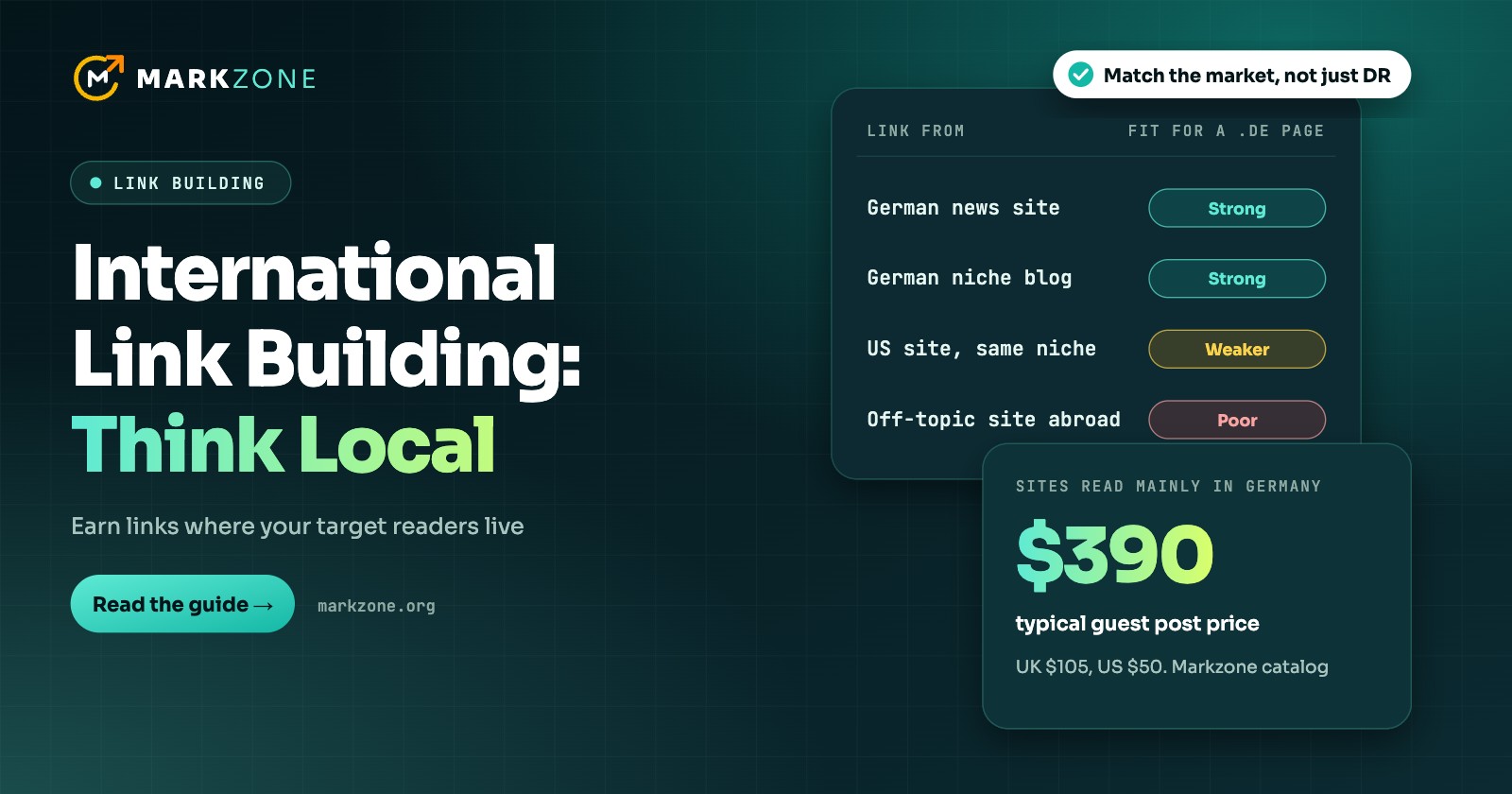
Local links help Google see who a site is for. Google lists “links from other local sites” among the signals of a site’s intended audience. Links from other countries don’t hurt you.
The market sets the budget. In our catalog, sites read mainly in Germany typically charge $390 a post, against $125 for Spain, $105 for the UK and $50 for the US. So $1,000 buys about 2 placements on sites read mainly in Germany, or 20 on sites read mainly in the US.
Send each link to the right version. Point links at the page in the reader’s language, and connect the versions with hreflang tags that point both ways.
International link building means earning links from websites read in the countries and languages you want to rank in. It also means pointing those links at the version of your site made for those readers. For German searchers, the best fit is a link from a site Germans read, pointing to your German page; links from other countries won’t hurt you. Plan one market at a time: build the local page, check where each linking site’s readers live, then set a budget. The typical placement costs anywhere from $25 to $390 across the 15 biggest markets in our catalog.
Markzone sells guest posts and link insertions on publisher sites in many countries, so we gain when you buy links abroad. Every price here is from our guest post price study of 13 November 2026, and much of this guide covers links nobody can sell you.
- Do links from other countries help or hurt?
- Choose your first markets
- Check a site’s market before you get a link
- What links cost in each market
- Point links at the right version of your site
- Where to find links in a new market
- How to pitch sites in another language
- Measure each market on its own
- Frequently asked questions
- Sources
Do links from other countries help or hurt?
They don’t hurt. In October 2016, Google’s John Mueller wrote that “the quality of links doesn’t depend on their nationality or the languages they speak.” In Mastodon replies reported in June 2023, he went further: “There’s no reason to disavow links just because the linking website is in another language,” calling the opposite belief “a somewhat common myth.”
Whether a link helps in a given market is a separate question. Google’s guide to multi-regional and multilingual sites lists “links from other local sites” as a signal of who a site is for. It puts them next to “local addresses and phone numbers on the pages” and “the use of local language and currency”. For your Spanish pages, a link from a well-read Spanish site does a job that a link from an unrelated site abroad can’t.
Choose your first markets
| Check | Where to look | A good first market |
|---|---|---|
| Demand | Search Console’s Performance report, grouped by Countries | You already get impressions there without trying |
| Competition | The top five results in that country for your main keywords (a rank tracker set to the country shows them), and their referring domains | The middle page has few; SEO without link building gives cut-offs |
| Cost per link | The typical catalog price for the market (table below) | The links you need fit your budget |
| Supply | Sites in your niche that the market reads | Enough relevant sites, partners and press to approach |
| Your page | Your own site | A page written for that market exists, or you build it first |
Start with the last row: links need a page in the right language to point to, and a translated menu over English content isn’t one.
Check a site’s market before you get a link
A .com address or an English menu says little about where a site’s readers live. Ahrefs’ Site Explorer shows a site’s “traffic share by country (%)” for organic and paid search. Semrush’s Domain Overview has a Distribution by Country widget showing “which countries generate the most organic and paid search traffic for the domain” (for the root domain only). Both are estimates. A site with no search traffic has no audience country to check, and in our catalog 7,133 of the 18,977 priced sites (38%) have no Ahrefs traffic.
| Signal | Where to look | Good sign |
|---|---|---|
| Traffic by country | Ahrefs or Semrush | Most search traffic comes from your target market |
| Language | The articles, not the menu | Written natively in your target language |
| Local detail | Recent articles | Local prices, laws, events and examples |
| Links out | Where recent posts link | Local businesses and sources |
| Domain | The address | A country domain such as .de, or a section for your country |
What links cost in each market
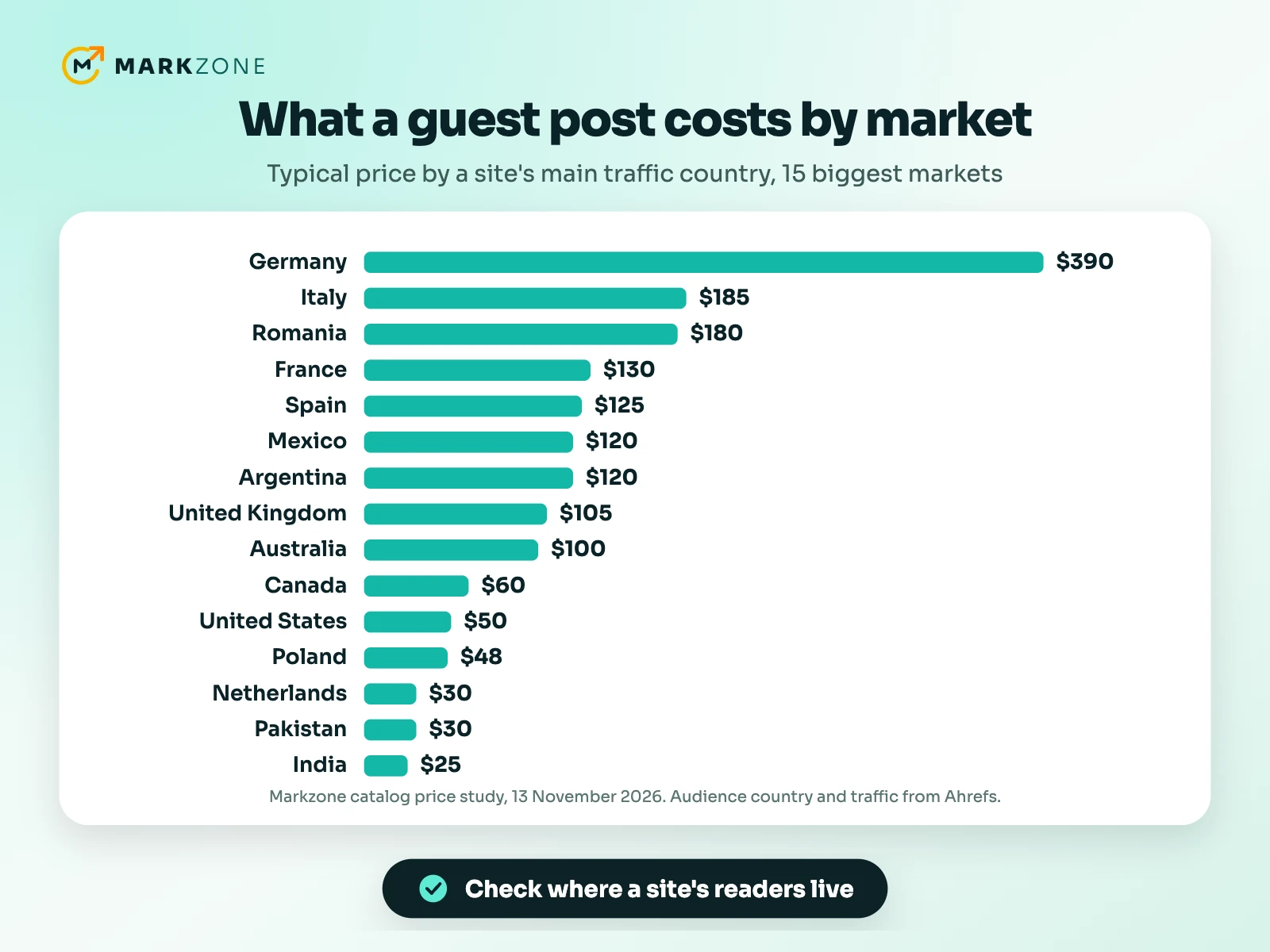
Our catalog groups sites by the country that sends them most of their search traffic, according to Ahrefs. Here are the 15 biggest countries by number of priced sites:
| Main traffic country | Priced sites | Typical guest post | Placements per $1,000 at that price |
|---|---|---|---|
| Germany | 860 | $390 | 2 |
| Italy | 658 | $185 | 5 |
| Romania | 169 | $180 | 5 |
| France | 773 | $130 | 7 |
| Spain | 492 | $125 | 8 |
| Mexico | 157 | $120 | 8 |
| Argentina | 138 | $120 | 8 |
| United Kingdom | 643 | $105 | 9 |
| Australia | 164 | $100 | 10 |
| Canada | 317 | $60 | 16 |
| United States | 3,543 | $50 | 20 |
| Poland | 206 | $48 | 20 |
| Netherlands | 402 | $30 | 33 |
| Pakistan | 151 | $30 | 33 |
| India | 2,008 | $25 | 40 |
Typical means the median price buyers pay through our catalog. It excludes article writing, placements are rounded down, and the study doesn’t publish price ranges by country. Three patterns stand out:
- Spanish costs about the same across markets. Sites read mainly in Spain have a typical price of $125, and those read mainly in Mexico or Argentina $120. If one Spanish page serves Spanish speakers everywhere, pick sites by topic and readers, not by country price.
- English markets split in two. The US at $50 and Canada at $60 cost about half as much as the UK at $105 and Australia at $100.
- Supply thins out fast. These 15 markets hold 10,681 of the 18,977 priced sites, and 3,543 of them are read mainly in the US. Argentina has 138 in all, so in a narrow niche you may find only a handful, and earned local links have to do more of the work.
Worked example (invented gaps, real catalog prices). A UK software company is launching German, French and Spanish pages. In each market, its new page is six linking sites short of the middle page in the local top five. At typical prices:
| Market | Placements | Typical price | Cost |
|---|---|---|---|
| Germany | 6 | $390 | $2,340 |
| France | 6 | $130 | $780 |
| Spain | 6 | $125 | $750 |
| Total | 18 | $3,870 |
The same 18 placements on UK-read sites would cost 18 × $105 = $1,890. The German gap alone, at $2,340, costs more than the French and Spanish gaps combined, at $1,530. Two ways to bring it down: close part of each gap with the earned links below, and take a link insertion where a site already has a relevant article. On sites that price both, an insertion is typically 20% cheaper; at the German median that would be about $312 instead of $390.
If you buy, the paid-link rule is the same in every language. Google’s spam policies don’t object to buying links for advertising, which they call “a normal part of the economy of the web.” The links must be marked, though: they’re within the rules “as long as they are qualified” with rel="sponsored" or rel="nofollow". Links from our catalog default to dofollow unless the publisher marks them otherwise, and you’re free to ask for a sponsored label on any order.
Point links at the right version of your site
Send each link to the page in the reader’s language: a German site should link to your German page, not your English homepage. Then make sure Google can connect your versions. From Google’s hreflang guide:
- Every version lists every version. “Each language version must list itself as well as all other language versions.” And “If two pages don’t both point to each other, the tags will be ignored.”
- Language first, region optional. Use de for German anywhere, or de-AT for German in Austria. “You can’t specify the country code by itself.”
- Use en-GB, not en-UK. Google says “using EU, UN, or UK in hreflang annotations doesn’t have an effect on Google Search.” Codes such as es-419 aren’t supported either.
- Translate the page, not just the template. “Google doesn’t use hreflang or the HTML lang attribute to detect the language of a page”; it reads the content.
- Link the versions to each other. Mueller in 2023: “Regardless of ranking, cross-linking language versions is generally a good idea.” A language switcher on every page does it.
Search Console no longer has a country-targeting setting. Google has deprecated the International Targeting report and says country targeting “was determined to have little value for the ecosystem, and is no longer supported.” It adds that it “will continue to support and use hreflang tags on your pages.” To test your tags, Google’s hreflang guide points to third-party tools that it says it doesn’t maintain or check.
Your URL structure decides where links build up. Google’s multi-regional guide compares the options:
| Structure | Google’s pros and cons | For link building |
|---|---|---|
| Country domain (example.de) | “Clear geotargeting,” but “Expensive,” “Requires more infrastructure” and “Can only target a single country” | A new domain starts with no links and needs its own |
| Subdomain (de.example.com) | “Easy to set up,” but users may not know whether “de” means the language or the country | A separate host; link to it clearly from your main pages |
| Subdirectory (example.com/de/) | “Easy to set up” and “Low maintenance (same host),” but “Separation of sites harder” | Sits on a domain that already has links, and your strongest pages can link to it |
| URL parameters (?loc=de) | “Not recommended” | Avoid |
Where to find links in a new market
| Source | How to find it in the market | Cost |
|---|---|---|
| Distributors, resellers and partners | Their “brands” or “partners” pages; ask for a listing in their language | Time |
| Trade associations and chambers | Search for your industry’s association in the local language; member directories often list websites | Membership dues |
| Local press | Publish data about that market, such as local prices or a survey of local customers, and pitch the reporters who cover your sector | Time and the research |
| Local guest posts | Sites read mainly in the market, with an article written or edited by a native speaker | The typical prices above, plus writing |
| Unlinked mentions | Alerts for your brand, with local spellings and product names | Time |
| Competitors’ local links | A backlink gap analysis on the sites that rank in that country | A backlink tool |
| Events and sponsorships | Meetups, conferences and clubs your customers care about | A fee; a paid sponsor link should be marked sponsored |
Filter our catalog by country, then weigh each site’s traffic, DR and price before you order.
How to pitch sites in another language
- Write in their language. A native speaker should write or check every pitch and every article.
- Don’t send machine translations at scale. Google’s spam policies count scraping content to generate many pages as scaled content abuse when “little value is provided to users.” The policy covers scraping “including through automated transformations like synonymizing, translating, or other obfuscation techniques”.
- Choose anchors a local writer would use. Your brand or a natural phrase in that language works better than a word-for-word translation of an English keyword; keyword backlinks covers the mix.
Measure each market on its own
- Search Console. In the Performance report, filter by country and by the market’s pages, such as /de/, and compare clicks, impressions and average position month by month.
- Local referring domains. Count new linking sites whose search traffic comes mainly from the target market, using the same country check as above.
Frequently asked questions
Should Spanish pages use hreflang “es” or one tag per country?
If one Spanish page serves every Spanish speaker, “es” is enough: Google’s own examples include “de: German language content, independent of region.” Use country codes such as es-MX and es-ES only when the pages differ by country, and skip es-419, which Google doesn’t support.
Do I need a country domain such as .de to rank in Germany?
No. Google’s multi-regional guide also offers subdomains, subdirectories and hreflang. It says country domains “provide a strong signal to both users and search engines that your site is explicitly intended for a certain country.” But its SEO Starter Guide says the TLD “only matters if you’re targeting a specific country’s users, and even then it’s usually a low impact signal.” The bigger cost is links: a new .de starts with none, while a /de/ folder sits on a domain that already has them.
Do links to my English pages help my German pages?
Google’s hreflang guide describes the tags as a way to point searchers to the right version, and it doesn’t mention link value moving between versions. On one domain, internal links such as a language switcher connect the versions. On separate country domains, plan links for each one.
Sources
- Google Search Central: Managing multi-regional and multilingual sites (last updated 10 December 2025)
- Google Search Central: Tell Google about localized versions of your page (last updated 21 September 2026)
- Search Console Help: The International Targeting report is deprecated (checked 20 November 2026)
- Search Console Help: Performance report (Search results) (checked 20 November 2026)
- Google Search Central: Spam policies for Google web search (last updated 28 August 2026)
- Google Search Central: SEO Starter Guide (last updated 10 December 2025)
- Search Engine Roundtable: Google: International & Multilingual Links Are Not Seen As Spammy (Barry Schwartz, 11 October 2016; Mueller on Twitter, 8 October 2016)
- Search Engine Journal: Google: Links From Non-English To English Language Sites Are Not Bad? (Roger Montti, 13 June 2023; Mueller’s Mastodon replies, including the cross-linking quote)
- Ahrefs Academy: Site Explorer, Overview report (“traffic share by country”; checked 20 November 2026)
- Semrush Knowledge Base: Domain Overview, Overview report (Distribution by Country widget; checked 20 November 2026)
- Markzone: Guest post price study (catalog snapshot of 13 November 2026: prices by main traffic country, no-traffic count, niche edit discount, writing not included)
Not sure which market to start with?
Tell us the market and the pages you want to rank. We’ll suggest sites whose readers are actually there.

Muhammad Suleman is the founder of Markzone. He has done guest posting and link building since 2018 and has worked with hundreds of clients. Today his team handles 300–400 orders a month for brands and SEO agencies, with publisher sites in every major niche. He leads outreach, site checks and reporting, and writes about link building from his daily work with publishers and clients.