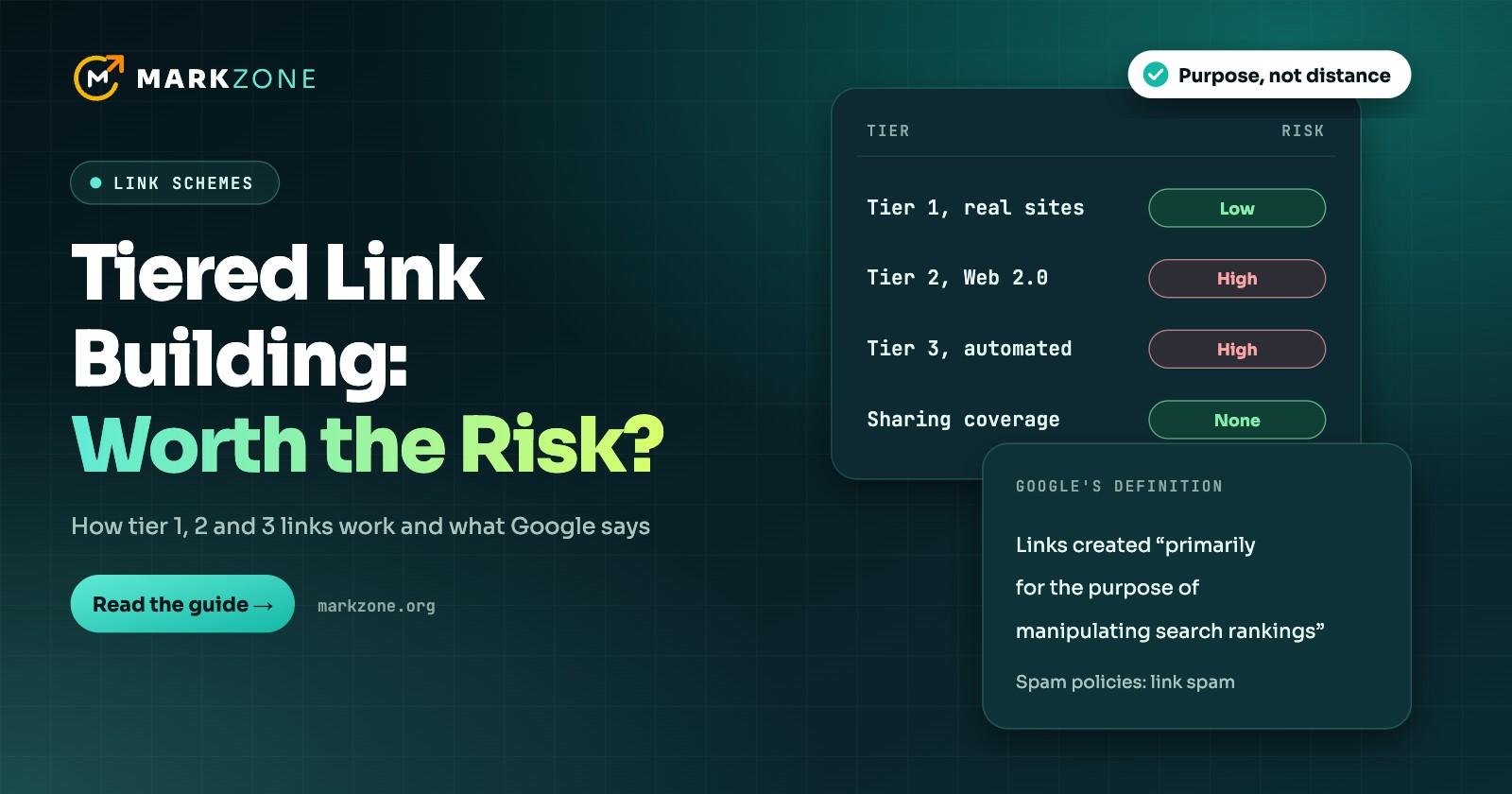
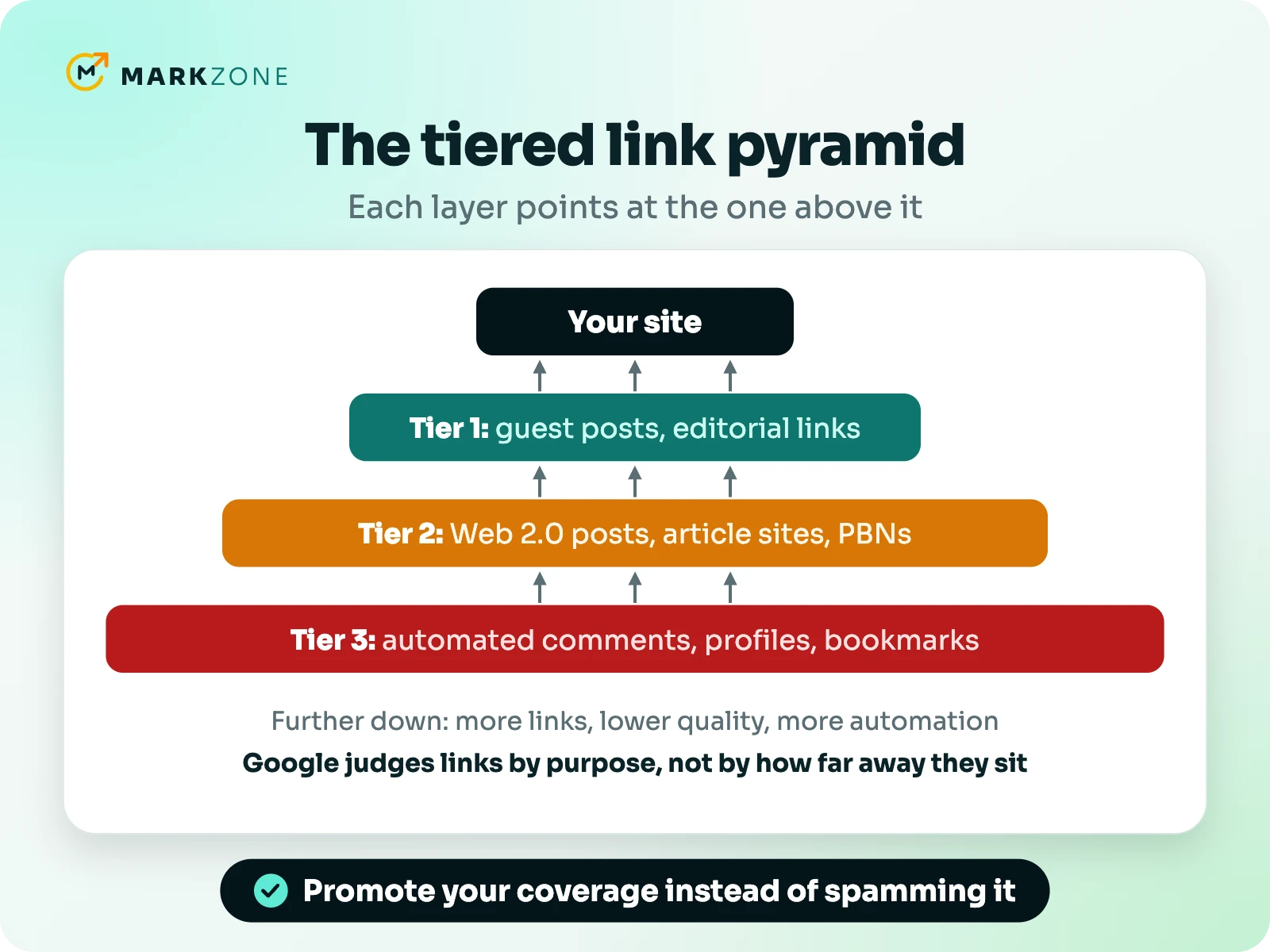
Tiers are links to your links. Tier 2 links point at the pages that link to you, and tier 3 links point at tier 2.
Google’s rule doesn’t stop at your domain. Link spam covers links made “to or from a site” mainly to manipulate rankings, including links aimed at a publisher’s page for your benefit.
Spend the money on tier 1. At our catalog’s median prices, a weak tier 1 post plus five tier 2 posts costs $185. One post on a site with 5,000 to 49,999 monthly visits typically costs $200.
Tiered link building means building links to the pages that link to you. Tier 1 links point at your site. Tier 2 links point at your tier 1 pages, and tier 3 links point at tier 2, usually in larger numbers and at lower quality. The idea is to make tier 1 links pass more value without pointing risky links straight at your site. Google’s spam policies don’t draw that line, though: they judge a link by why it was made, not by where it sits in a chain. Sharing an article that features you, or linking to it from your own site, is normal. Buying or automating links to it is not.
In tiered terms, Markzone sells tier 1 links: guest posts and link insertions placed on publishers’ sites. We’d rather you spent your budget on tier 1, so the cost comparison below shows its arithmetic for you to check.
Paid tier 1 links come under Google’s paid-link rule. In Google’s words, buying and selling links is “a normal part of the economy of the web” when done for advertising or sponsorship. It’s not a violation “as long as they are qualified” with a rel="nofollow" or rel="sponsored" attribute. That applies to links bought from us as well. Dofollow is the default for links in our catalog unless the publisher marks them otherwise, and you can add a sponsored label to any order by asking.
- What is tiered link building?
- Each tier next to Google’s own wording
- The claims, and what actually happens
- What a tiered stack costs next to one stronger link
- Supporting tier 1 links the normal way
- If someone builds tiered links to your pages
- Is tiered link building worth it in 2026?
- Frequently asked questions
- Sources
What is tiered link building?
It’s a way of stacking links in layers, often drawn as a link pyramid. Your site is at the top. Below it sit a few strong links, and below those, many weaker links pointing up at them.
The logic runs like this: a link is worth more when the page carrying it is strong, so strengthen that page and your link should gain. Instead of building more links to your own site, you build links to the pages that already link to you.
Each tier next to Google’s own wording
Nowhere in Google’s spam policies, last updated on 28 August 2026, does the word “tiered” appear. Their examples of link spam still cover every layer:
| Tier | Points to | Typical links | Google’s link spam example that fits |
|---|---|---|---|
| Tier 1 | Your site | Guest posts, link insertions, editorial mentions, press coverage | When paid and unqualified: “Exchanging money for links, or posts that contain links.” With keyword anchors: “links with optimized anchor text in articles, guest posts, or press releases distributed on other sites” |
| Tier 2 | Your tier 1 pages | Posts on free blog platforms, article sites, extra guest posts, sometimes PBN sites | “Creating low-value content primarily for the purposes of manipulating linking and ranking signals,” plus the paid-link example when tier 2 is bought |
| Tier 3 | Your tier 2 pages | Comments, forum and profile links, bookmarks, mostly made by software | “Using automated programs or services to create links to your site,” “Low-quality directory or bookmark site links” and “Forum comments with optimized links in the post or signature” |
Tier 1 can be clean: an editorial mention, or a paid link qualified with rel="sponsored", is within Google’s rules. Tiers 2 and 3 are harder to defend, because they exist only to move rankings.
The automated-links example says “your site,” and tier 3 links point at someone else’s pages. But the definition above the list is wider. Link spam is “the practice of creating links to or from a site primarily for the purpose of manipulating search rankings.” Google’s December 2022 link spam update put it more plainly: “links obtained primarily for artificial manipulation of Search rankings are link spam.” Neither sentence asks whose site the link points to, only why it was made.
The claims, and what actually happens
| The claim | What actually happens |
|---|---|
| “It makes tier 1 links stronger” | Only if Google counts the layers below. Its systems are built to discount low-quality and automated links, the raw material of tiers 2 and 3. |
| “Risky links never touch your site” | The definition is about purpose, not distance, and the risk moves onto the publisher whose page you’re boosting. |
| “It’s cheap” | Per link, yes. Per result, no: see the comparison below. |
| “It gets tier 1 pages indexed” | Internal links on the host site usually do that job without the risk; see how to index backlinks. |
What a tiered stack costs next to one stronger link
Here is a worked example built on median prices from our guest post price study, which covers our catalog as it stood on 13 November 2026. It’s an illustration, not a real campaign.
| Option A: tiered | Option B: one stronger link | |
|---|---|---|
| Tier 1 | Guest post, site with 1 to 999 monthly visits: $60 | Guest post, site with 5,000 to 49,999 monthly visits: $200 |
| Tier 2 | Five guest posts on sites with no search traffic, each linking to the tier 1 post: 5 × $25 = $125 | Not needed |
| Tier 3 | Software or a service at extra cost (we don’t sell it and have no price data) | Not needed |
| Placements at median prices | $185, plus tier 3 and your time | $200 |
| Articles, if we write them at $20 per 800 words | 6 × $20 = $120 | $20 |
| Total | $305, plus tier 3 | $220 |
| What you end up with | One link on a page few people read, propped up by links Google’s systems are built to discount | One link on a site that already has readers |
The median is $200 in both the 5,000 to 9,999 and the 10,000 to 49,999 bands. The tier 2 budget alone, $125, is within $5 of the $130 median in the 1,000 to 4,999 monthly visits band. So the money spent propping up one weak link would buy a second link on a site with an audience.
Four caveats. These are medians, and prices spread widely. The middle half runs from $40 to $340 in the 1,000 to 4,999 band. It runs from $40 to $500 and $40 to $540 in the 5,000 to 9,999 and 10,000 to 49,999 bands behind Option B. Traffic is Ahrefs’ estimate. Our listed prices cover our outreach, site checks and 8-month guarantee on each link, and you can send your own articles instead of paying for ours. And we priced tier 2 as catalog guest posts because that’s the only tier 2 we have data for; posts on free platforms cost less money and more time. The comparison favors what we sell, so rerun it with your own quotes.
Finding a tier 1 site that needs no help takes filtering. Only about a quarter of priced catalog sites, 4,587 of 18,977 (24%), have Ahrefs traffic estimates of 1,000 visits a month or more. That’s the sum of the six traffic bands from 1,000 visits up. You can filter our catalog by Ahrefs traffic, or ask us for a shortlist.
Supporting tier 1 links the normal way
Strengthening a page that links to you isn’t wrong in itself. These ways carry no real risk:
- Link to it from your site. A press page or an “as featured in” section is normal. Google’s John Mueller was asked whether a site owner could link from their homepage to their guest posts. He said: “With regards to linking back to that site, to kind of highlight where your content is shown, you can do that however you want.” He called a normal followed link “also perfectly fine for that” (Search Engine Journal, 9 April 2020). In the same answer, he said a link you place inside your own guest post “would be considered an unnatural link” and “I would recommend using nofollow for that.” That advice applies to tier 1 guest posts themselves.
- Send readers to it. A newsletter item or a social post brings people to the publisher’s page, which helps the publisher as much as you.
- Ask for an internal link. A link from a related article on the host site helps readers and Google find the post.
- Choose a page that already has support. A link insertion in an article that already has backlinks and traffic starts where a tiered scheme hopes to end. Of the 8,387 catalog sites that list both prices, 70% price an insertion below a new post, and the typical insertion costs 20% less. Our guide to niche edits shows what to check on that page.
- Write a post worth citing. Links that others add on their own are the only tier 2 that needs no managing.
If someone builds tiered links to your pages
Publishers see the other side. Signs that your page has become someone’s tier 1:
- A sudden burst of links to one article, often a guest post that mentions another business.
- Anchors that match someone else’s product, not your page’s topic.
- Throwaway sources: comments, profiles and new blogs on free platforms, often in languages your site doesn’t use.
Usually you don’t need to act. Google’s disavow help page is clear on this: “In most cases, Google can assess which links to trust without additional guidance.” Search Console’s Manual Actions report describes “Unnatural links to your site” as “a pattern of unnatural, artificial, deceptive, or manipulative links pointing to your site.” In a tiered scheme, that pattern points at the publisher’s page, not the buyer’s site. That’s our reading of Google’s wording. Disavowing is for a manual action or one that looks likely; how to disavow backlinks covers when it applies. If a guest author is behind the links, ask them to stop, and add a line to your contributor terms saying authors may not build links to their posts.
Is tiered link building worth it in 2026?
| Situation | Our advice |
|---|---|
| Automated tier 3 links | Skip. They match Google’s examples almost word for word. |
| Bought tier 2 posts or network links aimed at a tier 1 page | Skip. You pay twice, and the risk lands on your publisher too. |
| A tier 1 link that only works if you prop it up | Replace it in your plan with a placement on a site that already has readers. |
| Sharing or linking to coverage of you | Do it. It’s normal, and it helps the publisher. |
Frequently asked questions
What is a tier 2 backlink?
A link that points to a page linking to your site, rather than to your site itself. If a blog links to a guest post you wrote, that’s a tier 2 link for your site.
How many tier 2 links are safe?
Google gives no number, and the count is the wrong test. A few links from people who found the article useful are normal. Links you pay for or generate to boost it are link spam at any number.
How can I tell if a link package includes tiered links?
Read the package for words like “tier 2,” “link boost,” “Web 2.0” or “drip-feed.” After delivery, look up your placements in Ahrefs or Semrush. If a guest post that had a handful of referring domains suddenly shows hundreds of comment and profile links, someone built tiers under it.
Sources
- Google Search Central: Spam policies for Google web search (last updated 28 August 2026)
- Google Search Central Blog: December 2022 link spam update releasing for Google Search (14 December 2022)
- Search Console Help: Disavow links to your site (checked 16 November 2026)
- Search Console Help: Manual Actions report (checked 16 November 2026)
- Search Engine Journal: Google Answers: Is It OK to Link to My Own Guest Post? (9 April 2020)
- Markzone guest post price study (catalog snapshot of 13 November 2026)
- Markzone: Link building pricing 2026 (8 November 2026; article writing at $20 per 800 words)
Want strong links that don’t need propping up?
Share your site and goals. We’ll suggest publishers whose pages already have traffic and links.

Muhammad Suleman is the founder of Markzone. He has done guest posting and link building since 2018 and has worked with hundreds of clients. Today his team handles 300–400 orders a month for brands and SEO agencies, with publisher sites in every major niche. He leads outreach, site checks and reporting, and writes about link building from his daily work with publishers and clients.