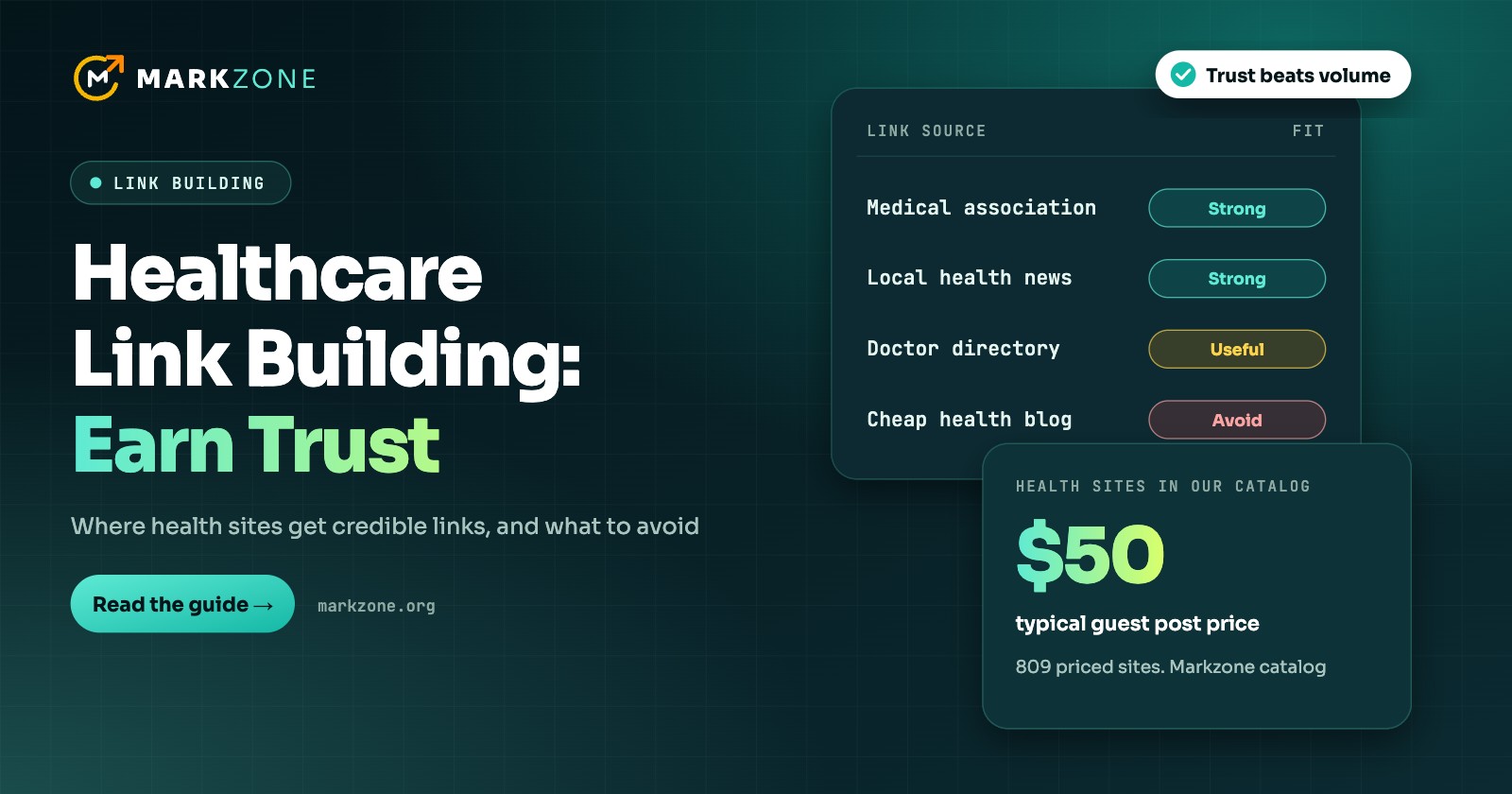
Health links are judged on trust. Google gives “even more weight” to content with strong E-E-A-T on topics that can affect people’s health, and it reads links from prominent sites as a sign of trustworthy information.
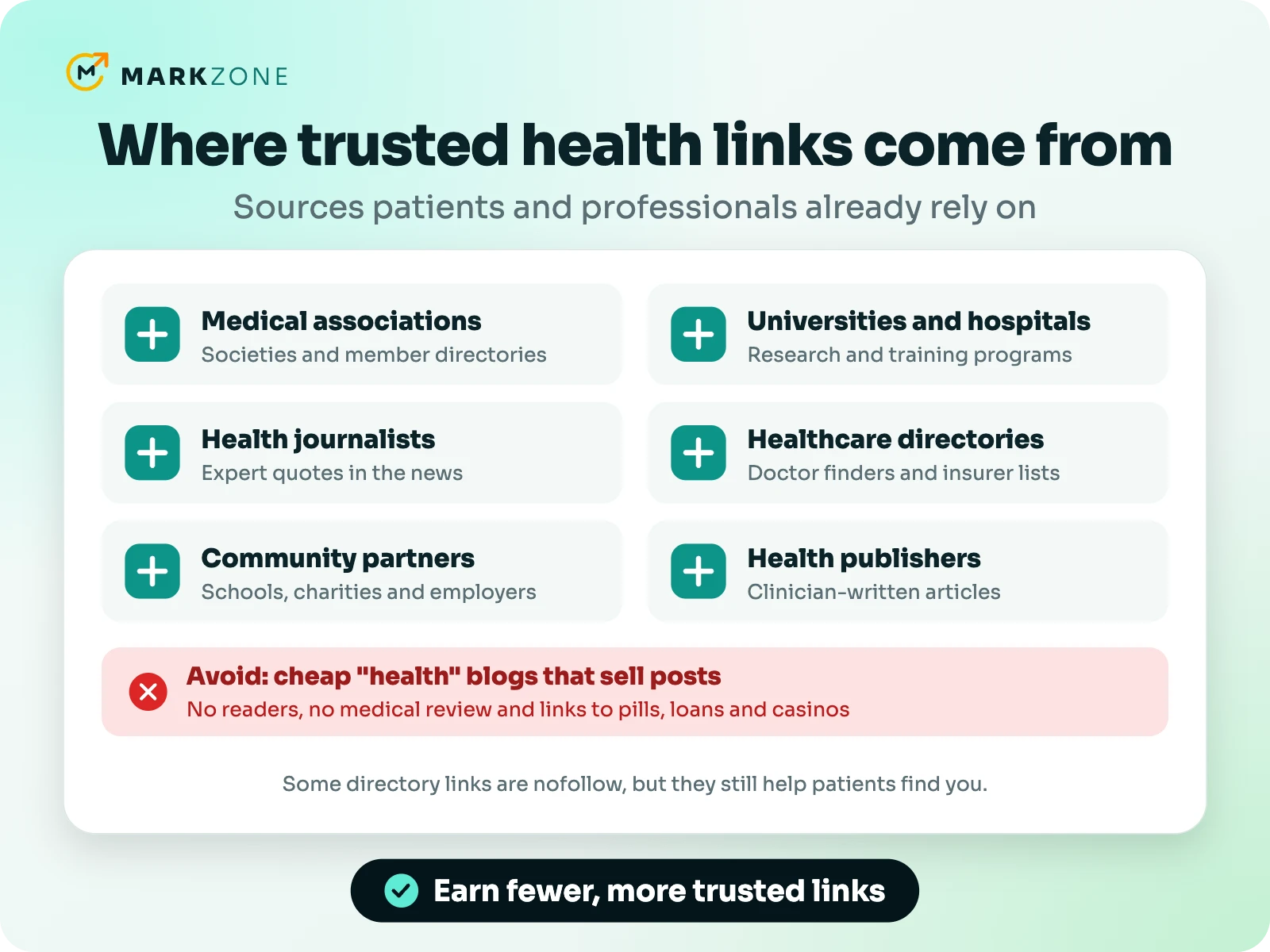
Most good health links are earned. Associations, hospitals, universities, journalists and local partners link to named clinicians and accurate patient resources.
If you pay, vet the site and ask for the label. Health sites in our catalog typically charge $50 a post, but only 240 of 22,073 catalog sites say they mark guest posts as sponsored.
Healthcare link building means earning links to a medical or health website from sources that patients and professionals already trust. These include medical associations, hospitals, universities, health journalists, directories and respected health publishers. It matters more in health than in most niches. Google says its systems give “even more weight” to content with strong E-E-A-T on topics that “could significantly impact the health, financial stability, or safety of people.” It adds that links from “other prominent websites” are “generally a good sign that the information is trustworthy.” So aim for a few credible links, earned with clinician-reviewed resources, expert comment and local partnerships, and treat any paid placement as advertising that must be labeled and accurate. This guide covers search and marketing rules only; it makes no medical claims.
Markzone sells guest posts and link insertions, including on health sites, so we have an interest in paid placements. Earned links come first below, and the catalog figures are from our price study of 13 November 2026.
- Why health sites need a higher standard
- Where trusted healthcare links come from
- 8 healthcare link building strategies
- The rules for each tactic
- Paying for health placements: what our catalog shows
- Where your healthcare links should point
- Mistakes that cost health sites trust
- Frequently asked questions
- Sources
Why health sites need a higher standard
Health is what Google calls a “Your Money or Your Life” (YMYL) topic. Its guide to helpful content (updated 5 October 2026) says that of the parts of E-E-A-T, “trust is most important,” while noting that E-E-A-T “itself isn’t a specific ranking factor.” Two more lines on that page apply to anything you publish to earn links:
- Accuracy. Google’s quality raters are trained to check that YMYL content is “highly accurate and consistent with established expert consensus.” Raters don’t set rankings; Google uses their feedback to test its systems.
- Real authors. Google asks whether it is “self-evident to your visitors who authored your content,” and calls fabricated creator profiles, including “false credentials,” “a form of deception.”
A link from a hospital, specialty society or respected health publisher is the kind of signal Google describes. A link from a blog that publishes anything for anyone is not.
US rules apply as well: the FTC polices health advertising, and HIPAA’s Privacy Rule governs how covered practices use patient information. The rules table below covers both. This isn’t legal advice, so check the rules where you practice.
Where trusted healthcare links come from
| Source | Examples | How the link is earned |
|---|---|---|
| Medical associations | Specialty societies, state and regional associations | Member directories, conference talks, committee work |
| Universities and teaching hospitals | Research groups, clinical training programs | Research collaboration, student placements |
| Health journalists | National health desks, local news | Clinicians available as expert sources |
| Directories patients use | Doctor finders, insurer networks, hospital affiliation pages | Complete, accurate profiles |
| Community partners | Schools, charities, employers, sports clubs | Talks, events and sponsorships |
| Health publishers | Patient education sites, condition communities | Clinician-written articles and resources |
8 healthcare link building strategies
1. Publish clinician-reviewed patient resources
Clear guides to conditions, procedures and recovery are what libraries, schools and health sites link to. Have a clinician write or review each one, and show their name, credentials, sources and a review date.
2. Offer your clinicians to journalists
Health reporters need qualified sources fast. Introduce your doctors, nurses or dietitians to local and specialist reporters, and answer requests that match their expertise. Named experts are often credited with a link to their profile.
3. Publish aggregated practice data
Trends from your own practice, such as seasonal shifts in appointment types, can make a local story. Publish only totals that can’t identify anyone, and have your privacy or compliance lead approve them first.
4. Get listed where patients look
Keep your Google Business Profile, insurer directories and hospital affiliation pages complete and consistent. For a clinic with one or two locations, links from local news, chambers and community sites usually matter more than national blogs.
5. Work with universities and associations
Research partnerships, student placements, conference talks and committee work lead to profile pages and mentions on trusted sites, the kind of .edu links worth having.
6. Run community programs
Health talks at schools, charity runs and workplace events earn local coverage and partner links. If you sponsor one, the link is paid, so ask the organizer for rel="sponsored".
7. Write for respected health publishers
Pitch clinician-written articles to patient education sites and condition communities that already have readers. A paid placement is advertising: it needs a clear sponsored label for readers and a qualified link for Google. What paid health placements cost is in the catalog section below.
8. Reclaim mentions and fix broken links
Set alerts for your practice’s and clinicians’ names. When an article names you without a link, ask the writer to link whichever of your pages best serves their readers. Resource pages that point to dead patient guides are another opening: offer your current version.
The rules for each tactic
| Tactic | US guidance (FTC, HHS) | What to do | |
|---|---|---|---|
| Paid article on a health site | Paid links must be qualified with rel="sponsored" or rel="nofollow" | Claims about the health benefits or safety of products need “competent and reliable scientific evidence” | Ask for the sponsored label, and send your sources with the draft |
| Free or paid review by a blogger | “Sending someone a product in exchange for them writing about it and including a link” is link spam | “Disclose the relationship if you got anything of value to mention a product” | Ask for a disclosure and a qualified link |
| Clinician or patient endorsement | No special rule | Advertisers “should clearly and conspicuously disclose any material connection between the endorser and the advertiser” | State the relationship next to the quote |
| Patient story | No special rule | HIPAA: “With limited exceptions,” a patient’s written authorization is required before their health information is used for marketing | Get signed authorization first |
| Event or charity sponsorship | A paid link like any other | No special rule | Ask the organizer to mark it sponsored |
Paying for health placements: what our catalog shows
Our guest post price study of 13 November 2026 has a Health row: 809 priced sites, a typical price of $50 per post and a middle half of $25 to $130. That matches the $50 median of all 18,977 priced sites, and its middle half tops out at $130 against $170 overall. A site can carry several niche tags, and niche medians aren’t broken down by traffic, so compare each site with the catalog-wide figures:
- Traffic sets the price. Sites with no Ahrefs traffic typically charge $25, sites with 1,000 to 4,999 monthly visits $130, and sites with 5,000 to 49,999 visits $200.
- A rating isn’t an audience. Across all niches, 38% of priced sites (7,133 of 18,977) show no Ahrefs traffic. Among sites rated DR 50 or more, 722 of 3,856 show none.
- Few publishers label by default. Of the 22,073 catalog sites, 240 state that guest posts carry a sponsored label, 7,190 state that they don’t, and 14,643 are silent. Ask before you pay.
- CBD costs more. On the 7,213 sites that price both, a CBD post typically costs 1.4 times the standard rate; 7,753 sites accept the topic. In December 2020 the FTC announced its first crackdown on CBD claims, against six sellers. The orders require them to have “scientific evidence to support any health claims they make for CBD and other products.”
Catalog prices exclude article writing, so budget separately for writing and clinician review.
Example: three offers checked against catalog medians (hypothetical offers, real medians).
| Offer | Catalog yardstick | Read |
|---|---|---|
| A “health” blog rated DR 64 with no Ahrefs traffic, $45 | No-traffic sites: $25 typical. DR 60–69 with under 1,000 visits: $80 | Priced for its rating, with no readers behind it. Skip |
| A health site rated DR 38 with about 2,500 monthly visits, mostly from the US, clinician bylines, $120 | 1,000 to 4,999 visits: $130. DR 30–39 with 1,000+ visits: $160. US-audience sites: $50 typical, not split by traffic | Below typical for its traffic and DR; the US median mixes all traffic levels. Check its recent outbound links, then ask for the label |
| A lifestyle magazine rated DR 72 with real traffic, $300 for its “partner content” section, which also runs casino and loan posts | DR 70–79 with 1,000+ visits: $400 | The price looks fair, but the section resembles Google’s site reputation examples. Skip, or ask for the main health section |
Google’s examples include “A medical site hosting a low-quality, third-party advertising page about ‘best casinos’ that isn’t integrated with the site”. The page is “being placed on the site to rank better due to the established site’s ranking signals.” Google also says it can treat a section that is starkly different from the rest of a site as a standalone site. It does this “so that sub-sections of sites don’t get a ranking boost just because of the reputation of the main site.”
Label what you pay for. Google’s spam policies treat paying for links as advertising or sponsorship as “a normal part of the economy of the web.” Google has no objection to such links “as long as they are qualified” with rel="nofollow" or rel="sponsored". Links in our catalog default to dofollow unless a publisher sets otherwise; if your health content calls for a sponsored label, ask for it on any order.
Filter our catalog by niche and organic traffic, then run the checks above.
Where your healthcare links should point
Most earned links land on your homepage, clinician profiles and patient resources, not on service pages. Link from those pages to the related services and locations with descriptive anchors, so their link equity reaches the pages patients book from.
Mistakes that cost health sites trust
- Posts on sites with no readers. A cheap “health” post on a site without search traffic adds risk and no patients.
- Keyword anchors. Twenty links that all say “best dentist in Chicago” look arranged, so mix your practice name and natural phrases into your anchor text.
- Link bait that bends the evidence. A surprising but inaccurate article can earn links and lose trust at the same time.
- Counting links instead of results. Track links from health organizations, local media and partners, rankings for the services patients search with your location, and appointment requests from organic and referral visits.
Frequently asked questions
Can a clinic use patient stories to earn links?
Only with written permission. For practices covered by HIPAA, HHS says that “With limited exceptions,” the Privacy Rule requires a patient’s written authorization before their health information is used for marketing. It defines marketing as “a communication about a product or service that encourages recipients of the communication to purchase or use the product or service.” A patient story that promotes your services can fit that definition, so get the authorization first.
Are nofollow directory and sponsorship links worth having?
Yes, for patients more than rankings. A doctor-finder profile or a sponsor page reaches people already looking for care, and it keeps your practice details consistent across the web. Nofollow links covers how Google handles the attribute.
Can AI write the articles you pitch to health sites?
AI can speed up a draft, but it doesn’t remove the checks. When automation substantially generates content, Google’s helpful content guide asks whether that is “self-evident to visitors through disclosures or in other ways.” For a health article, have a named clinician verify every claim and sign off, and keep the source list you send to the editor.
Sources
- Google Search Central: Creating helpful, reliable, people-first content (last updated 5 October 2026)
- Google Search: How Search Works, ranking results (checked 20 November 2026)
- Google Search Central: Spam policies for Google web search (last updated 28 August 2026)
- Google Search Central Blog: Updating our site reputation abuse policy (19 November 2024)
- FTC: Health Products Compliance Guidance (December 2022)
- FTC: FTC Announces New Business Guidance for Marketers and Sellers of Health Products (20 December 2022)
- FTC: Disclosures 101 for Social Media Influencers (November 2019)
- FTC: FTC Announces Crackdown on Deceptively Marketed CBD Products (17 December 2020)
- HHS: Marketing (HIPAA Privacy Rule guidance) (content last reviewed 26 July 2013; read in the Wayback Machine capture of 16 October 2026, because hhs.gov blocks automated requests)
- Markzone guest post price study (catalog snapshot of 13 November 2026: Health row, traffic tiers, DR and traffic, sponsored labels, CBD surcharge)
Building links for a clinic or health brand?
Tell us your specialty and location. We’ll suggest health and local publishers with real readers and tell you which to skip.

Muhammad Suleman is the founder of Markzone. He has done guest posting and link building since 2018 and has worked with hundreds of clients. Today his team handles 300–400 orders a month for brands and SEO agencies, with publisher sites in every major niche. He leads outreach, site checks and reporting, and writes about link building from his daily work with publishers and clients.